Thursday, January 31, 2013

TSO Allows the Audience to Pick

For many months the Toronto Symphony posted polls listing pieces of music and inviting potential  audience members to pick their favourites.  After several rounds and finals the six top pieces were combined into an Audience Choice concert.  Not a lot of the music I voted for made the final list, but I was getting excited just listening to the orchestra warm up and hearing snippets from Star Wars!

The "Main Title Theme from Star Wars" opened the evening with a soaring brass section that let loose to great effect.  There's nothing quite like John Williams.  I was left wondering if it's the first time anyone in attendance had heard that piece live given that there isn't always a lot of crossover between people who favour classical concerts and ones who prefer the Pops series.  Maybe programs like this will help in the promotion of each.

Next up was the "long, short, short, long" movement from Beethoven's Symphony No. 7 (ok, technically movement 2).  The theme was introduced so beautifully by the strings and then got even quieter.   Wow, just lovely.

Ms. Rizikov
(ttp://glenngouldvariations.tumblr.com)
Rachmaninoff's "Rhapsody on a Theme by Paganini" is probably my favourite piano piece, and I'll admit to being cliche and name Variation 18 as my favourite within it.  That variation proved to be another winner and made the program.  We also helped to fulfill a dream of sorts for the young pianist.  Thirteen year old Anastasia Rizikov had told the conductor who announced to the audience that it was her dream to perform with the TSO.  She took to the stage looking every bit a polished young lady.  Raising off the piano bench at times to get the sound from the piano to counter the orchestra, she got the job done, and musically at that.  I expect this won't be her last time on the Roy Thomson Hall stage.

Next was Movement 4 from Dvorak's "Symphony No. 9: From the New World".  It was a good book end to the first half with the Jaws sounding opening and brass fanfare that could slip right into a John Williams movie score.

Resident Conductor
Shalom Bard (tso.ca)
The audience voting continued even during the concert as after intermission we were tasked with making a selection between "The Great Gate of Kiev" from Mussorgsky's Pictures at an Exhibition, or "Intermezzo" from the opera Cavalleria Rusticana by Mascangni.  The method of voting by was shouting the favourite phrase of the conductor for the evening, the TSO's new resident conductor, Shalom Bard.  No idea what it means but to me it sounded like "oy mon choi".  The brassy sounds of Kiev won.

Then a drastic change of pace for "Adagio for Strings", which was poignant as always.  I had forgotten this was in the movie Lorenzo's Oil, and while listening my mind wandered back to when I saw that movie in high school.

The evening concluded with the full "1812 Overture"!  Another smashingly exciting piece.  Particularly the finale that accompanies fireworks shows, yet I like hearing the whole thing in a concert setting, even if the real cannon fire is replaced with recorded shots.

But wait!  That ended up not being the end of the evening.  Letting those who lost the vote still be winners, "Intermezzo" was played as an encore.  It was my vote and I'm glad they played it.  The theme is likely to be known by many but it's not a piece I've ever heard in it's entirety and really had no idea where the melody that's so popular was from.  It was a wonderful conclusion.

I think the audience choice idea went over well and perhaps there will be more in the future.

Wednesday, January 23, 2013

Mozart @ 257 Festival


The TSO Mozart @ 257 concert series concluded last week.  I attended the final event which featured three works by the prolific composer.  Music director Peter Oundjian provided some opening comments and mentioned that we'd see the orchestra growing as the evening progressed.  He wasn't kidding.  The opening "Serenade No. 12 in C Minor" had only eight musicians, two each of oboe, clarinet, french horn, and bassoon.  It was nice to hear the more chamber size group and be able to pick out the instruments clearly.  I particularly liked the driving force of the 2nd clarinet part and the equality in timing and tone.
Teng Li (www.lizpr.com)
The second piece, "Sinfonia concertante in E-flat Major for Violin, Viola and Orchestra" featured concert master Jonathan Crow and principal violist Teng Li.  Mozart apparently played the viola part when he performed it and why not?  He didn't relegate it to a supporting instrument but used it equally with the violin.  True it doesn't have the higher, easier to project tone, and when both violin and viola were playing, particulary with the now larger orchestral accompaniment, it was sometimes difficult to hear the viola part. However, when they alternated melodic lines, even switching seemlessly in the middle of the phrase, the viola shone through.  The ending had an alternating repetative part violin, viola, violin with embellishment, that was repeated again with the viola starting so it got the embellishment section.  That was a cool moment.
At intermission there was a lobby chat with William Littler and Teng Li.  He asked about the viola not getting the respect it deserves and shared a few viola jokes.  The first joke being if you see a crushed skunk and a crushed viola on the roadway what is the difference between the two?  Answer: There are skid marks in front of the skunk.  He ended the chat with one he'd been told by another viola player, why are viola jokes so short?  So violinists can understand them.  The listening audience and Ms. Li seemed to appreciate that :)
(www.flipkart.com)
The concert concluded with "Symphony 40 in G Minor".  I tend to associate minor keys with dissonance and lack of melody.  Honestly I never really knew this symphony was in a minor key because it is so melodic.  The opening movement is probably my favourite, likely because I'm familiar with it from who knows where.  As Maestro Oundjian also commented Mozart's music is everywhere, even in elevators. As symphonies go it didn't feel very long, but was very full with lots for the ear to latch on to.  It was evident in all the pieces that Mozart's music is open, there may be a lot going on but each section, each part is exposed and can be honed in on.  Nothing sounded off or out of place so I'd say the TSO did a great job in their celebration of Mozart's 257th birthday.  Looking forward to 258!

Thursday, December 20, 2012

A Merry TSO Christmas

Tree in Metro Square
outside RTH
The TSO Christmas Concert this year featured guest conductor Jeff Tyzik and narrator Colin Mochrie.  The concert contained typical festive fare with some twists.

The first twist was the opening "A Christmas Overture" which was "Deck the Halls" played in the styles of Mozart, Gabrieli, Count Basie, and Stravinsky.  So cool!

The second was a gorgeous version of "Gesu Bambino" which Tyzik arranged and featured two soloists from the Toronto Symphony Youth Orchestra on violin and cello.  I particularly liked how he wove in melodies from "Jesu, Joy of Man's Desire" giving added interested to the somewhat repetative theme in the main piece.

John Rudolph (tso.ca)
The third was "Rudolph the Red Nose Reindeer Rag" and featured percussionist John Rudolph on a xylophone that was decorated with Christmas lights.  The piece itself was fun with some impressive playing.

The fourth was a selection of Chanukah songs.  The only one I recognized was the ever popular Dreidel song but the others were really nice and there was a great clarinet solo played by YaoGuang Zhai.  The Festival of Lights has some great music and it was enjoyable to hear some extra variety this time of year.

The highlight of the evening though was the concluding "The Twelve Days of Christmas: A Pageant".  This piece was apparently part of the Youth Symphony concert last season and received such great acclaim that it was moved to the main series event this year.  Arranged by Richard Hayman for the St. Louis Symphony, where he worked for 45 years, the TSO is only the second orchestra to have the piece in their library.  Major coup, it's so much fun! (well from the audience perspective anyway, hopefully the orchestra likes it as well).  Narrated by Mr. Mochrie, who did a bang up job of having a dead pan reaction to the flirting calling birds, and interacting with the children who decorated him with eight sets of 5 golden rings.  

The large cast, including Holiday Dancers and the Etobicoke School of the Arts Chorus, embraced their parts enthusiastically, perhaps none moreso then the 10 lords who leapt down the aisle from the rear of the hall.  The orchestra played various segments that fit each day such as (based on my best guesses) The "Theme from Romeo and Juliet" by Tchaikovsky for Day 2's turtle doves, "Aloutte" and the "Can-Can" for Day 3's French hens, "The Wedding March" for the 5 golden rings, "Odette's Theme" from Swan Lake for the Day 7 swans, "Old MacDonald" and "Turkey in the Straw" for eight maids a milkin', "Trepek" from The Nutcracker for the Leaping Lords, and an "Artist's Life Waltz" by Strauss for the nine ladies dancing.  The conclusion with 11 pipers from the Highland Creek Pipes and Drums piping through the choir loft playing "Scotland the Brave" followed shortly there after by 12 drummers drumming the theme from "The Bridge Over the River Kwai" was fantastic.

It's a rather long piece that took up a substantial portion of the second half, so perhaps this need not become a yearly undertaking but maybe it's something the TSO could make tradition by reprising every few years.

Tuesday, December 18, 2012

Return to Yuletide Celebration

Finding myself with some days off at the beginning of December, I decided on a road trip to the best concert for getting in the Christmas spirit, Yuletide Celebration with the Indianapolis Symphony Orchestra!  Two years ago I made the trip for the 25th anniversary concert (that review here) and while I wasn't expecting the elaborateness of that milestone, the 27th version came pretty close.


Justin Stahl, Lobby
Organist
The lobby decorations were as gorgeous as ever, and the cookies just as delicious.  Entertaining concert goers and showing off the Wurlitzer Theatre Pipe Organ to great effect was Justin Stahl who played before and after the concerts.  When leaving I noticed his closed music book, it was the "Reader's Digest Merry Christmas Songbook" which I also have! (although anything I've played didn't sound nearly as good).

Angela and Ben
The show opened with a new arrangement of "O Come, All Ye Faithful" by music director and maestro, Jack Everly.  It had English lyrics, Latin lyrics, and even the "wonderful, councillor..." quote from The Messiah.  Featuring the whole cast, it also served as an introduction to the voices of the hosts, opera star Angela Brown and Broadway leading man Ben Crawford.  I've seen Ben in other Symphonic Pops Consortium concerts, and have always enjoyed his voice.   This concert was no exception.  Angela and Ben joked around introducing each other with Angela playing the opera diva and claiming herself as sole host because she's from Indianapolis, which garnered audience applause.  At the matinee I attended however, Ben's announcement at being from Tuscan, Arizona created a stronger audience reaction.  Maybe he stacked the crowd with friends and family.  Being an out of towner I cheered for him :)

Anthony Kniffen & Grinch
After a solo by Angela of "Sleigh Ride" (because really what concert is complete without the Leroy Anderson classic, which incidentally was written in Georgia when the temperature was 105 deg. F) the orchestra was showcased in a medley from The Grinch Who Stole Christmas.  I haven't watched the movie in years and wasn't recognizing anything.  Then all of a sudden I noticed the tuba player, Anthony Kniffen, disappear from his spot at the back of the stage balcony.  He reappeared centre stage wrapped in a sousaphone and wearing a Santa hat to play "You're a Mean One Mr. Grinch".  The Grinch himself (he was wondering around the lobby earlier), even poked his head out from the window above the stage drumming his fingers together in an evil fashion.

Ben and cast decked out in Christmas bling
The costumes and gowns were extravagant, and none more so than Angela's dress for "Sparklejollytwinklejingley" from Elf: The Musical.  It was all gold and so glittery under the lights it was hard to look at.  Ben, by contrast was wearing a classic black tux and was accused of needing some Christmas bling.  He obliged by removing the tux to reveal black sequined pants and a red sparkly jacket.  The singers and dancers all sported major sparkles and glitter during an energetic dance interlude.  I hadn't heard anything from Elf before, but quite liked this and the selection later of "There is a Santa Claus".  That piece has a lyric about Rudolph's nose really glowing and a red spot light swept around the hall to emphasis the point.  It was a simple but effective bit of lighting design.


Christmas Eve Radio Highlights
The highlight of the first act for me was being taken back to December 24, 1942 for the "Christmas Eve Radio Broadcast".  A WISO sign descended from the stage complete with "On Air" and "Applause" indictors.  After a jive style dance number to "Hark the Harold Angels Sing" (or at least part of it) by Anne Nicole Beck and Joseph Perkins Jr., Ben and several Yuletide ladies performed "Fum, Fum, Fum".  The "broadcast" then officially started complete with an ad for Hazel Bishop lipstick.  I looked it up and it was the brand of the first non-smear lipstick although it wasn't an incorporated company until 1950.  But who says you can't adjust history to suit the needs of a show? :)  The catchy Chiquita Banana jingle was part of the segment as well, complete with Ben in a grass skirt and coconut bra.  Three singers with great harmony did an Andrew's Sisters style song similar to "Boogie Woogie Buggle Boy" only about "Roly Poly Santa Claus".  Mike Runyan (ISO librarian) was featured with his "Cowboy Harmonica Christmas" that contains half a dozen harmonicas in various sizes and songs such as "Rudolph the Red-Nosed Reindeer", "Up On the Housetop", and "Holly, Jolly Christmas".  That was one of my favourite parts two years ago and it was really fun to see him again.  The segment concluded with Angela singing a touching rendition of "I'll Be Home for Christmas" with harmonica accompaniment.

The traditional tap dancing kick line of Santa's brought down the curtain for intermission.  The second half opened with "The Enchanted Toy Shoppe" a feature which I believe was new at last season's concert.  Angela began by telling the story of a toy maker and how one magical night his toys came to life.  She also sang the beginning of "Once Upon a December" from Anastasia (Liz Callaway was a host last year and the singing voice of Anastasia in the movie, which may have influenced the song choice, but it fit in well).  The fairy waved her wand to a slow version of the "The Sorcerer's Apprentice" theme bringing the toys to life.   Included in the toys were a music box dancer and doll, who danced, en pointe even, to something by Tchaikovsky from "Swan Lake" I think.  By magic a juggler (Cirque de la Symphonie artist Vova Tsarkov) stepped out of building blocks that were stacked together before our eyes.  I liked the following rag doll segment the best of the Cirque acts.

Check out that Statue of Liberty style tiara!
(Angela photo from her facebook page)
Alina Sergeeva as the doll 'danced' with the juggler as he picked her up and she flopped back over into incredible positions that showed off her amazing flexibility.  The way she carried momentum and flopped at the slightest touch was so realistic of how a doll would behave.  "Hedwig's Theme" was used as the music for extracting the aerial silks artist (Rachel Bowman) from the "empty" Toy Parts box.  Then Ben returned to sing "Somewhere in My Memory" for the silks act.  It's a lovely song and the move where the aerialist wrapped herself in the silk and then fell as it unravelled always make me catch my breath.  The variety of pieces that appear in arrangements by Jack Everly and company is second to none!

Presumably while they cleared the Toy Shoppe props away behind the curtain, Angela took the front of the stage and performed "My Simple Christmas Wish".  Apparently this is a popular cabaret act song, but I was unfamiliar with it.  Some lyrics were changed to be family friendly and a new line about not being Oprah so don't look under your seat (a joke about Oprah giving gifts away to audience members) shot by so fast it took a second to process, but once people got it, there were giggles.

Not to be outdone, the curtain opened on a now empty stage and Ben walked out to sing "Believe" from The Polar Express.  The most popular version is likely with Josh Groban, but I much preferred Ben's.  Groban's seems heavy to me, but Ben had hope and a bit more lightness, not to mention his wonderful voice.

Zach and Jack
An exciting instrumental version of "Good King Wenceslas" featuring ISO concertmaster Zach De Pue was introduced by Jack Everly.  He said the lyrics were added to the tune in 1853, and a new Christmas song was born, but we'd never heard it like this.  So true!  The arrangement, by Alex De Pue (Zach's brother), had more notes than it seemed possible to play and ones higher than I thought a violin could hit.  It was great to see a little Time For Three style jammin' going on!  Check out the same arrangement with Alex playing the fiddle accompanied by a hammered dulcimer (it's better with full orchestra but I was excited to find the arrangement in any form!).

Not that the audience needed any waking up after that, but the ensemble got their own lively number with "All I Want for Christmas is You".  The highlighted voices weren't all my taste, but the guys shoes sure stood out...red with white inserts sure fit the Christmas bling criteria.

Slowing things down Angela and Ben combined forces for "The Prayer" with Ben taking the Italian part of the duet and creating a beautiful deep sound.  Their voices and talents were highlighted the best here.

Full cast in "The First Noel"
Ben continued with the beginning of "The First Noel" singing it straight and with meaning, until the curtain rose on a stained glass style backdrop and the full cast joined for the concluding verses and chorus.  After an almost instant standing ovation (the powerful arrangement by David Clydesdale almost draws you out of your seat) we were seated again and treated to an acapella "Silent Night" by Angela before joining our voices with everyone else's for "We Wish You a Merry Christmas".  I love singing with a full orchestra!

Thank you to all the friendly people I met (and especially to one I still haven't), the performers and everyone behind the scenes who work together to create such a wonderful show.  My mission was accomplished, Christmas spirit attained and should anyone be in the need for some I highly recommend this method of acquisition!  Because it's really true that...


(All photos except where noted from the Indianapolis Symphony, some via The Examiner and The Star.)

Friday, November 30, 2012

Montreal Symphony in Toronto

New Maison Symphonic.  Similar in look to The Four Seasons
Centre in Toronto.   They are both designed by architect
Jack Diamond (www.azuremagazine.com)
This season, in addition to having an exchange of venue with the National Arts Centre Orchestra, the Toronto Symphony also has one with the Montreal Symphony Orchestra.  On November 21, the MSO was at Roy Thomson Hall, and the previous Sunday the TSO was trying out the new Maison symphonique in Montreal.

The evening of the 21st started with the always interesting pre-concert chat hosted by Rick Philips.  This evening he had MSO conductor, Kent Nagano as a guest.  They discussed Haydn's work and how it has fallen off the programming radar of the larger orchestras in recent years.  Nagano described how he had this great idea to do a Haydn cycle.  He was all excited and pitched it to the box office and marketing departments.  Unfortunately they were less than enthused not being sure how to sell that sort of concert.

(www.last.fm)
The Haydn on our program was Symphony No. 94 "Surprise".  It's one of the first of the last group he wrote (104 symphonies in total) referred to as the London Symphonies.  Getting the okay to actually program a series of Haydn works, the next issue to tackle by Maestro Nagano was, what do you pair with them?  His choices for the "Surprise" were "An Orkney Wedding, with Sunrise", and "Le Sacre du printemps" ("The Rite of Spring").  He programmed these selections because they also have dance themes that can be bombastic and beautiful, and perfectly complete ideas and ones that leave you hanging.

The symphony opened with an Adagio cantabile first movement and light airy theme.  The second movement begins innocently enough, although I imagine the entire audience was on the edge of their seats awaiting the "surprise".  The sudden fortissimo about 30 seconds in occurred, but I was underwhelmed by it.  The pianissimo just before the section was so excellent that I think the forte could have had a real punch to it, but given the anticipation of the moment I was expecting more.

I believe at least part of "An Orkney Wedding, with Sunrise" was on a TSO program not that long ago. (The Last Night of the Proms from June 2011 to be exact)  The comma in the title makes me giggle, as if the piece was too short so the "with sunrise" was an afterthought.  The humour in this piece has to do with the deterioration of the dance theme as it goes from the flute, clarinet, oboe, bassoon and violin depicting the results as the amount of whiskey ingested by the wedding guests increases.  I like how the strings can mimic the sound of bagpipes.  The final call of the real bagpipes, decrescendo as the night fades and crescendo as morning breaks completes the picture.

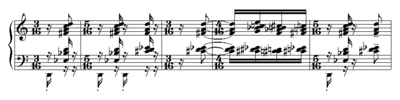
4 bars from the Rite of Spring, 4 change in time signature
The "Rite of Spring" ending the evening in startling fashion.  Honestly I didn't know much about it other than the changes in time signature are legendary.  In the pre-concert chat I was reminded it was actually a ballet, the premiere of which was also legendary for "provoking the most notorious riot in twentieth century music" (as per the program notes).   I wasn't sure what to expect, but really wasn't expecting what it was or the subject matter (Part 2: The Great Sacrifice involves maidens performing secret rites with one doomed to die).  There were disjointed melodies that seemed to come out of nowhere and disappear without feeling complete.  Some of them were beautiful and lyrical while some of them were very dissonant.   The dynamic range was well varied.  I can now say I've seen and heard another of the classics.

Sunday, November 25, 2012

Beethoven Triple Concerto

There's a wonderful magazine in Toronto about all things music called The WholeNote.  Each month they publish, there's a Music's Child feature.  On this page is a picture of a musician as a child, and a rhyme or short clue about them.  Readers then take their best guess as to who the person might be.  The remainder of the page contains an interview with the previous month's "child".  Very rarely do I have any idea who the person is, however September's was the new Toronto Symphony Concertmaster Jonathan Crow.  On a lark I sent in my guess.  I was surprised when I got an email saying that I had been one of the people to guess right and would I like tickets to the TSO concert that would feature Jonathan Crow in Beethoven's "Triple Concerto" for piano, violin and cello.  I readily accepted.  So thank you very much to The WholeNote for treating me to a night of music!

The concert on Nov. 15 was headed by TSO conductor Peter Oundjian and in addition to featuring Mr. Crow, had guest pianist Andre Laplante, and guest cellist Shauna Rolston, Canadian's all!  However, before the Beethoven, there was a piece by Pierre Mercure called "Triptyque".  Written in 1959 it was pretty good for contemporary music.  I'd like to see the score and actually compare the opening Adagio with the concluding Adagio since the final one is the exact reversal of the first, or retrograde in musical terms.

Soloists
Up next was the Beethoven.  It's an interesting choice of instruments to feature and the only concerto Beethoven wrote for multiple solo instruments.  The more prominent of the solo parts is also given to the cello, rather than the violin or piano.  The dynamic contrasts in the orchestra were exceptional, the pianissimos were barely heard.  Of the trio I think I liked the piano part the best, even if it was limited.  I heard the piece described as having some of the bubbliest music Beethoven wrote, I'm not sure I'd go that far, but it was all pleasant with a fun trading/echoing of parts between the instruments.  It was also funny that even standing on the podium given to the cellist, Ms. Rolston was about the same height as Mr. Crow who was standing on the floor.  His violin looks so small in his hands.

The evening concluded with the not often played Shostakovich "Symphony No. 12" subtitled "The Year 1917".  I've heard recordings of Symphony No. 11 and found it emotionally exhausting with the heavy and sad subject matter.  No. 12 used a few of the same themes and while the slow movements were smooth and mesmerizing I liked the finale.  The power that crashed over you with 8 basses, 5 horns, 4 trumpets, 3 trombones, 3 oboes, 3 bassoons, loud timpani and cymbals, and a full compliment of violins, violas, and celli all playing at the same time was thrilling.  It also woke me up enough for the drive back home.  It was a great conclusion to a long day.    Thanks WholeNote!
Full stage and full house, great to see
(http://thereckoner.ca)

Friday, November 23, 2012

Alice's Adventures In Wonderland

Last season the National Ballet of Canada premiered Alice's Adventures in Wonderland, and it sold out!  So I was very pleased they decided to bring it back this year for a longer run and made plans not to miss it.

Opening with Carroll reading to Alice and her sisters
(Photo by Cylla von Tiedemann)
The evening began with the always enlightening and philosophical ballet talk by Lindsay Fischer, ballet master.  He took the audience through the various tableaus that form the basis of the story.  It began with Alice and her sisters playing while her mother is preparing for a grand tea party.  Because ballet isn't ballet without a love interest with which to dance a pas de deux, Alice and Jack, the gardener's boy, like each other.  However social norms of 1862 time period and Alice's mother, forbid her from having anything to do with Jack.  This is particularly true after she gives him a tart in return for the red rose he mistakingly put in with the white ones for her mother.  What I particularly loved was that Lewis Carroll was a guest at this party.  The "real life" part of the story wove in how the book of Alice's Adventures in Wonderland actually came about.  Carroll wrote them at the request of his friend's daughter Alice, after he was entertaining the girls for the day and told them these great stories.

Aleksandar as the White Rabbit
(Photo by Cylla von Tiedemann)
Suddenly at this party things begin to change, Carroll becomes the White Rabbit (both parts played by Aleksandar Antonijevic) and Alice follows him down the jelly dessert in the middle of the table, an interesting twist on a rabbit hole, to Wonderland.  Multi media was used well throughout the performance.  It really gave the feeling of falling into or rising out of a hole without going over the top or being overused.  The scenes of growing, shrinking, crying and floating through tears, of which my best recollections are from the Disney movie, were all there.  Sonia Rodriguez played Alice at the performance I saw and did a wonderful job of acting the little girl who eventually learns about life and grows up.

The action truly never ended.  The idea that in a good movie you don't even notice the music was so true here.  A shame in a way because the music was so good, but it fit the dance and story so well it melted in rather than stood out.  The orchestra was big with the percussion filling the entire back of the pit and there were two harps!  The White Rabbit theme reminded me of segments from Bernstien's West Side Story score.  After a crazy scene in a fiery kitchen hidden behind the innocent needlepoint claiming "Home Sweet Home", Jack returns, only as the Knave of Hearts now, with a tray of tarts.  They hide in the cottage while the bad tempered Queen of Hearts (Alice's mother) looks for him to chop off his head.

Eventually the magician at the garden party appears as the Mad Hatter.  If one wants to read into the meanings behind what Alice could be learning with each encounter, the Hatter teaches Alice about time.  One doesn't grow up just by waiting out time, because time can be divided however one wants.  This is demonstrated to great effect by having the Mad Hatter tap dance!  When was the last time you saw anything other than ballet slippers and pointe shoes at a ballet?  It was great.  In fact Rick Mercer even got in on the action for The Rick Mercer Report, where he learned a little tap.  Check it out here.

Sonia as Alice and the Cheshire cat
(Photo by Bruce Zinger)
Alice meets the cheshire cat who exists in pieces held by dancers dressed in black, so his various parts glow in the black light.  Here the mime conversation, as explained by Mr. Fischer, was the cat asking her where she wants to go.  Her response is anywhere but here.  The cat replies, then it doesn't matter which road you take.  Philosophy on the simple level, yet she learns that it's not the road that matters but you guide your own path.  Alice also takes part in the croquet game with the Queen complete with dancing flamingo croquet mallets.  In the Queen's court the corps du ballet costumes were so well done with the card tutus.
Corps as cards
(Photo by Bruce Zinger)

Jiri as the Caterpillar
(Photo by Cylla von Tiedemann)


One of the final characters Alice meets is the caterpillar, danced by Jiri Jelinek.  An exotic dance, that reminded me in a way of the Coffee dance in The Nutcracker.  It even had a more refined version of 'the worm'.

The Queen and card dancers not doing so well
(http://xlablog.blogspot.ca)
In the garden the Queen wants to display her dancing skills and has trouble finding any willing partners.  The four gentlemen reluctantly agree and each tries to get out of it by having the other take their place.  Coined the "tart adagio" (a take off of the "rose adagio" in Sleeping Beauty) it takes the real life worry of the rose adagio suiters who don't want to screw up for the prima ballerina playing Aurora, and converts that into the situation of these gentlemen not wanting to screw up and hear the horrible "off with their heads" cry.

To add some tension the Knave is accused of stealing the tarts and he and Alice have a reprise of the pas de deux from the opening tea party scene.  I like when the choreography repeats, especially a really intricate move, and this dance had that and was beautifully executed by Guillaume Cote who was playing the Knave.  Eventually Alice decides to stand up to the Queen for him, and say the Knave didn't steal any tarts, she gave it to him.  By taking a stand she pushes over the house of cards and they come falling down as she falls back up the rabbit hole and back to real life.

The ending was very well done.  It jumped to modern times with Jack and Alice, now a couple, reclining on a bench when Alice suddenly wakes up and describes the dream she just had about the book she was reading.  A gentleman walks by and Alice seems to think he's familiar.  He takes their picture, and then sits down on the bench vacated by Alice and Jack.  The curtain falls as he scratches his ear in the fashion of the White Rabbit leaving one with the question, was it really only a dream?