Showing posts with label composers. Show all posts

Sunday, November 9, 2014

What Makes The Four Seasons Great?

amazon.com
I enjoy Rob Kapilow.  I learn more about music in an hour of his talks deconstructing a piece then I did in all of my high school music history class.  Granted that classes didn't focus on the same things, but it was so boring compared to the enthusiasm and insight Kapilow provides.

He was in town as part of the Toronto Symphony's "Exposed" series.  The piece of music in question: Vivaldi's The Four Seasons, "Autumn" and "Winter".  Apparently several seasons ago he covered "Spring" and "Summer".  Unfortunately I missed that concert. Chee-Yun was the guest violinist and is a beautiful player.  In the Q&A after the concert she told us she had started learning the piece in middle school, a "long, long time ago".  My understanding of her story, which I hope I heard correctly, was that the violin she was playing was from 1669 and was actually buried with a guy for a while.  Obviously it has been well looked after since then as it still has the original varnish.  She's decorated it a bit by adding a glittering fine tuning post and mute, which was a gift from a student.  They matched her shimmering dress and shoes.  She doesn't practice in the heels though :)
Chee-Yun (chee-yun.net)

While we're on the subject of violins, someone asked about the one played by concertmaster Mark Skazinetsky.  His was made in 2008 by a friend in Salt Lake City.  Talk about old meeting new.

But let's get to Vivaldi.  I had no idea The Four Seasons had accompanying poetry!  Granted, it's not great poetry which has led some to believe Vivaldi wrote it himself.  Given how well it fits the music, that makes sense to me.  I also never thought about "Autumn" and "Winter" each having three movements.  I generally classified The Four Seasons itself as a piece with 4 movements, never thinking they were further divided.

thisismyjoystick.com
A highlight in the deconstruction of the first movement of "Autumn" was the seven ways Vivaldi makes music sound drunk, including a cello that can't find the beat paired with double stops in the solo violin.  Kapilow also pointed out examples of sequencing where the same pattern is repeated higher or lower.  It was fun to listen for this and be able to recognize it elsewhere as well.  In the second movement the orchestra goes to sleep, not literally, but the music has descending arcs as if each time they can't get back to the top note to repeat the pattern.  The concluding movement is made exciting by the dotted rhythm which we sang out along with Kapilow.  A boring version using a straight rhythm was demonstrated by the orchestra with the instructions to play it in as dull a manner as possible.  There's nothing quite like a little rhythmic pattern to add interest.

shirt.woot.com
The poetry of "Winter" is perfect for the music.  So we could see this the appropriate lines of text were projected above the orchestra in the second half of the concert where they performed the full piece.  The trembling notes represent shivering while the solo violin breaks in as the "bitter blast of a horrible wind".  This then gives way to "...run, constantly stamping one's feet".  It's so easy to hear what's happening with the words put to it.  The second movement text opens with "to spend restful, happy days at the fireside".   Musically this is matched perfectly by the lovely solo melody, while the pizzicato in the orchestra is the rain outside.  Ice arrives in the third movement "to walk on the ice, and with slow steps to move about cautiously for fear of falling".  Then "to go fast, to slip and fall down" represented by the downward running notes.  It finishes with "that's winter, but of a kind to gladden one's heart".  At Kapilow said, how very Canadian.  Here's hoping this winter is like movement two more than three.

Vivaldi has always been one of my favourite composers, but this work is even more enjoyable now that I know more about the music, and all you have to do is listen.

Saturday, March 15, 2014

10th New Creations Festival

A many months late, Happy New Year!  It was a slow winter for my attendance at musical events, and the first concert I went to was the opening of the 10th annual New Creations Festival with the TSO.  The concert, titled Adams: Doctor Atomic, included the title work as this years featured composer was American John Adams.  Unfortunately he wasn't on hand to do the conducting honours, but was schedule to arrive in time for some of the later concerts.

I don't know what was different this year, but I found myself liking the music.   All of it, even the opening lobby entertainment by The Glenn Gould School of New Music Ensemble, was enjoyable.  "My Twentieth Century" the pre-concert Ensemble piece was different, sure, but the mixture of poetry and music worked for me.

Kevin Lau
(www.sneakpeekorchestra.com)
The concert began with a new work by affiliate composer, Kevin Lau, "Down the Rivers of Windfall Light".  It's based off the Dylan Thomas poem Fern Hill, about a child escaping into their imagination. Maybe it was the premise or the fact I was listening to the cast recording of Alice in Wonderland on my drive down, but it reminded me of that story.  I didn't find it weird, but programmatic with an overarching story that was understandable.  The brass was exquisitely used and one five note theme reminded me of the theme from Close Encounters of the Third Kind.  It had some interesting instrumentation in the percussion section, even a rain stick.

Completely switching gears, Adams' "Doctor Atomic Symphony" was up next.  It's a 25 minute, single movement work based on his opera of the same name
(www.scena.org)
about the making of the atomic bomb.  The scenes evoked are of the test site: the electrical storm that occurred a few hours before the test, a ritual "corn dance" by Tewa Indians, and the poem "Batter my heart, three person'd God" that inspired the naming of the site "Trinity".  At times it was bombastic and at others excruciatingly longing.  Andrew McCandless played the trumpet solo beautifully, as did the other brass soloists on the horn, trombone, and tuba.  In the percussion section were some things I hadn't seen before.  There was a huge set of chimes that had a set of stairs up to them, two thunder sheets, and cymbals being played by running a bow along the edges.

Magnus Lindburg
(symfonieorkest.be)
The last piece was "Piano Concerto No. 2" by Magnus Lindberg, featuring guest soloist Yefim Bronfman, who didn't look very much like his picture in the program.  Moments reminded me of "Rhapsody in Blue", and there's no doubt he's a powerful pianist.  Perhaps it was because of where I was sitting, but it sounded like the orchestra overpowered the piano at times.  The cadenza, written very late in the composing process, was impressive.  It was not my favourite piece of the night, but got a rousing ovation and multiple curtain calls.

For an analysis by a real critic, try the National Post.

Monday, July 29, 2013

Anything Goes in Toronto

Wow!  That's the first word that comes to mind after seeing, and being delighted by, Anything Goes, which is currently playing at the Princess of Wales Theatre.  For this show I wasn't a last minute ticket buyer.  I knew I wanted to see it ever since the Tony Awards broadcast where Sutton Foster as Reno Sweeney led the cast in a wonderful tap dance to "Anything Goes".  It was worth the wait.  My familiarity with the title and the song came from the 1956 Paramount movie version with Bing Crosby, Donald O'Connor, Mitzi Gaynor and JeanMarie.  I knew the musical plot was different from the movie, but it still had a great Cole Porter score, with some additional songs that may not have been Porter creations, and a great dance number with O'Connor and Gaynor to "De-Lovely".

Cast in "Anything Goes" (Photo: Joan Marcus)
Anyhow, I went into the musical knowing the music (I had sought out a Broadway cast recording, and found the one from the late 80's with Patti LuPone), but not the plot.  It's quirky, with characters changing names, and clothes, all over.  But if it doesn't put you on the edge of your seat wondering what's going to happen next (and there is a little bit of that.   When leading man Billy finds himself in the brig with a wedding to stop, "how are they going to get out of this one" did cross my mind.), it certainly does with production numbers.  The act one closer "Anything Goes" is huge, and the act two opener "Blow, Gabriel, Blow" topped it.  While this is a touring show, there's nothing that looks scaled down giving that impression.

The fullness of the show extends to the action in the orchestra pit as well.  Filled with 15 or so local musicians, playing who knows how many instruments (peeking in at intermission there were as many types of clarinets and saxes as I know of), they dazzled in the overture and entr'acte.  The three trumpet players particularly were wonderful.  The jazzy, screamer style playing in the entr'acte warmed them up for "Blow, Gabriel, Blow" and they really blew me away.
One moment in the overture that stood out was a completely seamless transition from a held note in the clarinet to that same note in the trumpet.  They matched perfectly before the trumpet went "brassy" (probably not a word, but it's really hard to describe sounds) with it.  A smile hit my face as I thought, oh how smooth, and it didn't leave for the rest of the show.  Well ok, the smile started before then when conductor Jay Alger took the podium wearing a captains hat, which he discarded then donned again post intermission.

Reno and Lord Oakleigh in "The Gypsy in Me"
(Photo: Joan Marcus)
What to say about the cast?  There's nothing left wanting from any of them, so I'll just mention a few.  Rachel York as Reno Sweeney can do anything.  Her voice is big and bold; her comedy with Moonface Martin in "Friendship", and elsewhere throughout the show, never falls flat; she can dance with the best of them; and somehow manages to keep a straight face while Edward Staudenmayer as Lord Evelyn Oakleigh let out his inner gypsy in "The Gypsy in Me".

Josh Franklin
(www.joshfranklin.net)
I'll take Josh Franklin (who plays Billy Crocker) as a leading man anytime.  He looks dashing in a tux, and only slightly less so in the too short pants he tends to "borrow" while trying to hide in plain sight.  His voice is also lovely to listen to, from the lively "You're the Top" duet with Reno, to the ballads "Easy to Love" and "All Through the Night".

The solo song for Moonface Martin, Public Enemy #13 and played by Fred Applegate, is "Be Like a Bluebird".  It's a song I never quite understood from the plotless cast recording.  He sings it trying to cheer Billy up when they're in jail and it has one of the cutest lighting effects.  The "bluebird" is a blue light that flutters over Moonface and even "lands" on his fingers.  It's funny to watch Billy's stoic face as Moonface acts rather silly.

Chuck Wagner (chuckwagner.com)
A face that was a surprise to see in the program was that of Chuck Wagner playing the Captain of the USS American.  He was the Beast in the Toronto production of Beauty and the Beast when it first opened here in 1995.  His head shot in the program has to be 15 years old, but he's gotten more distinguished with age, and still has a gorgeous voice (check out some of his singing on his website).  It's not hard to tell he enjoys his work.  In the ship nightclub scene during "Blow, Gabriel, Blow" he was dancing enthusiastically from his spot on the steps.

Anything Goes deserves the 4/4 stars it got from the Toronto Star (review here) and any other accolades that have been thrown its way.  It just got extended for another week, and is worth seeing.  Get thee to the theatre!


Thursday, June 13, 2013

High and Low Guest Artists

On June 6 the TSO performed a concert titled Joshua Bell and Edgar Meyer, artists who play instruments at opposite ends of the sonic spectrum.  My reasons for wanting to go were to hear (in no particular order):
-  the acclaimed Bell who I'd heard about, including the busking in the Washington DC subway story
- "Appalachian Spring" because I like the piece and haven't ever heard a great recording of it
-  "Pines of Rome" because I heard the name of the composer, Respighi, mentioned in an interview and turns out this is one of his famous pieces.
The heart of the concert, according to the program, was the "Concerto for Violin and Double Bass" composed by bassist Meyer with Bell in mind.

The evening opened with "Appalachian Spring".  It was "wow" for me.  Soft and soaring in all the right spots.  The layering at the start of the strings and the winds was spot on.  I've never heard it clearly before because recordings are always so quiet I have to turn up the volume and then when the dynamic changes and the tempo picks up it blows you away, and not in a good way.  The balance live was perfect.  Associate Principal clarinet Yao Guang Zhai seemed to have a good time with the solos and I love that the "Simple Gifts" melody appears in the clarinet first.  In fact there were notable clarinet parts in every piece.

Bell and Meyer during the concerto (TSO photo)
The concerto followed with Meyer adding a bit of a casual flair to the evening dressed in shirt sleeves rolled to the elbows, bow tie and suspenders.  There was some dissonance in the piece, but enough to peak interest as to where it was going to go, and most often satisfactorily resolved.  I particularly liked the melodic theme and rhythmic drive in movements 1 and 3, named "Quarter Note = 135" and "Half Note = 80" respectively.  The theme from the third particularly got into your head and I heard people humming the theme at intermission.  Meyer's bass looked smaller than the others in the orchestra and had an extended finger board on one side allowing him to get to the upper end of the basses 6 octaves and into the register of Bell's violin part.  The middle movement was more reflective, fitting in that it was a memorial to a student they both knew at Curtis.

Post intermission Joshua Bell got his solo chance to dazzle in "Tzigane, rapsodie de concert for Violin and Orchestra" by Ravel.  Honestly all I know of Ravel is "Bolero".  This was completely different and Bell demonstrated his very impressive skills elegantly.

Finally, "The Pines of Rome".  Honestly I was expecting to recognize more.  I've had the same
problem with recordings of this as with "Appalachian Spring" since there is such dynamic contrast.  It involves a large orchestra; there were 8 basses, 3 trombones and 3 trumpets on stage plus another 2 of each above the choir loft.  There's something about a huge brass sound that's thrilling, particularly when it builds like the final movement "The Pines of the Appian Way".  I could have sat through the entire concert again right away.


Friday, April 26, 2013

TSO and Photo Choreography

I made the notes on this concert ages ago and realized I never actually posted them.  So without further ado, on April 17th the TSO and guest artist Gil Shaham were featured in a program called My Homeland.  

I've loved "The Moldau" (a movement of "Ma Vlast" or "My Fatherland") since having to study Smetana and program music in high school.  Funny how dissecting music doesn't ruin my enjoyment of it in the same way as dissecting literature.  When the TSO put "Ma Vlast" on the program I jumped at the chance to hear "The Moldau" as it should be played and the rest of the work in its entirety.


Gil Shaham
(credit: Christian Steiner)
The concert opened with Mozart's "Turkish Violin Concerto No. 5".  Gil Shaham had entertaining facial expressions and sometimes seemed to be playing directly to conductor Peter Oundjian. When Mr. Shaham was not playing he looked like he could have been dancing to the music in his head.  The smiling, friendly personally he displayed was very fitting for the quick light dance style piece.  It was a shame that after the first movement we had to wait so long for the late comers to find their seats.  Oundjian even commented "there's some lovely seats up here" and pointed to a few in the front row.  I recognized more of the music than I thought I would and it's probably my favourite of the violin concertos I've heard.

Prague (www.gooverseas.com)
Recognizing more than I expected happened with "Ma Vlast" as well.  There was what some people would call a gimmick to the performance.  Two gentleman, James Westwater and Nicholas Bardonnay spent June and October in the Czech Republic taking photos and then fit them to the music.  The end result was pretty astounding and they coined the term "photo choreography" to describe it.  While the orchestra played, the images were projected on three screens above them.  The images weren't meant to tell the same story that Smetana's program music was, but just match/create moods and feelings.
I loved and recognized the opening movement titled "The High Castle".  This was paired with images of what I imagine was Prague, as well as castles and forts on green hills against a gorgeous blue sky.

"The Moldau" was my favourite and fittingly the photos were mostly of water.  At one climax just
The Moldau (www.hberlioz.com)
before the section in the music where the river starts to flow through the city and the melody changes, the somewhat suspensful music was paired with photos of a group of people in various canoes and kayaks going down some rough water beside a water fall.  Some people made it, some capsized but it fit the music absolutely perfectly!
The movement "Sarka" or "A Princess" was paired with images of churches and cathedrals, all very regal looking.  Prior to the performance when Oundjian described the piece, he gave the most details about this section which he admitted to liking very much.  It's the story of a girl who hates all men (at which point he quipped "nothing really changes does it").  She poisons them all and they start falling asleep, "starting with the second bassoon".  Sure enough in the music there were a final series of calls that started with the bassoon so perhaps that's what he was talking about.


The images for an "Encampment" took on a darker tone moving to World War Two and opening with a picture of a swastika.  There were historical pictures from a concentration camp with the more graphic being held in slight shadow, never coming into perfect focus but getting the point across without needing to be.  The music switches abruptly between dark and light and to counter the darkness were images of peace.  One was even of a wall with John Lennon's picture and hearts.

This isn't the first piece that has been paired with images by Westwater and Bardonnay.  I didn't think that it detracted from the music, and it wasn't hard to focus on the orchestra and not watch the pictures.  However, that isn't the same opinion held by others.  "Ma Vlast" with photo choreography was a co-commission and had its debut in Scotland with the Royal Scottish National Orchestra.  This is a review of that performance where the photo aspect is lambasted in the comments, 
http://www.guardian.co.uk/music/2013/mar/24/rsno-oundjian-review
All I can say is experience it yourself before making a judgement.  I'm glad I found the review after I'd already seen the performance.

Friday, April 19, 2013

Off to See the Wizard

Back in November 2012, the Canadian public voted on who they wanted for the lead in a new Andrew Lloyd Webber production of The Wizard of Oz.  Over a series of weeks people tuned in to Over the Rainbow on CBC to watch the very talented cast of Canadian young ladies compete for the job.  In the end Danielle Wade came out victorious.  A few weeks ago I went to see the show.

I didn't have super high expectations having gotten a ho hum review from a friend, but I was quite impressed and really enjoyed it.  To begin, Danielle was a fantastic Dorothy, her voice is lovely and she brings the right mix of young girl trying to find her place in the world combined with the courage to handle her time in Oz.  At times I was even reminded of Judy Garland.  Sure Danielle probably has lots more to learn when it comes to acting, but what she knows works well in the role.  Her attempt to walk across the stage during the tornado was very well done, you'd really think she was facing a wall of wind.
Danielle as Dorothy in Kanses
(www.facebook.com/CBCOverTheRainbow)

I have high praise for the music aspect as well.  Webber didn't take anything major out that would be expected by fans of the movie (well ok "If I Were King of the Forest" could be considered major by some, but it was never my favourite song so I really didn't miss it), and the additional music and songs fit the style as well.  The biggest new song would be the finale in Oz "Already Home", however I particularly liked what they did with Dorothy's meeting of Professor Marvel.

Cedric Smith as Prof. Marvel
(toronto.broadwayworld.com)
His song, "Wonders of the World" was witty and who knew Cedric Smith (known to me from his years as Alec King on Road to Avonlea) could sing?  The small orchestra in the pit couldn't duplicate the lushness of the original MGM orchestrations but they held their own giving a larger sound than expected for only 12 players.  Their names were listed in the program and it was cool to see the French Horn player was Erin Cooper-Gay, who often can be seen as an extra musician in the horn row of the Toronto Symphony.

The opening scenes in Kansas could have been slow and dull, but the under current of "Nobody Understands Me" where Dorothy laments her life and Toto's fate if Miss Gulch gets him, the farm hands try to get a generator (that looks like Maurice's invention from Beauty and the Beast), started, and Uncle Henry and Aunt Em worry about the chicks, kept things moving along at a good pace.  The use of technology for the tornado was impressive.  When the projected image of the funnel cloud filled the stage and items were shown swirling along for the ride then "hitting" the stage, they bounced back up!  Someone thought to incorporate some physics!  It added a certain degree of realism rather than having the items just disappear above or below the projector sight lines.

The farm hands Hunk, Hickory, and Zeke who would become the Scarecrow, Tin Man, and Lion in
Oz had hints in their Kansas lines of what was to come.  They were vague enough to not give anything away for people who weren't familiar with the movie, but were a smooth way of slipping in that little something extra for people who knew.

With the Wizard
(www.thespec.com)
As for the vocal talents of Mike Jackson (Tin Man), Jamie McKnight (Scarecrow), and Lee MacDougall (Lion), they were impressive in their "If I Only Had a Brain/Heart/Nerve" solos, and had decent mannerisms for their characters, although I doubt anyone can reproduce the rubber-ness of Ray Bolger.  I particularly liked that they gave the Tin Man tap shoes.

Ensemble in Emerald City
(www.hipurbangirl.com)
Another area where thought was evident was the costuming.  By dressing the ensemble of Munchkins in high waisted, puffy dresses or pants with flat shoes it shortened their appearance, especially once Dorothy was in heels and beside the statuesque Robin Evan Willis as Glinda the good witch.  Switching tactics for Emerald City, the same people appeared to grow instantly by giving the ladies heels and lower waisted dresses and jackets.

There was the required flying by the monkeys and witches with mostly hidden cables.  Dorothy got in on the action with her capture by said monkeys, and the harnessing was smooth and hidden with enough other action on the stage that attention was not focused on her awaiting the take-off.

The set for the Wicked Witch of the West's castle wasn't my favourite.  The door to Oz was more
Wicked Witch
(toronto.broadwayworld.com)
imposing than the scaffolding like tower Dorothy was locked in.  Lisa Horner did a fine job with her  additional solo song "Red Shoe Blues".

There will forever be comparisons between the MGM movie and any recreations of The Wizard of Oz story, but I think this one works well with the combination of old and new brought to life by a great Canadian cast!

Sunday, April 7, 2013

The Music of James Bond

Bond through the years
(www.torontovka.com)

Conductor John Morris Russell, another of my favourites, returned to the Toronto Symphony this past week bringing with him the original scores from some of the best music in the 23 James Bond movies.  Composed by various people such as John Barry, Monty Norman, David Arnold, and even John McCartney, the person who really gave Bond his sound was someone not nearly as well known, arranger Nic Raine.  It was those arrangements the TSO brilliantly performed, and appeared to have an enjoyable time doing it.  

The night opened with the "James Bond Main Theme" before
Capathia Jenkins
(broadwayworld.com)
moving on to some of the hits from the Sean Connery era.  Guest vocalist Ron Bohmer made his TSO debut singing "Thunderball" to great effect.  Capathia Jenkins followed with "For Your Eyes Only", also her debut performance.  She has a gorgeous sultry voice that totally suited the James Bond style.  I think that was my favourite vocal song of the evening, although Bohmer's "From Russia With Love" was a close second.  Both singers, but especially Jenkins, seemed so pleased with the audience reaction and generously indicated their thanks to the audience and orchestra.

As usual the orchestra was not left out.  They played a short suite from Dr. No, complete with a recorded voice over of the most famous line in movie history (according to Conductor Russell), "martini, shaken not stirred".  

Mrs. Peel
Opening the second half was a series of orchestral selections featuring guest saxophonist John Johnson and brassy solos by trumpeter James Gardiner.  It started with the "Soul Bossa Nova" better known as the theme from Austin Powers, then moved to the piece that started the spy-fi genre, the "Peter Gunn Theme".  Russell broke in to continue the history and stories he was providing between pieces to discuss the appeal a character named Mrs. Peel, who "wore leather and kicked butt", had for a young boy growing up in Ohio.  The orchestra followed with the theme from the TV series The Avengers.  

Ron Bohmer
(www.imdb.com)
Also included were Mission Impossible with it's identifying 5/4 time, the Pink Panther, and the theme from Shaft where Bohmer reappeared in his own leathers.

Moving on to more recent Bond movies, Jenkins sounded just like Adele singing "Skyfall" then switched to Gladys Knight for "Licence to Kill".  "The Look of Love" from the original Casino Royale had Russell get in on the non conducting action to join Jenkins for a classy slow dance.  Bohmer returned a final time to sing "You Know My Name" from the Daniel Craig as Bond version of Casino Royale.

Of course one couldn't leave until perhaps the most popular Bond song, made famous with the Shirley Bassey vocals but left as an orchestral encore piece, was played.  The evening was brought to a final close with "Goldfinger"!

Check out a photo of the TSO in rehearsal
TSO rehearsal with Maestro Russell (www.680news.com)

Thursday, February 28, 2013

Those MGM Musicals Really Are Glorious

The Symphonic Pops Consortium created concert Those Glorious MGM Musicals will always hold a very special place in my heart.  Ten seasons ago it was performed in Ottawa by the National Arts Centre Orchestra, conducted by guest maestro Jack Everly.  Having an affinity for musicals, and being a student always looking for a cheap night out, I convinced three of my friends it would be fun and we headed downtown.  For the first time I was attending a symphony concert and while the write up sounded entertaining I wasn't sure what to expect. 

Needless to say my worries were completely unfounded and I loved it.  It was the start of my affection for Pops concerts, the sound of a symphony orchestra, the live music experience, and the knowledge imparted in such a charismatic way by the Maestro who, several years later, would accept the post of Principal Pops Conductor.  I left that evening with the goal of seeing all the musicals that had been featured in the show.  It took about five years before I had the time to start tracking them down, and I almost accomplished the goal.  The early operettas I haven't found in their entirety, although youtube has helped with relevant clips.  The movie search took me places I hadn't expected, mostly into the world of autobiographies and behind the scenes books.  Several books covered one of my favourite musicals, Singin' in the Rain, and the performers in it, but my interest has branched out into a greater appreciation for all classical and symphonic music.  Really what better result from a first concert experience could there be?

Anyhow, when I found out that I was going to be in the area when the Naples Philharmonic Orchestra was performing the same show, I couldn't resist.  Not exactly a bookend to how I got hooked on this genre, but a wonderful reminder of everything that I love about it. 

Nick Fitzer
(www.irtlive.com)
The concert itself was great, there were things I didn't remember from the version I'd previously seen and variations from the printed program.  Perhaps Nick Fitzer wasn't feeling well since his solo pieces were unfortunately replaced or cut.

Nick Adams is an incredible talent.  His dancing in "Steppin' Out With My Baby" was high energy and his voice just as strong after a series of
Nick Adams
(www.nickadams.biz)
steps as when he first walked out.  A highlight of the whole show was his "Singin' in the Rain" number to close the evening.  The dance choreography mirrored that of Gene Kelly (minus the shrinking suit coat sleeves.  Aside: the suit he wore in the film was wool and the water caused it to shrink so noticably that you can see the sleeve length change) and Nick did a great job.  It would have been the icing on the cake to include a police man at the end coming up and tapping him on the shoulder adding yet another element of the movie.

Scott Hogsed
(calendar.gsu.edu)
Other highlights were "The Atchinson, Topika, and the Santa Fe" from The Harvey Girls which started with Scott Hogsed and Nick Fitzer, then continued with Kathy Voytko in the Judy Garland role.  The vocal arrangement was done by Kay Thompson and won an Oscar for Best Original Song.  I believe Thompson was also the basis for the character of Phoebe Dinsmore, Lena Lamont's vocal coach, in Singin' in the Rain.  Dan'yelle Williamson's version of "Get Happy" dressed in the suit jacket style made famous by Judy Garland, and "Stormy Weather", a Lena Horne signature piece, were also very enjoyable.

Dan'yelle Williamson
(www.abouttheartists.com)
Kathy Voytko
(www.playbillvault.com)

The ladies teamed up for a lovely and very special arrangement of "Can't Help Lovin' That Man" from Showboat.  The history of the musical by Jerome Kern and Oscar Hammerstein II is really quite interesting.  After starting on Broadway, the first movie version was a silent film made in 1929 (technically based off the novel not the musical, so I suppose that partially justifies a silent film, although the musical had opened 2 years earlier).  Some of the original broadway cast ended up in the movie when several talking sequences were added.  More cast from the stage appeared in the second version from 1936, then in 1951 MGM got their hands on it for the lavish treatment with which they produced musicals.  Lena Horne wanted the role of Julie (and I think would have been a perfect fit), but it went to her friend Ava Gardner instead.  Obviously a disappointment, but the two ladies still remained friends.  The duet arrangement let the audience imagine what it might have been like had casting turned out differently.

Many more musicals were featured from The Wizard of Oz and Meet Me in St. Louis (two more Judy Garland classics) to The Band Wagon.  Speaking of Oz in his introduction to the piece conductor Everly read from a newspaper synopsis that described what we think of as a children's movie as "girl transported to psychedelic world, kills first woman seen, then teams up with three others to kill again".  When you put it like that, maybe not for children after all.  It likely would have had quite a different feel had studio head Louis B. Mayer gotten his choice of cast with Shirley Temple as Dorothy.

After the encore of "That's Entertainment" I got to thinking about all the people I've inflicted my love
of this stuff on since that first evening.  There have been a lot and I now have a few standing agreements about which concerts friends want to go to.  I'm glad that my excitment has rubbed off and I hope I've helped in some small way to keep the performance of this music alive.

In 1969 a portion of MGM was sold with props, costumes, and the backlot divvied up and also sold off.   The music library however was tragically sent to a landfill.  Many thanks to Jack Everly and the others who worked for two years to recreate the symphonic scores that were so carelessly tossed out, so that a concert of this music could exist.  I don't like to imagine what I'd have missed out on if I hadn't shown up to Southem Hall 10 years ago.

Wednesday, January 23, 2013

Mozart @ 257 Festival


The TSO Mozart @ 257 concert series concluded last week.  I attended the final event which featured three works by the prolific composer.  Music director Peter Oundjian provided some opening comments and mentioned that we'd see the orchestra growing as the evening progressed.  He wasn't kidding.  The opening "Serenade No. 12 in C Minor" had only eight musicians, two each of oboe, clarinet, french horn, and bassoon.  It was nice to hear the more chamber size group and be able to pick out the instruments clearly.  I particularly liked the driving force of the 2nd clarinet part and the equality in timing and tone.
Teng Li (www.lizpr.com)
The second piece, "Sinfonia concertante in E-flat Major for Violin, Viola and Orchestra" featured concert master Jonathan Crow and principal violist Teng Li.  Mozart apparently played the viola part when he performed it and why not?  He didn't relegate it to a supporting instrument but used it equally with the violin.  True it doesn't have the higher, easier to project tone, and when both violin and viola were playing, particulary with the now larger orchestral accompaniment, it was sometimes difficult to hear the viola part. However, when they alternated melodic lines, even switching seemlessly in the middle of the phrase, the viola shone through.  The ending had an alternating repetative part violin, viola, violin with embellishment, that was repeated again with the viola starting so it got the embellishment section.  That was a cool moment.
At intermission there was a lobby chat with William Littler and Teng Li.  He asked about the viola not getting the respect it deserves and shared a few viola jokes.  The first joke being if you see a crushed skunk and a crushed viola on the roadway what is the difference between the two?  Answer: There are skid marks in front of the skunk.  He ended the chat with one he'd been told by another viola player, why are viola jokes so short?  So violinists can understand them.  The listening audience and Ms. Li seemed to appreciate that :)
(www.flipkart.com)
The concert concluded with "Symphony 40 in G Minor".  I tend to associate minor keys with dissonance and lack of melody.  Honestly I never really knew this symphony was in a minor key because it is so melodic.  The opening movement is probably my favourite, likely because I'm familiar with it from who knows where.  As Maestro Oundjian also commented Mozart's music is everywhere, even in elevators. As symphonies go it didn't feel very long, but was very full with lots for the ear to latch on to.  It was evident in all the pieces that Mozart's music is open, there may be a lot going on but each section, each part is exposed and can be honed in on.  Nothing sounded off or out of place so I'd say the TSO did a great job in their celebration of Mozart's 257th birthday.  Looking forward to 258!

Friday, November 30, 2012

Montreal Symphony in Toronto

New Maison Symphonic.  Similar in look to The Four Seasons
Centre in Toronto.   They are both designed by architect
Jack Diamond (www.azuremagazine.com)
This season, in addition to having an exchange of venue with the National Arts Centre Orchestra, the Toronto Symphony also has one with the Montreal Symphony Orchestra.  On November 21, the MSO was at Roy Thomson Hall, and the previous Sunday the TSO was trying out the new Maison symphonique in Montreal.

The evening of the 21st started with the always interesting pre-concert chat hosted by Rick Philips.  This evening he had MSO conductor, Kent Nagano as a guest.  They discussed Haydn's work and how it has fallen off the programming radar of the larger orchestras in recent years.  Nagano described how he had this great idea to do a Haydn cycle.  He was all excited and pitched it to the box office and marketing departments.  Unfortunately they were less than enthused not being sure how to sell that sort of concert.

(www.last.fm)
The Haydn on our program was Symphony No. 94 "Surprise".  It's one of the first of the last group he wrote (104 symphonies in total) referred to as the London Symphonies.  Getting the okay to actually program a series of Haydn works, the next issue to tackle by Maestro Nagano was, what do you pair with them?  His choices for the "Surprise" were "An Orkney Wedding, with Sunrise", and "Le Sacre du printemps" ("The Rite of Spring").  He programmed these selections because they also have dance themes that can be bombastic and beautiful, and perfectly complete ideas and ones that leave you hanging.

The symphony opened with an Adagio cantabile first movement and light airy theme.  The second movement begins innocently enough, although I imagine the entire audience was on the edge of their seats awaiting the "surprise".  The sudden fortissimo about 30 seconds in occurred, but I was underwhelmed by it.  The pianissimo just before the section was so excellent that I think the forte could have had a real punch to it, but given the anticipation of the moment I was expecting more.

I believe at least part of "An Orkney Wedding, with Sunrise" was on a TSO program not that long ago. (The Last Night of the Proms from June 2011 to be exact)  The comma in the title makes me giggle, as if the piece was too short so the "with sunrise" was an afterthought.  The humour in this piece has to do with the deterioration of the dance theme as it goes from the flute, clarinet, oboe, bassoon and violin depicting the results as the amount of whiskey ingested by the wedding guests increases.  I like how the strings can mimic the sound of bagpipes.  The final call of the real bagpipes, decrescendo as the night fades and crescendo as morning breaks completes the picture.

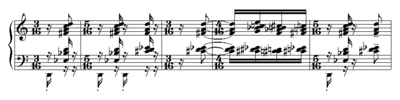
4 bars from the Rite of Spring, 4 change in time signature
The "Rite of Spring" ending the evening in startling fashion.  Honestly I didn't know much about it other than the changes in time signature are legendary.  In the pre-concert chat I was reminded it was actually a ballet, the premiere of which was also legendary for "provoking the most notorious riot in twentieth century music" (as per the program notes).   I wasn't sure what to expect, but really wasn't expecting what it was or the subject matter (Part 2: The Great Sacrifice involves maidens performing secret rites with one doomed to die).  There were disjointed melodies that seemed to come out of nowhere and disappear without feeling complete.  Some of them were beautiful and lyrical while some of them were very dissonant.   The dynamic range was well varied.  I can now say I've seen and heard another of the classics.

Sunday, October 14, 2012

Some Enchanted Evening with the TSO

Tuesday evening the Toronto Symphony opened its Pops Concert Series with new Principal Pops Conductor Steven Reineke at the helm for an evening of Rodgers and Hammerstein hits.  At first glance in the new, all glossy pages program (which had the side effect of condensing the piece order list to 1/2 a page!) I wasn't entirely thrilled with the pieces listed.  It seemed like a rehash of what's typically done at Pops concerts.  However my opinion changed once things got started.  While some of the these pieces are well worn and typical fare the vocalists made them come alive again!  Additionally some pieces often done by soloists were done by the choir combination of the Orpheus Choir of Toronto and the University of Toronto MacMillan Singers.  There were even a few included that often get overlooked.  "We Kiss in a Shadow" for example,  I don't recall ever hearing before. Obviously it's been a LONG time since I've watched The King and I.

The arc to the evening was chronological.  Reineke briefly described the plots of each musical and mentioned some of the historical significance Carousel and South Pacific had being the first to include subject matter regarding abuse, sexism and racism.

Ashley and her husband Daniel
looking lovely at their wedding
( www.patsybrownblog.com)
I have no complaints about any of the singers, they all had good voices, Ashley Brown though is spectacular!  Just wow!  She looked stunning as well in two lovely gowns.  Total side note: I couldn't help noticing a ring I didn't remember before.  Turns out she's been married almost a year (thanks google) and congrats Ashley!

I've heard her before and was so excited she was going to be coming to Toronto.  In fact all the singers were making their TSO debut.  In addition to Ashley was Aaron Lazar, and it was great to see Canadian talent on the program with Jonathan Estabrooks (see his interview regarding this concert here).

The choirs were highlighted as well, beginning with "It's Grand Night for Singing".  They also got to show off their whistling skills in their other main numbers "There is Nothin' Like a Dame" and "I Whistle a Happy Tune".  "Nothin' Like a Dame" was probably the most enjoyable selection as they passed around a mike singling out individual lines.  There was one guy in the front row who stood out even before his solo with his apparent enjoyment and great expressions.  It's great fun watching people like that.  Back in the audience, I don't think the young gentlemen in front of me had heard the song before because he was cracking up at some of the more humerous lyrics.

Carousel was apparently Richard Rodgers favourite musical and is Reineke's as well.  Here Ashley embraced a variety of vocal styles from the twang of "June is Bustin' Out All Over" to the serious romantic "You'll Never Walk Alone".  Later in The King and I section she shared the loving romantic "I Have Dreamed" with Jonathan for probably my favourite piece of the evening.  Such a wonderful combination of melody and voices.

Jonathan (operatoonity.com)
While a bit repetitive with the gestures in "Soliloquy", Jonathan showed impressive stamina throughout the 7.5 minute long song, which follows the character's wondering over all the fun he could have with a son, lamenting that his child may be a girl,  deciding that might not be so bad after all, and resolving to do all he can to support her!  I think it's one of the first times I haven't been bored by the full version and the ending was just as powerful as the start.

Aaron Lazar
(www.phototv.fr/aaron-lazar.html)
South Pacific selections in the second half allowed Aaron to reprise his Lt. Cable days (he performed the part at the Hollywood Bowl) with a nice rendition of "Younger than Springtime".   Jonathan got the ever popular "Some Enchanted Evening".  If I closed my eyes at the start of "A Wonderful Guy" I could have sworn it was Kelli O'Hara singing.  It diverged from there, but Ashley started out so similarly.

It's always nice when the orchestra gets its chance to be centre stage as well.   Here they were featured in the opening "Orchestral Interlude" which included segments of songs that weren't elsewhere in the show such as "Everything's Up to Date in Kanses City" (from Oklahoma) and "Shall We Dance?" (from The King and I).  The second half opened with the "Waltz" from the 1957 made for TV movie Cinderella.  Rodgers and Hammerstein took that project just to work with Julie Andrews and we all know what became of that collaboration.  It was a nice to hear the waltz live with full orchestra and I had forgotten that "10 Minutes Ago I Met You" was part of it.  I couldn't resist quietly singing along.  It was actually the Lesley Anne Warren remake from 1965 that I grew up watching and remember having to fast forward the commercials.

Hill Twirl
(www.the-sound-of-music-guide.com)
The evening concluded with the final R and H collaboration The Sound of Music.  The "Prologue and the Sound of Music" performed were the arrangement from the film.  It's been a while since I watched it but the start of "Prologue" sounded like dissonant contempoary music at times, with the flitty flutes (reminiscent of birds) and chime of church bells.  The horns calling with the mellow opening line "what will this day be like, what will my future be" in "I Have Confidence" was just enough to pull it back into context.  When Ashley walked to the front of the stage to start "The Sound of Music" I was so hoping she'd do the Julie Andrews twirl at the top of the hill, but she didn't.

After Jonathan's "Edelweiss" solo he invited the audience to participate in the second time through.  Nothing beats singing with full symphony orchestra!  The vocalists then all joined together for the concert conclusion "Climb Ev'ry Mountain".

After a standing ovation and several sets of bows, the orchestra returned to their seats for an encore (yay!) of "Do Re Mi".  At the first line from the choir of "Let's start at the very beginning" there was applause and cheers from the audience!  I absolutely agree it would have been no trouble to sit through the entire concert again.

I will venture that the A-list of symphonic pop artists isn't huge (well ok, maybe it is, but I've only been exposed to a limited number, so still think it's small) and Reineke and Ashley have worked together before so let's hope that this is only the beginning of her collaborations with the TSO.  Hmm, how about a dream team concert?  My votes go to Hugh Panaro, Ashley Brown and Ben Crawford...could you imagine an evening with them...heavenly!

Kudos also to the sound mixer.  It was perfect!  The singers didn't sound over amplified that I've sometimes noticed before, and their voices were melded beautifully with the orchestra.