Showing posts with label conductors. Show all posts

Sunday, November 9, 2014

What Makes The Four Seasons Great?

amazon.com
I enjoy Rob Kapilow.  I learn more about music in an hour of his talks deconstructing a piece then I did in all of my high school music history class.  Granted that classes didn't focus on the same things, but it was so boring compared to the enthusiasm and insight Kapilow provides.

He was in town as part of the Toronto Symphony's "Exposed" series.  The piece of music in question: Vivaldi's The Four Seasons, "Autumn" and "Winter".  Apparently several seasons ago he covered "Spring" and "Summer".  Unfortunately I missed that concert. Chee-Yun was the guest violinist and is a beautiful player.  In the Q&A after the concert she told us she had started learning the piece in middle school, a "long, long time ago".  My understanding of her story, which I hope I heard correctly, was that the violin she was playing was from 1669 and was actually buried with a guy for a while.  Obviously it has been well looked after since then as it still has the original varnish.  She's decorated it a bit by adding a glittering fine tuning post and mute, which was a gift from a student.  They matched her shimmering dress and shoes.  She doesn't practice in the heels though :)
Chee-Yun (chee-yun.net)

While we're on the subject of violins, someone asked about the one played by concertmaster Mark Skazinetsky.  His was made in 2008 by a friend in Salt Lake City.  Talk about old meeting new.

But let's get to Vivaldi.  I had no idea The Four Seasons had accompanying poetry!  Granted, it's not great poetry which has led some to believe Vivaldi wrote it himself.  Given how well it fits the music, that makes sense to me.  I also never thought about "Autumn" and "Winter" each having three movements.  I generally classified The Four Seasons itself as a piece with 4 movements, never thinking they were further divided.

thisismyjoystick.com
A highlight in the deconstruction of the first movement of "Autumn" was the seven ways Vivaldi makes music sound drunk, including a cello that can't find the beat paired with double stops in the solo violin.  Kapilow also pointed out examples of sequencing where the same pattern is repeated higher or lower.  It was fun to listen for this and be able to recognize it elsewhere as well.  In the second movement the orchestra goes to sleep, not literally, but the music has descending arcs as if each time they can't get back to the top note to repeat the pattern.  The concluding movement is made exciting by the dotted rhythm which we sang out along with Kapilow.  A boring version using a straight rhythm was demonstrated by the orchestra with the instructions to play it in as dull a manner as possible.  There's nothing quite like a little rhythmic pattern to add interest.

shirt.woot.com
The poetry of "Winter" is perfect for the music.  So we could see this the appropriate lines of text were projected above the orchestra in the second half of the concert where they performed the full piece.  The trembling notes represent shivering while the solo violin breaks in as the "bitter blast of a horrible wind".  This then gives way to "...run, constantly stamping one's feet".  It's so easy to hear what's happening with the words put to it.  The second movement text opens with "to spend restful, happy days at the fireside".   Musically this is matched perfectly by the lovely solo melody, while the pizzicato in the orchestra is the rain outside.  Ice arrives in the third movement "to walk on the ice, and with slow steps to move about cautiously for fear of falling".  Then "to go fast, to slip and fall down" represented by the downward running notes.  It finishes with "that's winter, but of a kind to gladden one's heart".  At Kapilow said, how very Canadian.  Here's hoping this winter is like movement two more than three.

Vivaldi has always been one of my favourite composers, but this work is even more enjoyable now that I know more about the music, and all you have to do is listen.

Sunday, June 30, 2013

Invitation to the Dance

Conductors Andrew Grams and James Gaffigan have been on my "to see" list since they were both on the NACOcast back in March 2010.  Host Christopher Millard had them pull questions out of a hat to answer.  I'm pretty sure Gaffigan has been to Toronto, I just haven't made it to the concert.  So my task to see them both started on June 22 when Andrew Grams conducted the last series of TSO 2012/2013 season concerts titled Invitation to the Dance.

The concert opened with the title piece by Carl Maria Von Weber.  There's a story that plays out as the cello, being the gentleman, asks the lady, the woodwinds, to dance.  She says maybe, eventually agrees and they dance!  At the conclusion they go their separate ways and fade away.

"Carmen Fantasie" was written for the 1945 Joan Crawford movie Humoresque about a virtuosic violinist.  Sixteen year old Kerson Leong, making his TSO debut, certainly fit the bill.  Based on themes from Bizet's opera Carmen, there's no lack of great content and Leong had the whole orchestra and audience applauding when he finished.
Leong and the TSO (TSO photo)

The first half finished with the always popular "Can-Can" from Offenbach's operetta Orpheus and the Underworld.  I've played an arrangement of this piece and whether listening or playing it has been forever converted in my mind from the words I knew as a child "can can can you do the can-can..." to the Straight No Chaser lyrics from their "Christmas Can-Can", "it's time to do the Christmas can-can if you can't can't dance well that's ok, not going to do the kickline..." etc.  Great song really no matter how you think of it.  One of those tunes guaranteed to stick in your head.

Andrew Grams (musicvinearts.com)
Having been a violinist with the New York City Ballet, Grams said he'd played about 300 performances of The Nutcracker.  Yet he still is able to like Tchaikovsky and conduced a "Suite from The Sleeping Beauty".  It featured the intrduction of the Lilac Fairy, the Waltz (known to me as "Once Upon a Dream" from the Disney version), and the Rose Adagio.

Grams also shared that one of the common questions he's asked is what's his favourite music to conduct?  He said that people expect a young person like himself to say Mahler or Shostakovich.  But he really likes polkas and waltzes because they're the most fun!  He got to have fun and brought the audience along with him as the concert concluded with "On the Beautiful Blue Danube Waltz" by Strauss Jr. and "Radetzky March" by Strauss Sr.

"Radetzky's" was the other reason I wanted to attend this concert.  It was the recessional all through high school for commencement so we played it a lot and I was looking forward to hearing how it should sound.  I wasn't disappointed!  It's one of my favourites.  I had no idea there was a whole audience participation tradition though.  It took a bit to get the hang of the dynamics but finally we followed the conductor and got it right.

In addition to being the season ending for the TSO, it was the last concert for second trombonist William Cross, who is retiring.  He was acknowledged with enthusiastic applause from the audience.

Thanks to the Toronto Symphony for another great season.  See you in September!


Thursday, June 20, 2013

MGM at the NAC Completes a Cycle

Ten seasons ago Those Glorious MGM Musicals debuted at the National Arts Centre.  I was in the audience attending my first symphony concert.  The rest, as they say, is history.  Thursday June 20 Jack Everly was back on the podium, at the venue, and with the concert that hooked me.

With each viewing there are different stories and new things to see and hear.  The content of this program was the same as the Naples Philharmonic version, except with a new guy in the song and dance man roll, David Elder replaced Nick Adams.

David Elder
(michaelcassara.net )
David's first number "Steppin' Out With My Baby" was entertaining if not as athletic or high flying as Nick's.  Although I enjoyed David's interpretation of Groucho Marx's "Lydia Oh Lydia" more.  His "Singin' in the Rain" at the end of the program was joyous and always one of my favourites.  The others in the cast were Nick Fitzer, Scott Hogsed, Kathy Voytko, and Dan'yelle Williamson.

Let's see, new stories from Everly this time around were in the introduction to a medley from "Meet Me in St. Louis".  Originally the casting was to be Gene Kelly and June Allison, however when Kelly broke his ankle and the role went to Fred Astaire they re-cast the leading lady as well.   Judy Garland was deemed a better fit for Astaire.

The final piece in the opening half was a "Hollywood Hit Parade" medley which featured "You Stepped Out a Dream" from Ziegfeld Girl; "Easy to Love" which I'm familiar with from Anything Goes, however was introduced in the musical Born to Dance and allowed the orchestra to show their skills free from vocal additions; "Wonderful Day" from Seven Brides for Seven Brothers, "Most Unusual Day" from A Date with Judy; "San Francisco" which was sung by the choir and from the movie by the same name; "Be My Love" from The Toast of New Orleans, was the first song sung by Nick in a powerful tenor voice; "Get Happy" from Summer Stock the Garland classic, was again performed beautifully by Dan'yelle.  It concluded with "Sing Hallelujah" from Hallelujah! and had costuming direct from patriotic America, by design or not I don't know (the ladies wore lovely red and blue ball gowns while the gentlemen were dashing in black tuxes).  It wasn't quite the "360 hits" mentioned in Everly's intro, but it covered a lot of the wonderful classics.

Peter Webster
(nac-cna.ca)
Following Kathy and Dan'yelle's "Can't Help Lovin' That Man" duet, Jack took a moment to say how fitting a piece that was because a 41 year veteran of the orchestra was retiring.  Violist Peter Webster was coaxed to his feet to take a bow while the audience enthusiastically recognized him for his contributions.

The "That's Entertainment" encore, is perhaps a piece that's growing a bit thin with entertainers.  Jack started by saying how it was Kathy's favourite song so they had to include it in the program.  Meanwhile she's motioning that it's not her favourite at all.  I enjoyed it for the conclusion of "Hip Hooray, the Canadian way..."  It was a nice touch.

With that a cycle of sorts has been completed for me, going back to the same show having spent a wonderful 10 seasons of experiencing all orchestras have to offer.  I have no intentions of stopped now, there's always much more to hear!  Many thanks to the orchestra and program who started it all.


Sunday, April 7, 2013

The Music of James Bond

Bond through the years
(www.torontovka.com)

Conductor John Morris Russell, another of my favourites, returned to the Toronto Symphony this past week bringing with him the original scores from some of the best music in the 23 James Bond movies.  Composed by various people such as John Barry, Monty Norman, David Arnold, and even John McCartney, the person who really gave Bond his sound was someone not nearly as well known, arranger Nic Raine.  It was those arrangements the TSO brilliantly performed, and appeared to have an enjoyable time doing it.  

The night opened with the "James Bond Main Theme" before
Capathia Jenkins
(broadwayworld.com)
moving on to some of the hits from the Sean Connery era.  Guest vocalist Ron Bohmer made his TSO debut singing "Thunderball" to great effect.  Capathia Jenkins followed with "For Your Eyes Only", also her debut performance.  She has a gorgeous sultry voice that totally suited the James Bond style.  I think that was my favourite vocal song of the evening, although Bohmer's "From Russia With Love" was a close second.  Both singers, but especially Jenkins, seemed so pleased with the audience reaction and generously indicated their thanks to the audience and orchestra.

As usual the orchestra was not left out.  They played a short suite from Dr. No, complete with a recorded voice over of the most famous line in movie history (according to Conductor Russell), "martini, shaken not stirred".  

Mrs. Peel
Opening the second half was a series of orchestral selections featuring guest saxophonist John Johnson and brassy solos by trumpeter James Gardiner.  It started with the "Soul Bossa Nova" better known as the theme from Austin Powers, then moved to the piece that started the spy-fi genre, the "Peter Gunn Theme".  Russell broke in to continue the history and stories he was providing between pieces to discuss the appeal a character named Mrs. Peel, who "wore leather and kicked butt", had for a young boy growing up in Ohio.  The orchestra followed with the theme from the TV series The Avengers.  

Ron Bohmer
(www.imdb.com)
Also included were Mission Impossible with it's identifying 5/4 time, the Pink Panther, and the theme from Shaft where Bohmer reappeared in his own leathers.

Moving on to more recent Bond movies, Jenkins sounded just like Adele singing "Skyfall" then switched to Gladys Knight for "Licence to Kill".  "The Look of Love" from the original Casino Royale had Russell get in on the non conducting action to join Jenkins for a classy slow dance.  Bohmer returned a final time to sing "You Know My Name" from the Daniel Craig as Bond version of Casino Royale.

Of course one couldn't leave until perhaps the most popular Bond song, made famous with the Shirley Bassey vocals but left as an orchestral encore piece, was played.  The evening was brought to a final close with "Goldfinger"!

Check out a photo of the TSO in rehearsal
TSO rehearsal with Maestro Russell (www.680news.com)

Wednesday, February 20, 2013

Beethoven Symphony 9

Conductor Matthew Halls
(www.bach-cantatas.com)
I'm unsure where I heard it, but regarding conductors it was said that "the score needs to be in their head, not their head in the score".  Never was that more clearly demonstrated then at the Toronto Symphony concert Wed. Feb. 13 Beethoven Symphony 9.  Guest conductor Matthew Halls, conducted the entire evening from memory.  What a memory to contain not only Beethoven's longest symphony but his "Coriolan Overture" and "Serenade in E Minor for String Orchestra" by Elgar as well.

I really enjoyed the "Coriolan Overture".  It opened with a decisive series of chords and ended, in a way I don't expect from Beethoven, by literally fading away.  The orchestra did a fantastic disappearing act at the end, bringing the sound level ever so gradually to nothing.

Elgar's "Serenade" was just beautiful with lovely playing from the string section.

The meat of the evening and the reason everyone was there had to be Beethoven's Ninth Symphony!  It was my first time hearing it live and just the way the stage was set up indicated something was going to be different.  Rather than relegating the Toronto Mendelssohn Choir to the seats in the choir loft, the orchestra was pushed to the front of the stage and the choir seated on risers behind them.
http://www.musicaltoronto.org/
(Photo by John Terauds)
Obviously the part everyone knows is the "Ode to Joy" from the fourth movement, but I discovered there's so much more to the piece than that.  For example in the second movement there was a great melody that would start to develop and each time it reached a peak it would drop away into something else.  Not sure where he was going with that because I was anxious to hear it continue and to my ears it never did.  Even in the fourth movement the "Ode to Joy" theme is of course there, but it's expanded on and left then returned to.  All things I wasn't expecting.  It was truly an uplifting evening, and I hope to catch Beethoven 9 again sometime.  To top it all off, it was Mr. Halls first time conducting the Ninth Symphony.  No one ever would have guessed and I wonder how his approach may change as he conducts it in the future after such a successful first experience.  For a more detailed review check out the Toronto Star article.

Thursday, January 31, 2013

TSO Allows the Audience to Pick

For many months the Toronto Symphony posted polls listing pieces of music and inviting potential  audience members to pick their favourites.  After several rounds and finals the six top pieces were combined into an Audience Choice concert.  Not a lot of the music I voted for made the final list, but I was getting excited just listening to the orchestra warm up and hearing snippets from Star Wars!

The "Main Title Theme from Star Wars" opened the evening with a soaring brass section that let loose to great effect.  There's nothing quite like John Williams.  I was left wondering if it's the first time anyone in attendance had heard that piece live given that there isn't always a lot of crossover between people who favour classical concerts and ones who prefer the Pops series.  Maybe programs like this will help in the promotion of each.

Next up was the "long, short, short, long" movement from Beethoven's Symphony No. 7 (ok, technically movement 2).  The theme was introduced so beautifully by the strings and then got even quieter.   Wow, just lovely.

Ms. Rizikov
(ttp://glenngouldvariations.tumblr.com)
Rachmaninoff's "Rhapsody on a Theme by Paganini" is probably my favourite piano piece, and I'll admit to being cliche and name Variation 18 as my favourite within it.  That variation proved to be another winner and made the program.  We also helped to fulfill a dream of sorts for the young pianist.  Thirteen year old Anastasia Rizikov had told the conductor who announced to the audience that it was her dream to perform with the TSO.  She took to the stage looking every bit a polished young lady.  Raising off the piano bench at times to get the sound from the piano to counter the orchestra, she got the job done, and musically at that.  I expect this won't be her last time on the Roy Thomson Hall stage.

Next was Movement 4 from Dvorak's "Symphony No. 9: From the New World".  It was a good book end to the first half with the Jaws sounding opening and brass fanfare that could slip right into a John Williams movie score.

Resident Conductor
Shalom Bard (tso.ca)
The audience voting continued even during the concert as after intermission we were tasked with making a selection between "The Great Gate of Kiev" from Mussorgsky's Pictures at an Exhibition, or "Intermezzo" from the opera Cavalleria Rusticana by Mascangni.  The method of voting by was shouting the favourite phrase of the conductor for the evening, the TSO's new resident conductor, Shalom Bard.  No idea what it means but to me it sounded like "oy mon choi".  The brassy sounds of Kiev won.

Then a drastic change of pace for "Adagio for Strings", which was poignant as always.  I had forgotten this was in the movie Lorenzo's Oil, and while listening my mind wandered back to when I saw that movie in high school.

The evening concluded with the full "1812 Overture"!  Another smashingly exciting piece.  Particularly the finale that accompanies fireworks shows, yet I like hearing the whole thing in a concert setting, even if the real cannon fire is replaced with recorded shots.

But wait!  That ended up not being the end of the evening.  Letting those who lost the vote still be winners, "Intermezzo" was played as an encore.  It was my vote and I'm glad they played it.  The theme is likely to be known by many but it's not a piece I've ever heard in it's entirety and really had no idea where the melody that's so popular was from.  It was a wonderful conclusion.

I think the audience choice idea went over well and perhaps there will be more in the future.

Tuesday, December 18, 2012

Return to Yuletide Celebration

Finding myself with some days off at the beginning of December, I decided on a road trip to the best concert for getting in the Christmas spirit, Yuletide Celebration with the Indianapolis Symphony Orchestra!  Two years ago I made the trip for the 25th anniversary concert (that review here) and while I wasn't expecting the elaborateness of that milestone, the 27th version came pretty close.


Justin Stahl, Lobby
Organist
The lobby decorations were as gorgeous as ever, and the cookies just as delicious.  Entertaining concert goers and showing off the Wurlitzer Theatre Pipe Organ to great effect was Justin Stahl who played before and after the concerts.  When leaving I noticed his closed music book, it was the "Reader's Digest Merry Christmas Songbook" which I also have! (although anything I've played didn't sound nearly as good).

Angela and Ben
The show opened with a new arrangement of "O Come, All Ye Faithful" by music director and maestro, Jack Everly.  It had English lyrics, Latin lyrics, and even the "wonderful, councillor..." quote from The Messiah.  Featuring the whole cast, it also served as an introduction to the voices of the hosts, opera star Angela Brown and Broadway leading man Ben Crawford.  I've seen Ben in other Symphonic Pops Consortium concerts, and have always enjoyed his voice.   This concert was no exception.  Angela and Ben joked around introducing each other with Angela playing the opera diva and claiming herself as sole host because she's from Indianapolis, which garnered audience applause.  At the matinee I attended however, Ben's announcement at being from Tuscan, Arizona created a stronger audience reaction.  Maybe he stacked the crowd with friends and family.  Being an out of towner I cheered for him :)

Anthony Kniffen & Grinch
After a solo by Angela of "Sleigh Ride" (because really what concert is complete without the Leroy Anderson classic, which incidentally was written in Georgia when the temperature was 105 deg. F) the orchestra was showcased in a medley from The Grinch Who Stole Christmas.  I haven't watched the movie in years and wasn't recognizing anything.  Then all of a sudden I noticed the tuba player, Anthony Kniffen, disappear from his spot at the back of the stage balcony.  He reappeared centre stage wrapped in a sousaphone and wearing a Santa hat to play "You're a Mean One Mr. Grinch".  The Grinch himself (he was wondering around the lobby earlier), even poked his head out from the window above the stage drumming his fingers together in an evil fashion.

Ben and cast decked out in Christmas bling
The costumes and gowns were extravagant, and none more so than Angela's dress for "Sparklejollytwinklejingley" from Elf: The Musical.  It was all gold and so glittery under the lights it was hard to look at.  Ben, by contrast was wearing a classic black tux and was accused of needing some Christmas bling.  He obliged by removing the tux to reveal black sequined pants and a red sparkly jacket.  The singers and dancers all sported major sparkles and glitter during an energetic dance interlude.  I hadn't heard anything from Elf before, but quite liked this and the selection later of "There is a Santa Claus".  That piece has a lyric about Rudolph's nose really glowing and a red spot light swept around the hall to emphasis the point.  It was a simple but effective bit of lighting design.


Christmas Eve Radio Highlights
The highlight of the first act for me was being taken back to December 24, 1942 for the "Christmas Eve Radio Broadcast".  A WISO sign descended from the stage complete with "On Air" and "Applause" indictors.  After a jive style dance number to "Hark the Harold Angels Sing" (or at least part of it) by Anne Nicole Beck and Joseph Perkins Jr., Ben and several Yuletide ladies performed "Fum, Fum, Fum".  The "broadcast" then officially started complete with an ad for Hazel Bishop lipstick.  I looked it up and it was the brand of the first non-smear lipstick although it wasn't an incorporated company until 1950.  But who says you can't adjust history to suit the needs of a show? :)  The catchy Chiquita Banana jingle was part of the segment as well, complete with Ben in a grass skirt and coconut bra.  Three singers with great harmony did an Andrew's Sisters style song similar to "Boogie Woogie Buggle Boy" only about "Roly Poly Santa Claus".  Mike Runyan (ISO librarian) was featured with his "Cowboy Harmonica Christmas" that contains half a dozen harmonicas in various sizes and songs such as "Rudolph the Red-Nosed Reindeer", "Up On the Housetop", and "Holly, Jolly Christmas".  That was one of my favourite parts two years ago and it was really fun to see him again.  The segment concluded with Angela singing a touching rendition of "I'll Be Home for Christmas" with harmonica accompaniment.

The traditional tap dancing kick line of Santa's brought down the curtain for intermission.  The second half opened with "The Enchanted Toy Shoppe" a feature which I believe was new at last season's concert.  Angela began by telling the story of a toy maker and how one magical night his toys came to life.  She also sang the beginning of "Once Upon a December" from Anastasia (Liz Callaway was a host last year and the singing voice of Anastasia in the movie, which may have influenced the song choice, but it fit in well).  The fairy waved her wand to a slow version of the "The Sorcerer's Apprentice" theme bringing the toys to life.   Included in the toys were a music box dancer and doll, who danced, en pointe even, to something by Tchaikovsky from "Swan Lake" I think.  By magic a juggler (Cirque de la Symphonie artist Vova Tsarkov) stepped out of building blocks that were stacked together before our eyes.  I liked the following rag doll segment the best of the Cirque acts.

Check out that Statue of Liberty style tiara!
(Angela photo from her facebook page)
Alina Sergeeva as the doll 'danced' with the juggler as he picked her up and she flopped back over into incredible positions that showed off her amazing flexibility.  The way she carried momentum and flopped at the slightest touch was so realistic of how a doll would behave.  "Hedwig's Theme" was used as the music for extracting the aerial silks artist (Rachel Bowman) from the "empty" Toy Parts box.  Then Ben returned to sing "Somewhere in My Memory" for the silks act.  It's a lovely song and the move where the aerialist wrapped herself in the silk and then fell as it unravelled always make me catch my breath.  The variety of pieces that appear in arrangements by Jack Everly and company is second to none!

Presumably while they cleared the Toy Shoppe props away behind the curtain, Angela took the front of the stage and performed "My Simple Christmas Wish".  Apparently this is a popular cabaret act song, but I was unfamiliar with it.  Some lyrics were changed to be family friendly and a new line about not being Oprah so don't look under your seat (a joke about Oprah giving gifts away to audience members) shot by so fast it took a second to process, but once people got it, there were giggles.

Not to be outdone, the curtain opened on a now empty stage and Ben walked out to sing "Believe" from The Polar Express.  The most popular version is likely with Josh Groban, but I much preferred Ben's.  Groban's seems heavy to me, but Ben had hope and a bit more lightness, not to mention his wonderful voice.

Zach and Jack
An exciting instrumental version of "Good King Wenceslas" featuring ISO concertmaster Zach De Pue was introduced by Jack Everly.  He said the lyrics were added to the tune in 1853, and a new Christmas song was born, but we'd never heard it like this.  So true!  The arrangement, by Alex De Pue (Zach's brother), had more notes than it seemed possible to play and ones higher than I thought a violin could hit.  It was great to see a little Time For Three style jammin' going on!  Check out the same arrangement with Alex playing the fiddle accompanied by a hammered dulcimer (it's better with full orchestra but I was excited to find the arrangement in any form!).

Not that the audience needed any waking up after that, but the ensemble got their own lively number with "All I Want for Christmas is You".  The highlighted voices weren't all my taste, but the guys shoes sure stood out...red with white inserts sure fit the Christmas bling criteria.

Slowing things down Angela and Ben combined forces for "The Prayer" with Ben taking the Italian part of the duet and creating a beautiful deep sound.  Their voices and talents were highlighted the best here.

Full cast in "The First Noel"
Ben continued with the beginning of "The First Noel" singing it straight and with meaning, until the curtain rose on a stained glass style backdrop and the full cast joined for the concluding verses and chorus.  After an almost instant standing ovation (the powerful arrangement by David Clydesdale almost draws you out of your seat) we were seated again and treated to an acapella "Silent Night" by Angela before joining our voices with everyone else's for "We Wish You a Merry Christmas".  I love singing with a full orchestra!

Thank you to all the friendly people I met (and especially to one I still haven't), the performers and everyone behind the scenes who work together to create such a wonderful show.  My mission was accomplished, Christmas spirit attained and should anyone be in the need for some I highly recommend this method of acquisition!  Because it's really true that...


(All photos except where noted from the Indianapolis Symphony, some via The Examiner and The Star.)

Friday, November 30, 2012

Montreal Symphony in Toronto

New Maison Symphonic.  Similar in look to The Four Seasons
Centre in Toronto.   They are both designed by architect
Jack Diamond (www.azuremagazine.com)
This season, in addition to having an exchange of venue with the National Arts Centre Orchestra, the Toronto Symphony also has one with the Montreal Symphony Orchestra.  On November 21, the MSO was at Roy Thomson Hall, and the previous Sunday the TSO was trying out the new Maison symphonique in Montreal.

The evening of the 21st started with the always interesting pre-concert chat hosted by Rick Philips.  This evening he had MSO conductor, Kent Nagano as a guest.  They discussed Haydn's work and how it has fallen off the programming radar of the larger orchestras in recent years.  Nagano described how he had this great idea to do a Haydn cycle.  He was all excited and pitched it to the box office and marketing departments.  Unfortunately they were less than enthused not being sure how to sell that sort of concert.

(www.last.fm)
The Haydn on our program was Symphony No. 94 "Surprise".  It's one of the first of the last group he wrote (104 symphonies in total) referred to as the London Symphonies.  Getting the okay to actually program a series of Haydn works, the next issue to tackle by Maestro Nagano was, what do you pair with them?  His choices for the "Surprise" were "An Orkney Wedding, with Sunrise", and "Le Sacre du printemps" ("The Rite of Spring").  He programmed these selections because they also have dance themes that can be bombastic and beautiful, and perfectly complete ideas and ones that leave you hanging.

The symphony opened with an Adagio cantabile first movement and light airy theme.  The second movement begins innocently enough, although I imagine the entire audience was on the edge of their seats awaiting the "surprise".  The sudden fortissimo about 30 seconds in occurred, but I was underwhelmed by it.  The pianissimo just before the section was so excellent that I think the forte could have had a real punch to it, but given the anticipation of the moment I was expecting more.

I believe at least part of "An Orkney Wedding, with Sunrise" was on a TSO program not that long ago. (The Last Night of the Proms from June 2011 to be exact)  The comma in the title makes me giggle, as if the piece was too short so the "with sunrise" was an afterthought.  The humour in this piece has to do with the deterioration of the dance theme as it goes from the flute, clarinet, oboe, bassoon and violin depicting the results as the amount of whiskey ingested by the wedding guests increases.  I like how the strings can mimic the sound of bagpipes.  The final call of the real bagpipes, decrescendo as the night fades and crescendo as morning breaks completes the picture.

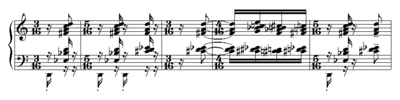
4 bars from the Rite of Spring, 4 change in time signature
The "Rite of Spring" ending the evening in startling fashion.  Honestly I didn't know much about it other than the changes in time signature are legendary.  In the pre-concert chat I was reminded it was actually a ballet, the premiere of which was also legendary for "provoking the most notorious riot in twentieth century music" (as per the program notes).   I wasn't sure what to expect, but really wasn't expecting what it was or the subject matter (Part 2: The Great Sacrifice involves maidens performing secret rites with one doomed to die).  There were disjointed melodies that seemed to come out of nowhere and disappear without feeling complete.  Some of them were beautiful and lyrical while some of them were very dissonant.   The dynamic range was well varied.  I can now say I've seen and heard another of the classics.

Sunday, October 21, 2012

A Whirlwind of Music

Shamefully this is being written in November and back dated a month (wow, so behind) so it shows in the correct month drop down menu.  So way back on Oct. 14 the Toronto Symphony offered a Whirlwind of Music program.  We started in Germany with the first movement of Mendelssohn's "Italian Symphony No. 4", then moved on to Italy for Vivaldi's "Concerto for Bassoon in F Major" and Rossini's "Overture to William Tell".  After intermission we went to Austria for the "Overture to the Magic Flute" by Mozart, then back to Germany for Mendelssohn's "Konzertstuck No. 1 for Two Clarinets", before finishing the trip with the second and fourth movements of Beethoven's "Symphony No. 7".

Joshua Weilerstein
The concert was conducted by the incredibly energetic (ah, the joys of youth) Joshua Weilerstein.  He's accomplished a lot in his 24 years, completing graduate studies in conducting and violin, assistant conductor of the New York Philharmonic, and has had conducting gigs all over the world with orchestras such as the BBC Symphony, Los Angeles Philharmonic, and Danish National Symphony to name a few.  He had an excellent rapport with the audience, provided interesting tidbits about the pieces and added humour by defining an intellectual as one who can "list to the William Tell Overture without thinking of The Lone Ranger".  True not a quote created by him (wikipedia credits it to Jack Guin of the Denver Post) but fun nonetheless.

Michael Sweeney
Highlights of the concert for me started with the bassoon concerto.  I enjoy the sound of the bassoon, but often find it difficult to pick out from the full orchestra unless it has an obvious melodic line.  So it was really nice to hear principal bassoonist Michael Sweeney take centre stage.  In fact it was an embellished version of the concerto that Mr. Sweeney created himself.  A rather prolific concerto writer with over 500 to his credit and more than three dozen for the bassoon, I've always liked that Vivaldi probably wrote most of these works for the female students at the Venetian orphanage where he worked.

L: Valdepenas, R: Zhai
The spotlight continued to be on principal players when new TSO clarinetist YaoGuang Zhai joined the veteran Joaquin Valdepenas for the "Konzertstuck (or Concert Piece) for Two Clarinets".  What impeccable tone, articulation and ability they both have that showed off the versatility of this wonderful instrument (sorry, I'm biased since that's my instrument too).

Clearly I'm no intellectual because I thought of The Lone Ranger, but I had no idea the "Overture to William Tell" had four sections and is 12 minutes long!  As a whole it's a great piece, and a shame so much gets forgotten about because of the popularity of the final gallop.  It opens with a section called Prelude: Dawn featuring only the cellos and basses, then the full orchestra joins for the Storm.  The third section, Call to the Cows, is the pastorale calm after the storm and features the English horn, before  transitioning to the brass filled finale.

It was a lot of variety packed into an fun filled afternoon concert.

Sunday, October 14, 2012

Some Enchanted Evening with the TSO

Tuesday evening the Toronto Symphony opened its Pops Concert Series with new Principal Pops Conductor Steven Reineke at the helm for an evening of Rodgers and Hammerstein hits.  At first glance in the new, all glossy pages program (which had the side effect of condensing the piece order list to 1/2 a page!) I wasn't entirely thrilled with the pieces listed.  It seemed like a rehash of what's typically done at Pops concerts.  However my opinion changed once things got started.  While some of the these pieces are well worn and typical fare the vocalists made them come alive again!  Additionally some pieces often done by soloists were done by the choir combination of the Orpheus Choir of Toronto and the University of Toronto MacMillan Singers.  There were even a few included that often get overlooked.  "We Kiss in a Shadow" for example,  I don't recall ever hearing before. Obviously it's been a LONG time since I've watched The King and I.

The arc to the evening was chronological.  Reineke briefly described the plots of each musical and mentioned some of the historical significance Carousel and South Pacific had being the first to include subject matter regarding abuse, sexism and racism.

Ashley and her husband Daniel
looking lovely at their wedding
( www.patsybrownblog.com)
I have no complaints about any of the singers, they all had good voices, Ashley Brown though is spectacular!  Just wow!  She looked stunning as well in two lovely gowns.  Total side note: I couldn't help noticing a ring I didn't remember before.  Turns out she's been married almost a year (thanks google) and congrats Ashley!

I've heard her before and was so excited she was going to be coming to Toronto.  In fact all the singers were making their TSO debut.  In addition to Ashley was Aaron Lazar, and it was great to see Canadian talent on the program with Jonathan Estabrooks (see his interview regarding this concert here).

The choirs were highlighted as well, beginning with "It's Grand Night for Singing".  They also got to show off their whistling skills in their other main numbers "There is Nothin' Like a Dame" and "I Whistle a Happy Tune".  "Nothin' Like a Dame" was probably the most enjoyable selection as they passed around a mike singling out individual lines.  There was one guy in the front row who stood out even before his solo with his apparent enjoyment and great expressions.  It's great fun watching people like that.  Back in the audience, I don't think the young gentlemen in front of me had heard the song before because he was cracking up at some of the more humerous lyrics.

Carousel was apparently Richard Rodgers favourite musical and is Reineke's as well.  Here Ashley embraced a variety of vocal styles from the twang of "June is Bustin' Out All Over" to the serious romantic "You'll Never Walk Alone".  Later in The King and I section she shared the loving romantic "I Have Dreamed" with Jonathan for probably my favourite piece of the evening.  Such a wonderful combination of melody and voices.

Jonathan (operatoonity.com)
While a bit repetitive with the gestures in "Soliloquy", Jonathan showed impressive stamina throughout the 7.5 minute long song, which follows the character's wondering over all the fun he could have with a son, lamenting that his child may be a girl,  deciding that might not be so bad after all, and resolving to do all he can to support her!  I think it's one of the first times I haven't been bored by the full version and the ending was just as powerful as the start.

Aaron Lazar
(www.phototv.fr/aaron-lazar.html)
South Pacific selections in the second half allowed Aaron to reprise his Lt. Cable days (he performed the part at the Hollywood Bowl) with a nice rendition of "Younger than Springtime".   Jonathan got the ever popular "Some Enchanted Evening".  If I closed my eyes at the start of "A Wonderful Guy" I could have sworn it was Kelli O'Hara singing.  It diverged from there, but Ashley started out so similarly.

It's always nice when the orchestra gets its chance to be centre stage as well.   Here they were featured in the opening "Orchestral Interlude" which included segments of songs that weren't elsewhere in the show such as "Everything's Up to Date in Kanses City" (from Oklahoma) and "Shall We Dance?" (from The King and I).  The second half opened with the "Waltz" from the 1957 made for TV movie Cinderella.  Rodgers and Hammerstein took that project just to work with Julie Andrews and we all know what became of that collaboration.  It was a nice to hear the waltz live with full orchestra and I had forgotten that "10 Minutes Ago I Met You" was part of it.  I couldn't resist quietly singing along.  It was actually the Lesley Anne Warren remake from 1965 that I grew up watching and remember having to fast forward the commercials.

Hill Twirl
(www.the-sound-of-music-guide.com)
The evening concluded with the final R and H collaboration The Sound of Music.  The "Prologue and the Sound of Music" performed were the arrangement from the film.  It's been a while since I watched it but the start of "Prologue" sounded like dissonant contempoary music at times, with the flitty flutes (reminiscent of birds) and chime of church bells.  The horns calling with the mellow opening line "what will this day be like, what will my future be" in "I Have Confidence" was just enough to pull it back into context.  When Ashley walked to the front of the stage to start "The Sound of Music" I was so hoping she'd do the Julie Andrews twirl at the top of the hill, but she didn't.

After Jonathan's "Edelweiss" solo he invited the audience to participate in the second time through.  Nothing beats singing with full symphony orchestra!  The vocalists then all joined together for the concert conclusion "Climb Ev'ry Mountain".

After a standing ovation and several sets of bows, the orchestra returned to their seats for an encore (yay!) of "Do Re Mi".  At the first line from the choir of "Let's start at the very beginning" there was applause and cheers from the audience!  I absolutely agree it would have been no trouble to sit through the entire concert again.

I will venture that the A-list of symphonic pop artists isn't huge (well ok, maybe it is, but I've only been exposed to a limited number, so still think it's small) and Reineke and Ashley have worked together before so let's hope that this is only the beginning of her collaborations with the TSO.  Hmm, how about a dream team concert?  My votes go to Hugh Panaro, Ashley Brown and Ben Crawford...could you imagine an evening with them...heavenly!

Kudos also to the sound mixer.  It was perfect!  The singers didn't sound over amplified that I've sometimes noticed before, and their voices were melded beautifully with the orchestra.

Monday, June 25, 2012

Diamond Jubilee Proms

The Toronto Symphony 90th anniversary season concluded (well practically, there was one more concert featuring the guest trumpet soloist a few days later) June 20th with the standard The Last Night of the Proms.  This year there was the added theme of celebrating the Queen's Diamond Jubilee year.  As I've been very lax in getting this written, it covers highlights only.

Conductor Bramwell Tovey, who was absent last year, was back and making her TSO debut was trumpeter Alison Balsom.  Rounding out the cast were soprano Laura Whalen and baritone James Westman.

The concert opened with a special appearance by the Fort York Honour Guard and Fife and Drum group who stood guard on stage during "O Canada" and "God Save the Queen".  The orchestra then continued with the "Crown Imperial March" which is one of my favourites.  Maestro Tovey was very engaging with the audience, particularly the late comers as he started to tell us about the piece "most of you have just heard".  He also promoted the volunteer committee's flag selling efforts at every opportunity.

One of the most humorous parts of the evening was when he asked those in the audience who were bearers of the large flags where they were from.  The first few who proudly displayed the Union Jack or St. George's Cross were from Lake Simcoe, Bobcaygeon and Toronto.  It took a few more people to find a true Londoner.  Perhaps the best response, that even had the orchestra laughing, was "Quebec".  Tovey replied he was looking forward to hearing them sing the finale "Jerusalem".

Alison Balsom
(beta.wosu.org)
Ms. Balsom, wearing a lovely white gown, started her part of the evening festivities with the well known "Trumpet Voluntary" then moved onto the "Prayer of St. Gregory".  What an amazingly beautiful sound!  When she returned in the second half, this time in a stunning red dress, with "Casta Diva Variations from Norma" by Vincenzo Bellini I think everyone's jaw was on the floor by the end.  How anyone can play that many notes with so few breaths is astounding.  I don't know of many trumpet guest soloists, and she's definitely one worth having back.

The red, white, and blue wardrobe theme was concluded by Ms. Whalen who had the blue gown and for the finale wore the Kate and Prince William flag from last year's concert as an additional shawl. Not to be outdone was Mr. Westman.  After demonstrating his vocal skills with "The Lost Chord" and "When Britain Really Ruled the Waves" he complemented his Union Jack handkerchief by revealing his Canada flag boxers.

Luba Goy as Queen (cbc.ca)
A special guest appearance was made by Queen Elizabeth II herself (in the form of Royal Canadian Air Farce actress Luba Goy).  She was accompanied by several hobby horse riding RCMP officers who managed to keep a straight face while she chatted with Tovey and indicated "60 years is a long time to be on the throne".  It took a second for the double entrendre to sink in and the audience laughter to start.

Mr. Tovey arranged several selections for the evening including "A Novello Rhapsody" consisting of parlour songs such as "I Can Give You the Starlight", "Waltz of My Heart", "Music in May", and "We'll Gather Lilacs" by Ivor Novello sung by Ms. Whalen and Mr. Westman.  In a tribute to Mr. Tovey's mother who passed away last year and the World War II veterans, of which there were a few in the audience, he played the piano in his own arrangement while Ms. Whalen sang "(There'll Be Bluebirds Over) The White Cliffs of Dover".  It was a tender, touching and quiet rendition that would have been easier to be sucked into without the distracting coughing from the audience.

The concert was bittersweet in that The Last Night of the Proms tradition is going on hiatus for a few years.  It was 20 years ago that Bramwell Tovey made his TSO debut, and I'm not sure how long after that the Proms started, but he's probably been the conductor of the concert since it's inception.  He shook hands with not just the concert master but all the front row players, then went to the bass row which consisted of the older veteran players he's probably known for most of those years.

I've only attended twice, but I like that the concert is a mix of Canada Day and Remembrance Day combined.  It's fun, and funny, but with its share of poignant and important moments as well.  The Wed. evening performance was quite full and I expect it will be missed next year.  So in the words of the encore song, until the Proms and the next TSO season return, "I'll Be Seeing You".

Thanks to everyone who made the 90th season a joy to attend!

Thursday, May 10, 2012

Gershwin and Beyond

(www.online-inquirer.com)
May 6 I was back at Roy Thomson Hall for Gershwin and Beyond.  It was to be conducted by Joana Carneiro however due to a shoulder injury she was unable to lead the series of two concerts.  Substituting was American Edwin Outwater.  He had conducted a concert earlier in the season I had wanted to go to but didn't so it was nice to have another opportunity.  Until I read his bio I didn't realize he's the music director of the Kitchener-Waterloo Symphony.

The concert opened with Bernstein's "Overture to Candide", which seems to be the selection of choice for opening light classics concerts.  As usual it was joyously played.  Really I don't mind if it's performed a lot, it's one of my favourites.

(hurdaudio.blogspot.ca)
In the introduction to "The Chairman Dances: Foxtrot for Orchestra" Mr. Outwater explained it was part of John Adams opera Nixon in China.  It comes from Act 3 when the President and Chairman Mao, along with their wives are dancing, probably at a ball.  He described the piece as starting with a bit of important business going on, then switching to a classic 1950's Hollywood sound before concluding with percussion sounds reminiscent of an old record with the needle sliding off and up.  It was funny as the young conductor indicated "well that's what I've been told.  I don't know records." :)  The ending didn't really sound like the needle lifting to me, but maybe I just need to hear the real thing again for comparison.  The record I remember playing as a kid was You're a Good Man Charlie Brown and I think the old record and player is still around somewhere.

The first half ended with the always enjoyable "Rhapsody in Blue".  Written by George Gershwin I believe originally for 2 pianos, it was actually orchestrated by Ferde Grofe.  It's true that this piece has become widely recognized.  As Mr. Outwater said "people know it from all sorts of places, like the tunnel between Terminal 1 at Chicago's O'Hare; Neon and Gershwin you might say."  So true!  Admittedly when I haven't been in a hurry in Chicago I've enjoyed a leisurely stroll through the tunnel.  But it wasn't always the soothing, relaxing piece we consider it today.  In its day it would have had things to make the previous generation gasp.  The guest pianist was Todd Yaniw, who I would consider a prodigy having made his debut with the Edmonton Symphony at 13.  Now 26, he's recently received a Master's degree from Rice University studying with another TSO regular Jon Kimura Parker.  As always, it opened with the fantastic clarinet solo by YaoGuang Zhai.

O'Hare Tunnel
Opening the second half was a fanfare inspired by Copland's "Fanfare for the Common Man", but written by Joan Tower and titled "Fanfare for the Uncommon Woman".  Back in March the Baltimore Symphony had a program which included both of these.  A good idea, although I think the "Common Man" would have overshadowed the "Uncommon Woman" merely by being more recognizable.  It was a good fanfare, one I'd like to hear performed again.

Barber's "Adagio for Strings" has been paired by the TSO with "Rhapsody in Blue" before.  It's always a stirring piece but it bothers me that people find the quietest pieces and moments within them to start coughing.  Someone should do a study on the reasoning behind why one cough triggers 15 more from other people around the hall.  I have to force myself to focus on the music, get sucked back into the beauty and try to ignore what's going on around me.  No one clapped though in the spot where there's a pause when people sometimes think the piece is over.

(www.sheetmusicplus.com)
The finale was by Aaron Copland, "Four Dance Episodes from Rodeo".  As part of his intro, Mr. Outwater said something akin to the following "Copland's music is considered by conservative politicians in my country to be an example of pristine America.  I guess they didn't know he was a gay, Jewish socialist from Brooklyn!"

The piece is in four movements Buckaroo Holiday, Corral Nocturne (a pun on chorale), Saturday Night Waltz, and Hoe Down.  The first and finale are fast and light hearted and my favourites.  I haven't seen the suite performed before, but would love to again.  The audience clearly enjoyed it and applauded after each movement which was considerately acknowledged by the conductor rather than just ignoring it; the benefit of a casual concert I suppose.  There was even a burst of applause in the middle of Hoe Down, although the indication from the podium at that point was a skeptical expression as if to say "we're not done yet".  It was great to hear the audience enjoying it, and I'll guess the orchestra didn't mind too much, they had just yelled "yee haw" :)