Showing posts with label classical. Show all posts

Sunday, November 9, 2014

What Makes The Four Seasons Great?

amazon.com
I enjoy Rob Kapilow.  I learn more about music in an hour of his talks deconstructing a piece then I did in all of my high school music history class.  Granted that classes didn't focus on the same things, but it was so boring compared to the enthusiasm and insight Kapilow provides.

He was in town as part of the Toronto Symphony's "Exposed" series.  The piece of music in question: Vivaldi's The Four Seasons, "Autumn" and "Winter".  Apparently several seasons ago he covered "Spring" and "Summer".  Unfortunately I missed that concert. Chee-Yun was the guest violinist and is a beautiful player.  In the Q&A after the concert she told us she had started learning the piece in middle school, a "long, long time ago".  My understanding of her story, which I hope I heard correctly, was that the violin she was playing was from 1669 and was actually buried with a guy for a while.  Obviously it has been well looked after since then as it still has the original varnish.  She's decorated it a bit by adding a glittering fine tuning post and mute, which was a gift from a student.  They matched her shimmering dress and shoes.  She doesn't practice in the heels though :)
Chee-Yun (chee-yun.net)

While we're on the subject of violins, someone asked about the one played by concertmaster Mark Skazinetsky.  His was made in 2008 by a friend in Salt Lake City.  Talk about old meeting new.

But let's get to Vivaldi.  I had no idea The Four Seasons had accompanying poetry!  Granted, it's not great poetry which has led some to believe Vivaldi wrote it himself.  Given how well it fits the music, that makes sense to me.  I also never thought about "Autumn" and "Winter" each having three movements.  I generally classified The Four Seasons itself as a piece with 4 movements, never thinking they were further divided.

thisismyjoystick.com
A highlight in the deconstruction of the first movement of "Autumn" was the seven ways Vivaldi makes music sound drunk, including a cello that can't find the beat paired with double stops in the solo violin.  Kapilow also pointed out examples of sequencing where the same pattern is repeated higher or lower.  It was fun to listen for this and be able to recognize it elsewhere as well.  In the second movement the orchestra goes to sleep, not literally, but the music has descending arcs as if each time they can't get back to the top note to repeat the pattern.  The concluding movement is made exciting by the dotted rhythm which we sang out along with Kapilow.  A boring version using a straight rhythm was demonstrated by the orchestra with the instructions to play it in as dull a manner as possible.  There's nothing quite like a little rhythmic pattern to add interest.

shirt.woot.com
The poetry of "Winter" is perfect for the music.  So we could see this the appropriate lines of text were projected above the orchestra in the second half of the concert where they performed the full piece.  The trembling notes represent shivering while the solo violin breaks in as the "bitter blast of a horrible wind".  This then gives way to "...run, constantly stamping one's feet".  It's so easy to hear what's happening with the words put to it.  The second movement text opens with "to spend restful, happy days at the fireside".   Musically this is matched perfectly by the lovely solo melody, while the pizzicato in the orchestra is the rain outside.  Ice arrives in the third movement "to walk on the ice, and with slow steps to move about cautiously for fear of falling".  Then "to go fast, to slip and fall down" represented by the downward running notes.  It finishes with "that's winter, but of a kind to gladden one's heart".  At Kapilow said, how very Canadian.  Here's hoping this winter is like movement two more than three.

Vivaldi has always been one of my favourite composers, but this work is even more enjoyable now that I know more about the music, and all you have to do is listen.

Sunday, September 21, 2014

Starting the 14/15 Season with the TSO

Saturday night I attended my first concert of the  TSO season.  As Peter Oundjian explained, he decided to open the season with a program to showcase the orchestra, ie: no special featured soloist.  It was titled Arabian Nights.

The evening opened with one of my favourite pieces, which never fails to conjure up images of Torvill and Dean in my mind...yep, it was "Bolero".  Snare drum player John Rudolph was moved to a place of honour in the centre of the orchestra, rather than remaining at the back in the percussion section.  The orchestra started so quietly it was hard to tell that the piece actually had started.  It took a moment for people to stop fidgeting and strain their ears for that familiar beat.
Torvill and Dean Bolero Program
(http://debralschubert.blogspot.ca)
I've seen the TSO perform this before, but it's such a great piece to watch being played.  There are still times when I'm looking around asking myself, what instrument is that?   The extra saxophone player had the quickest instrument swap completing the melody on one sax then switching to the soprano sax and picking it right up again.  "Bolero" grows so subtly and smoothly that by the time it gets to the end it's just a fantastic climax.

The second piece was another I'd heard before, but really like.  As I hear it more the other sections are starting to grow on me, but I still love the finale.  This was 1919 suite of "The Firebird", shorter than the other suite Stravinsky also wrote from the ballet score.  As Mr. Oundjian said in his introduction it has the same pull to your feet as the Bolero.  I was more inclined to get to my feet after Bolero, but perhaps that's just a personal preference.

There were multiple player switch-outs in the winds and brass for various pieces.   It was nice to see a lot of familiar faces in one evening.  Congratulations to the newest brass player, Steven Woomert, winning the Associate Principal Trumpet position and replacing his father Barton who retired last season.

"Scheherazade" by Rimsky-Korsakov, the teacher of Stavinsky, closed the program.  This piece seems to be programmed often, yet I've never gone to see it.  This time though it was accompanied by two others I new I liked, so there was no doubt it wouldn't be a great evening of music.  Concertmaster Jonathan Crow played the violin solo sections beautifully.  The very high note near the end, that slightly misplaced could have been very cringe worthy, was of course perfectly placed and sustained.  In all the pieces there were brief solos in the sections which I always enjoy.  An arrangement of the third movement, "The Young Prince and Princess" I've played before in quite a small ensemble.    It was thrilling to hear that theme as it was meant to be, played by 30 violins in perfect pitch.  "The Sea" section of the final movement is so cool.  I had no idea what the section was called but was thinking, wow this really sounds like the sea.  Kudos to the crash cymbal and bass drum players.  Timing the wind up and impacts seems like it could be pretty stressful.  Having not read the program, but knowing that it was somewhat based on the 1001 Nights, I was sucked into a story through music.  It doesn't get any better than that.

Saturday, March 15, 2014

10th New Creations Festival

A many months late, Happy New Year!  It was a slow winter for my attendance at musical events, and the first concert I went to was the opening of the 10th annual New Creations Festival with the TSO.  The concert, titled Adams: Doctor Atomic, included the title work as this years featured composer was American John Adams.  Unfortunately he wasn't on hand to do the conducting honours, but was schedule to arrive in time for some of the later concerts.

I don't know what was different this year, but I found myself liking the music.   All of it, even the opening lobby entertainment by The Glenn Gould School of New Music Ensemble, was enjoyable.  "My Twentieth Century" the pre-concert Ensemble piece was different, sure, but the mixture of poetry and music worked for me.

Kevin Lau
(www.sneakpeekorchestra.com)
The concert began with a new work by affiliate composer, Kevin Lau, "Down the Rivers of Windfall Light".  It's based off the Dylan Thomas poem Fern Hill, about a child escaping into their imagination. Maybe it was the premise or the fact I was listening to the cast recording of Alice in Wonderland on my drive down, but it reminded me of that story.  I didn't find it weird, but programmatic with an overarching story that was understandable.  The brass was exquisitely used and one five note theme reminded me of the theme from Close Encounters of the Third Kind.  It had some interesting instrumentation in the percussion section, even a rain stick.

Completely switching gears, Adams' "Doctor Atomic Symphony" was up next.  It's a 25 minute, single movement work based on his opera of the same name
(www.scena.org)
about the making of the atomic bomb.  The scenes evoked are of the test site: the electrical storm that occurred a few hours before the test, a ritual "corn dance" by Tewa Indians, and the poem "Batter my heart, three person'd God" that inspired the naming of the site "Trinity".  At times it was bombastic and at others excruciatingly longing.  Andrew McCandless played the trumpet solo beautifully, as did the other brass soloists on the horn, trombone, and tuba.  In the percussion section were some things I hadn't seen before.  There was a huge set of chimes that had a set of stairs up to them, two thunder sheets, and cymbals being played by running a bow along the edges.

Magnus Lindburg
(symfonieorkest.be)
The last piece was "Piano Concerto No. 2" by Magnus Lindberg, featuring guest soloist Yefim Bronfman, who didn't look very much like his picture in the program.  Moments reminded me of "Rhapsody in Blue", and there's no doubt he's a powerful pianist.  Perhaps it was because of where I was sitting, but it sounded like the orchestra overpowered the piano at times.  The cadenza, written very late in the composing process, was impressive.  It was not my favourite piece of the night, but got a rousing ovation and multiple curtain calls.

For an analysis by a real critic, try the National Post.

Saturday, November 30, 2013

Beethoven and Strauss

In my quest to hear all the Beethoven symphonies live, I attended the Toronto Symphony concert that included Symphony #4 on Nov. 20.  That was what I went for, but as usual found some other hidden gems.  The conductor for the occasion was Sir Andrew Davis, conductor laureate of the TSO.

The program opened with "Overture to The Consecration of the House".  The title struck me as familiar, yet I can't say I recognized any of the music.  Doing a bit of research I discovered I'd heard it as part of Jorma Elo's ballet Pur ti Miro performed by the National Ballet of Canada in 2010.  It's one of the few overtures Beethoven wrote that was meant to be a stand alone piece and is pretty impressive, not to mention great ballet music.

I can understand why Beethoven's 4th symphony doesn't seem to be performed all that often.   It doesn't have the same draw of #5 or scope of #9.  It's good music, but I think I needed to read more of the notes or know more about the form to deeply appreciate it.  I did like the opening where the rich chords jump keys and don't give you any idea where it's going.

Guest soprano Erin Wall joined the orchestra for "Seven Early Songs", by Alban Berg.  The songs had a nice variety with a love theme throughout.  The English translations were a welcome addition to the program.  I'm not usually a poetry person, but this series I actually read again.
Erin Wall (photo by Josh Clavir)

The evening ended with "Till Eulenspiegels lustige Streiche" (or "Till Eulenspiegel's Merry Pranks") by Richard Strauss.  This was probably my favourite of the evening.  Till Eulenspiegel was a quick witted prankster, and apparently a real German peasant who died around 1350.  What jumped out at me  was the horn solo which I'm familiar with from its use in one of my favourite versions of the "12 Days of Christmas" by the Indianapolis Symphony.  There's a story in this piece of music as well that I should have read the notes for in advance to fully appreciate.  Lessons learned for the next concert.

Professional review of the concert can be found here.

Tuesday, November 12, 2013

National Ballet of Canada Stages a Classic

I didn't want to let the opportunity to see the classic ballet Swan Lake pass by, yet not wanting to spend a considerable amount of money (ballet tickets are one of the most expensive in town), I opted to try for a rush ticket.  That didn't exactly work out but standing room did!  The absolute cheapest way to see some pretty fantastic ballet!  The rough story line of Swan Lake is well known.  My favourite version is the one told by Tchaikovsky himself (well how it could be imagined he'd tell it) in Tchaikovsky Discover's America.  There was some deviation from that since choreographers take license and obviously there are sections of music purely for the opportunity to put a solo or group number, but I enjoyed it.

Act 1 is the Hunting Ground where Siegfried (Piotr Stanczyk at the performance I saw) is melancholy even though it's his birthday.  So what else to do in a ballet, but to dance and try to cheer up the Prince.  The program notes describe the dances as "growing increasing unsettling and violent".  This is true, but one of the most exciting parts was the wench (Jordana Daumec) being thrown between the knights and servants.  There's actually only that one main female dancing part in Act 1.  The rest is a chance for the men to show their power with leaps and jumps.

What surprised me the most was that the famous theme from Swan Lake didn't have any swans dancing to it!  It is first heard in Act 2 when Benno (the Prince's friend) and Siegfried are walking through the forest going hunting for the swans.  There's not really any dancing to it at all, it's more scene change music as trees fly in and out symbolizing their travelling to the marsh.
The company (Photo by Bruce Zinger)
Now the swans get to dance, and here the artists of the ballet were awesome!  This is what I came to see, about 20 dancers in the classical white tutus floating around the stage.  We meet Odette (Sonia Rodriguez) and the duets between her and Siegfried were impressive.  If only all it took to fall in love was one dance.  In these duets the fantastic playing of the orchestra was especially apparent with cello and violin solos.  I do love how Tchaikovsky has various instruments take over a phrase and passes it around the orchestra.  The fact that it can sound like one instrument is a testament to the skill of the players.

Rebekah Rimsey as the
Hungarian Princess from a
previous performance
(photo by David Cooper)
Act 3 is in the ballroom where Siegfried is being forced to choose a wife from four princesses: Hungarian (Stephanie Hutchison), Russian (Elena Lobsonova), Spanish (Tiffany Mosher), and Italian (Shino Mori).  Each of course gets a dance and a chance to woo the Prince.  They were all good and I liked how the styles fit the country.  The Italian was my favourite though, maybe because I also recognized that bit of music (which seems to also be called the Neapolitan Dance).

Of course Siegfried has already fallen in love, so can't choose one of the princesses.  But, surprise, suddenly there's another lady, dressed in black, who looks exactly like Odette!  Unknown to Siegfried it's actually Odile, brought by the evil villain Rothbart.  Of course they dance and here Sonia was deliciously sensuous and seducing.  If Siegfried wasn't already in love with her, he would have been!  The black swan pas de duex is where the 32 fouette turns come it and to my untrained eye Sonia looked spot on.  The ballerina gets all the glory but Piotr's set of turns just after it were pretty stunning too.  (Similar choreography here, with a different ballet company)

Siegfried's choosing of Odile brings calamity as he's betrayed Odette, and a flood sweeps through killing everyone.  This was the moment where I was most awed and it was by the use of a simple piece of silk.  The silk was used as the water and was held on the sides by dancers and swept in circles causing people to be engulfed or ejected.  Then just as quickly as it appeared, Rothbart arrives, grabs the silk in the middle and it collapses in spectacular fashion as he runs off stage with it.  Simple yet so effective.

Artists of the National Ballet
(photo by David Cooper)
Back at the lakeside for Act 4, the host of swans have now turned black and dance (the famous Tchaikovsky melody reappears) while Siegfried stands at the back on the driftwood/rocks pining for Odette.  She forgives him but a storm appears.  Siegfried fights Rothbart and when the dust clears Odette is left to mourn her dead Prince.

Not a happy ending, but with the wonderful music and dancing it was a very happy way to spend an afternoon.  The National Ballet is bringing it back in March so there's still a chance to check it out if you missed it.


Thursday, October 31, 2013

Carmina Burana For Halloween

There were no witches, ghosts or goblins on the Roy Thomson Hall stage this October 31.  Just a group of people dressed up as musicians, with none pretending to be something they aren't.  This Halloween the TSO was more formal, performing three works that culminated with "Carmina Burana".  It seems like this has been programmed recently by all the other orchestras I follow, so I was anxiously awaiting the chance to hear it.  It was so good I tried to get tickets to go again, but the Saturday night was sold out.

The evening started with the audience being wished a "Happy Hallowe'en, if such a thing is appropriate" by maestro Peter Oundjian.  "Dances from Powder Her Face" by British composer Thomas Ades, received it's Canadian premiere to open the concert.  It had just enough lyrical bits to outweigh it being another odd contemporary piece.  It's one I could sit through again.  Oundjian mentioned in his introduction that it had some tango moments in the style of Astor Piazzolla which I was listening for.  There were a few near the end, although brief enough that just when you're looking forward to it going somewhere, it changed and disappeared.

Music by Benjamin Britten seems to be popular everywhere this season since it would be his 100th
Phan and Deland (Photo by Josh Clavir)
birthday.  Tenor Nicholas Phan (who would return again in "Carmina Burana") and TSO Principal Horn, Neil Deland, were the soloists in "Serenade for Tenor, Horn, and Strings".  The piece is sung in English to six poems by various writers including "Pastoral" by Charles Cotton, "Nocturne" by Alfred Lord Tennyson, "Elergy" by William Blake, and "Sonnet" by John Keats.  The styles varied and I really liked the opening and closing horn solos, which were played beautifully.

Finally after intermission, what I had been waiting for.  The Toronto Mendelssohn Choir filled the loft and launched into the opening "O Fortuna" with power.  How could you not with a full orchestra and two concert grand pianos on stage!  I hadn't read the text before and had no idea it was actually broken up into three segments (Spring, In the Tavern, and The Courts of Love) after the opening Fortune, Empress of the World.  The sections within the segments range from powerful and deep, to the somewhat silly "The Roast Swan Sings" (although maybe there's something profound I'm missing).  Phan added a few gestures that provided a humerous interlude to lighten what is otherwise a pretty serious piece.
TSO and soloists (jameswestman.com)
Joining Phan were soprano Valenina Farcas and baritone James Westman.  The baritone seemed to have the most to do and all had awesome voices.  Today we hardly bat an eye at some of the text regarding drinking and love, however I would think that in the 12th and 13th centuries when the manuscripts, from which the lyrics are taken, were written there would have been a different reaction.  Although a lot can get by in the name of art.

Hopefully the TSO brings this piece back again soon.  I know I'd love to hear it again!

Sunday, June 30, 2013

Invitation to the Dance

Conductors Andrew Grams and James Gaffigan have been on my "to see" list since they were both on the NACOcast back in March 2010.  Host Christopher Millard had them pull questions out of a hat to answer.  I'm pretty sure Gaffigan has been to Toronto, I just haven't made it to the concert.  So my task to see them both started on June 22 when Andrew Grams conducted the last series of TSO 2012/2013 season concerts titled Invitation to the Dance.

The concert opened with the title piece by Carl Maria Von Weber.  There's a story that plays out as the cello, being the gentleman, asks the lady, the woodwinds, to dance.  She says maybe, eventually agrees and they dance!  At the conclusion they go their separate ways and fade away.

"Carmen Fantasie" was written for the 1945 Joan Crawford movie Humoresque about a virtuosic violinist.  Sixteen year old Kerson Leong, making his TSO debut, certainly fit the bill.  Based on themes from Bizet's opera Carmen, there's no lack of great content and Leong had the whole orchestra and audience applauding when he finished.
Leong and the TSO (TSO photo)

The first half finished with the always popular "Can-Can" from Offenbach's operetta Orpheus and the Underworld.  I've played an arrangement of this piece and whether listening or playing it has been forever converted in my mind from the words I knew as a child "can can can you do the can-can..." to the Straight No Chaser lyrics from their "Christmas Can-Can", "it's time to do the Christmas can-can if you can't can't dance well that's ok, not going to do the kickline..." etc.  Great song really no matter how you think of it.  One of those tunes guaranteed to stick in your head.

Andrew Grams (musicvinearts.com)
Having been a violinist with the New York City Ballet, Grams said he'd played about 300 performances of The Nutcracker.  Yet he still is able to like Tchaikovsky and conduced a "Suite from The Sleeping Beauty".  It featured the intrduction of the Lilac Fairy, the Waltz (known to me as "Once Upon a Dream" from the Disney version), and the Rose Adagio.

Grams also shared that one of the common questions he's asked is what's his favourite music to conduct?  He said that people expect a young person like himself to say Mahler or Shostakovich.  But he really likes polkas and waltzes because they're the most fun!  He got to have fun and brought the audience along with him as the concert concluded with "On the Beautiful Blue Danube Waltz" by Strauss Jr. and "Radetzky March" by Strauss Sr.

"Radetzky's" was the other reason I wanted to attend this concert.  It was the recessional all through high school for commencement so we played it a lot and I was looking forward to hearing how it should sound.  I wasn't disappointed!  It's one of my favourites.  I had no idea there was a whole audience participation tradition though.  It took a bit to get the hang of the dynamics but finally we followed the conductor and got it right.

In addition to being the season ending for the TSO, it was the last concert for second trombonist William Cross, who is retiring.  He was acknowledged with enthusiastic applause from the audience.

Thanks to the Toronto Symphony for another great season.  See you in September!


Thursday, June 13, 2013

High and Low Guest Artists

On June 6 the TSO performed a concert titled Joshua Bell and Edgar Meyer, artists who play instruments at opposite ends of the sonic spectrum.  My reasons for wanting to go were to hear (in no particular order):
-  the acclaimed Bell who I'd heard about, including the busking in the Washington DC subway story
- "Appalachian Spring" because I like the piece and haven't ever heard a great recording of it
-  "Pines of Rome" because I heard the name of the composer, Respighi, mentioned in an interview and turns out this is one of his famous pieces.
The heart of the concert, according to the program, was the "Concerto for Violin and Double Bass" composed by bassist Meyer with Bell in mind.

The evening opened with "Appalachian Spring".  It was "wow" for me.  Soft and soaring in all the right spots.  The layering at the start of the strings and the winds was spot on.  I've never heard it clearly before because recordings are always so quiet I have to turn up the volume and then when the dynamic changes and the tempo picks up it blows you away, and not in a good way.  The balance live was perfect.  Associate Principal clarinet Yao Guang Zhai seemed to have a good time with the solos and I love that the "Simple Gifts" melody appears in the clarinet first.  In fact there were notable clarinet parts in every piece.

Bell and Meyer during the concerto (TSO photo)
The concerto followed with Meyer adding a bit of a casual flair to the evening dressed in shirt sleeves rolled to the elbows, bow tie and suspenders.  There was some dissonance in the piece, but enough to peak interest as to where it was going to go, and most often satisfactorily resolved.  I particularly liked the melodic theme and rhythmic drive in movements 1 and 3, named "Quarter Note = 135" and "Half Note = 80" respectively.  The theme from the third particularly got into your head and I heard people humming the theme at intermission.  Meyer's bass looked smaller than the others in the orchestra and had an extended finger board on one side allowing him to get to the upper end of the basses 6 octaves and into the register of Bell's violin part.  The middle movement was more reflective, fitting in that it was a memorial to a student they both knew at Curtis.

Post intermission Joshua Bell got his solo chance to dazzle in "Tzigane, rapsodie de concert for Violin and Orchestra" by Ravel.  Honestly all I know of Ravel is "Bolero".  This was completely different and Bell demonstrated his very impressive skills elegantly.

Finally, "The Pines of Rome".  Honestly I was expecting to recognize more.  I've had the same
problem with recordings of this as with "Appalachian Spring" since there is such dynamic contrast.  It involves a large orchestra; there were 8 basses, 3 trombones and 3 trumpets on stage plus another 2 of each above the choir loft.  There's something about a huge brass sound that's thrilling, particularly when it builds like the final movement "The Pines of the Appian Way".  I could have sat through the entire concert again right away.


Friday, April 26, 2013

TSO and Photo Choreography

I made the notes on this concert ages ago and realized I never actually posted them.  So without further ado, on April 17th the TSO and guest artist Gil Shaham were featured in a program called My Homeland.  

I've loved "The Moldau" (a movement of "Ma Vlast" or "My Fatherland") since having to study Smetana and program music in high school.  Funny how dissecting music doesn't ruin my enjoyment of it in the same way as dissecting literature.  When the TSO put "Ma Vlast" on the program I jumped at the chance to hear "The Moldau" as it should be played and the rest of the work in its entirety.


Gil Shaham
(credit: Christian Steiner)
The concert opened with Mozart's "Turkish Violin Concerto No. 5".  Gil Shaham had entertaining facial expressions and sometimes seemed to be playing directly to conductor Peter Oundjian. When Mr. Shaham was not playing he looked like he could have been dancing to the music in his head.  The smiling, friendly personally he displayed was very fitting for the quick light dance style piece.  It was a shame that after the first movement we had to wait so long for the late comers to find their seats.  Oundjian even commented "there's some lovely seats up here" and pointed to a few in the front row.  I recognized more of the music than I thought I would and it's probably my favourite of the violin concertos I've heard.

Prague (www.gooverseas.com)
Recognizing more than I expected happened with "Ma Vlast" as well.  There was what some people would call a gimmick to the performance.  Two gentleman, James Westwater and Nicholas Bardonnay spent June and October in the Czech Republic taking photos and then fit them to the music.  The end result was pretty astounding and they coined the term "photo choreography" to describe it.  While the orchestra played, the images were projected on three screens above them.  The images weren't meant to tell the same story that Smetana's program music was, but just match/create moods and feelings.
I loved and recognized the opening movement titled "The High Castle".  This was paired with images of what I imagine was Prague, as well as castles and forts on green hills against a gorgeous blue sky.

"The Moldau" was my favourite and fittingly the photos were mostly of water.  At one climax just
The Moldau (www.hberlioz.com)
before the section in the music where the river starts to flow through the city and the melody changes, the somewhat suspensful music was paired with photos of a group of people in various canoes and kayaks going down some rough water beside a water fall.  Some people made it, some capsized but it fit the music absolutely perfectly!
The movement "Sarka" or "A Princess" was paired with images of churches and cathedrals, all very regal looking.  Prior to the performance when Oundjian described the piece, he gave the most details about this section which he admitted to liking very much.  It's the story of a girl who hates all men (at which point he quipped "nothing really changes does it").  She poisons them all and they start falling asleep, "starting with the second bassoon".  Sure enough in the music there were a final series of calls that started with the bassoon so perhaps that's what he was talking about.


The images for an "Encampment" took on a darker tone moving to World War Two and opening with a picture of a swastika.  There were historical pictures from a concentration camp with the more graphic being held in slight shadow, never coming into perfect focus but getting the point across without needing to be.  The music switches abruptly between dark and light and to counter the darkness were images of peace.  One was even of a wall with John Lennon's picture and hearts.

This isn't the first piece that has been paired with images by Westwater and Bardonnay.  I didn't think that it detracted from the music, and it wasn't hard to focus on the orchestra and not watch the pictures.  However, that isn't the same opinion held by others.  "Ma Vlast" with photo choreography was a co-commission and had its debut in Scotland with the Royal Scottish National Orchestra.  This is a review of that performance where the photo aspect is lambasted in the comments, 
http://www.guardian.co.uk/music/2013/mar/24/rsno-oundjian-review
All I can say is experience it yourself before making a judgement.  I'm glad I found the review after I'd already seen the performance.

Wednesday, February 20, 2013

Beethoven Symphony 9

Conductor Matthew Halls
(www.bach-cantatas.com)
I'm unsure where I heard it, but regarding conductors it was said that "the score needs to be in their head, not their head in the score".  Never was that more clearly demonstrated then at the Toronto Symphony concert Wed. Feb. 13 Beethoven Symphony 9.  Guest conductor Matthew Halls, conducted the entire evening from memory.  What a memory to contain not only Beethoven's longest symphony but his "Coriolan Overture" and "Serenade in E Minor for String Orchestra" by Elgar as well.

I really enjoyed the "Coriolan Overture".  It opened with a decisive series of chords and ended, in a way I don't expect from Beethoven, by literally fading away.  The orchestra did a fantastic disappearing act at the end, bringing the sound level ever so gradually to nothing.

Elgar's "Serenade" was just beautiful with lovely playing from the string section.

The meat of the evening and the reason everyone was there had to be Beethoven's Ninth Symphony!  It was my first time hearing it live and just the way the stage was set up indicated something was going to be different.  Rather than relegating the Toronto Mendelssohn Choir to the seats in the choir loft, the orchestra was pushed to the front of the stage and the choir seated on risers behind them.
http://www.musicaltoronto.org/
(Photo by John Terauds)
Obviously the part everyone knows is the "Ode to Joy" from the fourth movement, but I discovered there's so much more to the piece than that.  For example in the second movement there was a great melody that would start to develop and each time it reached a peak it would drop away into something else.  Not sure where he was going with that because I was anxious to hear it continue and to my ears it never did.  Even in the fourth movement the "Ode to Joy" theme is of course there, but it's expanded on and left then returned to.  All things I wasn't expecting.  It was truly an uplifting evening, and I hope to catch Beethoven 9 again sometime.  To top it all off, it was Mr. Halls first time conducting the Ninth Symphony.  No one ever would have guessed and I wonder how his approach may change as he conducts it in the future after such a successful first experience.  For a more detailed review check out the Toronto Star article.

Thursday, January 31, 2013

TSO Allows the Audience to Pick

For many months the Toronto Symphony posted polls listing pieces of music and inviting potential  audience members to pick their favourites.  After several rounds and finals the six top pieces were combined into an Audience Choice concert.  Not a lot of the music I voted for made the final list, but I was getting excited just listening to the orchestra warm up and hearing snippets from Star Wars!

The "Main Title Theme from Star Wars" opened the evening with a soaring brass section that let loose to great effect.  There's nothing quite like John Williams.  I was left wondering if it's the first time anyone in attendance had heard that piece live given that there isn't always a lot of crossover between people who favour classical concerts and ones who prefer the Pops series.  Maybe programs like this will help in the promotion of each.

Next up was the "long, short, short, long" movement from Beethoven's Symphony No. 7 (ok, technically movement 2).  The theme was introduced so beautifully by the strings and then got even quieter.   Wow, just lovely.

Ms. Rizikov
(ttp://glenngouldvariations.tumblr.com)
Rachmaninoff's "Rhapsody on a Theme by Paganini" is probably my favourite piano piece, and I'll admit to being cliche and name Variation 18 as my favourite within it.  That variation proved to be another winner and made the program.  We also helped to fulfill a dream of sorts for the young pianist.  Thirteen year old Anastasia Rizikov had told the conductor who announced to the audience that it was her dream to perform with the TSO.  She took to the stage looking every bit a polished young lady.  Raising off the piano bench at times to get the sound from the piano to counter the orchestra, she got the job done, and musically at that.  I expect this won't be her last time on the Roy Thomson Hall stage.

Next was Movement 4 from Dvorak's "Symphony No. 9: From the New World".  It was a good book end to the first half with the Jaws sounding opening and brass fanfare that could slip right into a John Williams movie score.

Resident Conductor
Shalom Bard (tso.ca)
The audience voting continued even during the concert as after intermission we were tasked with making a selection between "The Great Gate of Kiev" from Mussorgsky's Pictures at an Exhibition, or "Intermezzo" from the opera Cavalleria Rusticana by Mascangni.  The method of voting by was shouting the favourite phrase of the conductor for the evening, the TSO's new resident conductor, Shalom Bard.  No idea what it means but to me it sounded like "oy mon choi".  The brassy sounds of Kiev won.

Then a drastic change of pace for "Adagio for Strings", which was poignant as always.  I had forgotten this was in the movie Lorenzo's Oil, and while listening my mind wandered back to when I saw that movie in high school.

The evening concluded with the full "1812 Overture"!  Another smashingly exciting piece.  Particularly the finale that accompanies fireworks shows, yet I like hearing the whole thing in a concert setting, even if the real cannon fire is replaced with recorded shots.

But wait!  That ended up not being the end of the evening.  Letting those who lost the vote still be winners, "Intermezzo" was played as an encore.  It was my vote and I'm glad they played it.  The theme is likely to be known by many but it's not a piece I've ever heard in it's entirety and really had no idea where the melody that's so popular was from.  It was a wonderful conclusion.

I think the audience choice idea went over well and perhaps there will be more in the future.

Wednesday, January 23, 2013

Mozart @ 257 Festival


The TSO Mozart @ 257 concert series concluded last week.  I attended the final event which featured three works by the prolific composer.  Music director Peter Oundjian provided some opening comments and mentioned that we'd see the orchestra growing as the evening progressed.  He wasn't kidding.  The opening "Serenade No. 12 in C Minor" had only eight musicians, two each of oboe, clarinet, french horn, and bassoon.  It was nice to hear the more chamber size group and be able to pick out the instruments clearly.  I particularly liked the driving force of the 2nd clarinet part and the equality in timing and tone.
Teng Li (www.lizpr.com)
The second piece, "Sinfonia concertante in E-flat Major for Violin, Viola and Orchestra" featured concert master Jonathan Crow and principal violist Teng Li.  Mozart apparently played the viola part when he performed it and why not?  He didn't relegate it to a supporting instrument but used it equally with the violin.  True it doesn't have the higher, easier to project tone, and when both violin and viola were playing, particulary with the now larger orchestral accompaniment, it was sometimes difficult to hear the viola part. However, when they alternated melodic lines, even switching seemlessly in the middle of the phrase, the viola shone through.  The ending had an alternating repetative part violin, viola, violin with embellishment, that was repeated again with the viola starting so it got the embellishment section.  That was a cool moment.
At intermission there was a lobby chat with William Littler and Teng Li.  He asked about the viola not getting the respect it deserves and shared a few viola jokes.  The first joke being if you see a crushed skunk and a crushed viola on the roadway what is the difference between the two?  Answer: There are skid marks in front of the skunk.  He ended the chat with one he'd been told by another viola player, why are viola jokes so short?  So violinists can understand them.  The listening audience and Ms. Li seemed to appreciate that :)
(www.flipkart.com)
The concert concluded with "Symphony 40 in G Minor".  I tend to associate minor keys with dissonance and lack of melody.  Honestly I never really knew this symphony was in a minor key because it is so melodic.  The opening movement is probably my favourite, likely because I'm familiar with it from who knows where.  As Maestro Oundjian also commented Mozart's music is everywhere, even in elevators. As symphonies go it didn't feel very long, but was very full with lots for the ear to latch on to.  It was evident in all the pieces that Mozart's music is open, there may be a lot going on but each section, each part is exposed and can be honed in on.  Nothing sounded off or out of place so I'd say the TSO did a great job in their celebration of Mozart's 257th birthday.  Looking forward to 258!

Friday, November 30, 2012

Montreal Symphony in Toronto

New Maison Symphonic.  Similar in look to The Four Seasons
Centre in Toronto.   They are both designed by architect
Jack Diamond (www.azuremagazine.com)
This season, in addition to having an exchange of venue with the National Arts Centre Orchestra, the Toronto Symphony also has one with the Montreal Symphony Orchestra.  On November 21, the MSO was at Roy Thomson Hall, and the previous Sunday the TSO was trying out the new Maison symphonique in Montreal.

The evening of the 21st started with the always interesting pre-concert chat hosted by Rick Philips.  This evening he had MSO conductor, Kent Nagano as a guest.  They discussed Haydn's work and how it has fallen off the programming radar of the larger orchestras in recent years.  Nagano described how he had this great idea to do a Haydn cycle.  He was all excited and pitched it to the box office and marketing departments.  Unfortunately they were less than enthused not being sure how to sell that sort of concert.

(www.last.fm)
The Haydn on our program was Symphony No. 94 "Surprise".  It's one of the first of the last group he wrote (104 symphonies in total) referred to as the London Symphonies.  Getting the okay to actually program a series of Haydn works, the next issue to tackle by Maestro Nagano was, what do you pair with them?  His choices for the "Surprise" were "An Orkney Wedding, with Sunrise", and "Le Sacre du printemps" ("The Rite of Spring").  He programmed these selections because they also have dance themes that can be bombastic and beautiful, and perfectly complete ideas and ones that leave you hanging.

The symphony opened with an Adagio cantabile first movement and light airy theme.  The second movement begins innocently enough, although I imagine the entire audience was on the edge of their seats awaiting the "surprise".  The sudden fortissimo about 30 seconds in occurred, but I was underwhelmed by it.  The pianissimo just before the section was so excellent that I think the forte could have had a real punch to it, but given the anticipation of the moment I was expecting more.

I believe at least part of "An Orkney Wedding, with Sunrise" was on a TSO program not that long ago. (The Last Night of the Proms from June 2011 to be exact)  The comma in the title makes me giggle, as if the piece was too short so the "with sunrise" was an afterthought.  The humour in this piece has to do with the deterioration of the dance theme as it goes from the flute, clarinet, oboe, bassoon and violin depicting the results as the amount of whiskey ingested by the wedding guests increases.  I like how the strings can mimic the sound of bagpipes.  The final call of the real bagpipes, decrescendo as the night fades and crescendo as morning breaks completes the picture.

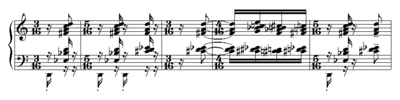
4 bars from the Rite of Spring, 4 change in time signature
The "Rite of Spring" ending the evening in startling fashion.  Honestly I didn't know much about it other than the changes in time signature are legendary.  In the pre-concert chat I was reminded it was actually a ballet, the premiere of which was also legendary for "provoking the most notorious riot in twentieth century music" (as per the program notes).   I wasn't sure what to expect, but really wasn't expecting what it was or the subject matter (Part 2: The Great Sacrifice involves maidens performing secret rites with one doomed to die).  There were disjointed melodies that seemed to come out of nowhere and disappear without feeling complete.  Some of them were beautiful and lyrical while some of them were very dissonant.   The dynamic range was well varied.  I can now say I've seen and heard another of the classics.

Sunday, November 25, 2012

Beethoven Triple Concerto

There's a wonderful magazine in Toronto about all things music called The WholeNote.  Each month they publish, there's a Music's Child feature.  On this page is a picture of a musician as a child, and a rhyme or short clue about them.  Readers then take their best guess as to who the person might be.  The remainder of the page contains an interview with the previous month's "child".  Very rarely do I have any idea who the person is, however September's was the new Toronto Symphony Concertmaster Jonathan Crow.  On a lark I sent in my guess.  I was surprised when I got an email saying that I had been one of the people to guess right and would I like tickets to the TSO concert that would feature Jonathan Crow in Beethoven's "Triple Concerto" for piano, violin and cello.  I readily accepted.  So thank you very much to The WholeNote for treating me to a night of music!

The concert on Nov. 15 was headed by TSO conductor Peter Oundjian and in addition to featuring Mr. Crow, had guest pianist Andre Laplante, and guest cellist Shauna Rolston, Canadian's all!  However, before the Beethoven, there was a piece by Pierre Mercure called "Triptyque".  Written in 1959 it was pretty good for contemporary music.  I'd like to see the score and actually compare the opening Adagio with the concluding Adagio since the final one is the exact reversal of the first, or retrograde in musical terms.

Soloists
Up next was the Beethoven.  It's an interesting choice of instruments to feature and the only concerto Beethoven wrote for multiple solo instruments.  The more prominent of the solo parts is also given to the cello, rather than the violin or piano.  The dynamic contrasts in the orchestra were exceptional, the pianissimos were barely heard.  Of the trio I think I liked the piano part the best, even if it was limited.  I heard the piece described as having some of the bubbliest music Beethoven wrote, I'm not sure I'd go that far, but it was all pleasant with a fun trading/echoing of parts between the instruments.  It was also funny that even standing on the podium given to the cellist, Ms. Rolston was about the same height as Mr. Crow who was standing on the floor.  His violin looks so small in his hands.

The evening concluded with the not often played Shostakovich "Symphony No. 12" subtitled "The Year 1917".  I've heard recordings of Symphony No. 11 and found it emotionally exhausting with the heavy and sad subject matter.  No. 12 used a few of the same themes and while the slow movements were smooth and mesmerizing I liked the finale.  The power that crashed over you with 8 basses, 5 horns, 4 trumpets, 3 trombones, 3 oboes, 3 bassoons, loud timpani and cymbals, and a full compliment of violins, violas, and celli all playing at the same time was thrilling.  It also woke me up enough for the drive back home.  It was a great conclusion to a long day.    Thanks WholeNote!
Full stage and full house, great to see
(http://thereckoner.ca)

Sunday, October 21, 2012

A Whirlwind of Music

Shamefully this is being written in November and back dated a month (wow, so behind) so it shows in the correct month drop down menu.  So way back on Oct. 14 the Toronto Symphony offered a Whirlwind of Music program.  We started in Germany with the first movement of Mendelssohn's "Italian Symphony No. 4", then moved on to Italy for Vivaldi's "Concerto for Bassoon in F Major" and Rossini's "Overture to William Tell".  After intermission we went to Austria for the "Overture to the Magic Flute" by Mozart, then back to Germany for Mendelssohn's "Konzertstuck No. 1 for Two Clarinets", before finishing the trip with the second and fourth movements of Beethoven's "Symphony No. 7".

Joshua Weilerstein
The concert was conducted by the incredibly energetic (ah, the joys of youth) Joshua Weilerstein.  He's accomplished a lot in his 24 years, completing graduate studies in conducting and violin, assistant conductor of the New York Philharmonic, and has had conducting gigs all over the world with orchestras such as the BBC Symphony, Los Angeles Philharmonic, and Danish National Symphony to name a few.  He had an excellent rapport with the audience, provided interesting tidbits about the pieces and added humour by defining an intellectual as one who can "list to the William Tell Overture without thinking of The Lone Ranger".  True not a quote created by him (wikipedia credits it to Jack Guin of the Denver Post) but fun nonetheless.

Michael Sweeney
Highlights of the concert for me started with the bassoon concerto.  I enjoy the sound of the bassoon, but often find it difficult to pick out from the full orchestra unless it has an obvious melodic line.  So it was really nice to hear principal bassoonist Michael Sweeney take centre stage.  In fact it was an embellished version of the concerto that Mr. Sweeney created himself.  A rather prolific concerto writer with over 500 to his credit and more than three dozen for the bassoon, I've always liked that Vivaldi probably wrote most of these works for the female students at the Venetian orphanage where he worked.

L: Valdepenas, R: Zhai
The spotlight continued to be on principal players when new TSO clarinetist YaoGuang Zhai joined the veteran Joaquin Valdepenas for the "Konzertstuck (or Concert Piece) for Two Clarinets".  What impeccable tone, articulation and ability they both have that showed off the versatility of this wonderful instrument (sorry, I'm biased since that's my instrument too).

Clearly I'm no intellectual because I thought of The Lone Ranger, but I had no idea the "Overture to William Tell" had four sections and is 12 minutes long!  As a whole it's a great piece, and a shame so much gets forgotten about because of the popularity of the final gallop.  It opens with a section called Prelude: Dawn featuring only the cellos and basses, then the full orchestra joins for the Storm.  The third section, Call to the Cows, is the pastorale calm after the storm and features the English horn, before  transitioning to the brass filled finale.

It was a lot of variety packed into an fun filled afternoon concert.

Wednesday, June 20, 2012

TSO Goes Outside!

For the first time in a decade the Toronto Symphony ventured outside the comfy confines of Roy Thomson Hall.  They didn't go very far, just next door to Metro Square (well ok, David Pecaut Square, it was renamed last year), but it was a departure from the norm none the less.  From what I saw and heard, it was a departure welcomed by fans.  But let's go back a bit.

June 17 was the finale of the 6th annual Toronto arts festival called Luminato.  This year is also the bicentennial anniversary of the War of 1812 which has sparked interest both north and south of the border.  It's a war both sides think they won.  In Canada it's remembered because we got to DC, burned down the White House and repelled an American invasion.  In America it's remembered for the defence of Fort McHenry in Baltimore which inspired the writing of their National Anthem.  So I was eagerly awaiting the results of a co-commissioned piece from the TSO and Baltimore Symphony Orchestra (BSO) by Philip Glass, a native of Baltimore.  How would this play out with both sides thinking they're the victors?  How patriotic a piece would an American write and would it be something Canadians could really care about?  But really there isn't anything wrong with each side winning.  No one really wins in a war, and it ended with each side occupying some of the others territory which was ultimately given back, so let's celebrate that both sides developed a stronger national pride and call it a day.

An added quirk was that this piece was receiving a joint world premiere.  Not that you'd know that from the BSO promo material, although various other US articles have mentioned the TSO.  But the 7pm BSO concert of other American music included the Glass piece as well.  It would have been fun to be a fly on the wall to see if the TSO was mentioned at the BSO concert.  They were in Toronto.

After welcoming and thank you speeches from Luminato people, and concert master Jonathan Crow (very cool to see him back again for this concert) led the orchestra tuning, the concert opened with Aaron Copland's "Fanfare for the Common Man".   Eventually the camera crew figured out what shot showed the brass so their image finally made the screen.  Hidden at the back of the orchestra with all the audience on a rather flat ground limited our view substantially.  There were a few brief imperfections, but I love this piece and it didn't hurt the overall grandeur of it.

(From Luminato facebook page)
Upon conclusion we heard piccolos in the distance.  Was this aural competition or part of the show?  The answer quickly provided itself as the players and honour guard complete with muskets marched in and up to the stage.  The audience and part of the orchestra stood while both the Canadian and American national anthems were performed (you can bet that didn't happen in Baltimore!).  I know there are some Americans in the orchestra, but I'd guess that "The Star Spangled Banner" isn't a piece Canadian Maestro Peter Oundjian has often been called upon to conduct.

As the soldiers marched away CBC personality Tom Allen announced them as the "Fort York Honour Guard ladies and gentlemen, keeping out invaders for 200 years".  And we're very thankful they did :)

Philip Glass
(www.colineatock.com)
Finally it was time for the much anticipated "Overture for 2012".  There was a video introduction by composer Philip Glass who could not have looked less energetic or enthusiastic for the piece.  Does he dislike it that much?  My gut reaction: seriously dude we helped pay you for this, the least you could do is look happy we're debuting your work!  The piece itself wasn't bad.  It was typically minimalist with lots of repetition and a brassy melodic line that transfered a bit throughout the orchestra.  There was the underlying motor of the driving incessant, not quite arpeggio rhythmic patterns.  At times it got boring, and I was hoping for a change in pattern, often one came shortly after.  It was suppose to be a 12 min long piece and seemed longer than the closer to 5 it was, which I'm not sure is a good thing.  I'll second Tim Smith's comments in his blog regarding the BSO's performance "can we get some money back?"

Tom Allen, one of the highlights of the evening with his humorous and information introductions, returned with an invitation for the audience to imagine:  To imagine that we were to go home after the concert and find a job offer waiting for us.  The job is in New York and pays six times our current salary.  So we go, and then end up leaving for a church organist position in Iowa (I wonder if it was River City?).  This is what Dvorak did.  He discovered he didn't like city live and ended up in Iowa where the entertainment one summer was an Indian Medicine Man Snake Oil type show.  He went to every one to absorb the music and incorporated the themes into his most popular symphony.  That would be Symphony No. 9 "From the New World".  The TSO then played the 4th movement.

Moving onto some Canadian music, the first piece was by Malcolm Forsyth (incidentally the father of NAC Orchestra principal cellist Amanda), and was inspired by his first trip to the barren beauty that is Canada's far north.  The orchestra played "The Dance" from his orchestral suite Atayoskewin which is the Cree word for "sacred legend".  Youtube lacked a quick search result for the piece, but the NAC musicbox came through.  Take a listen here.  At times it reminds me of Copland's "Rodeo", particularly the first few bars.

View of audience from the back of the stage
(from Luminato facebook page)
Mr. Allen then tested our knowledge with a multiple choice question, who wrote the music for Lord of the Rings?  Was it John Williams, someone else I don't remember, or the Canadian Howard Shore who won three Oscar's, scored the film Mrs. Doubtfire, and suggested the name "The Blues Brothers" to Dan Aykroyd and John Belushi?  Not a tricky question to figure out.  They played a short suite excerpt from Lord of the Rings.  Having only seen the movies once I'm not familiar with the music.  It was good, but perhaps I'd find it more epic if I knew it better.

Maestro Oundjian dedicated the next piece to all the cyclists who go wizzing around the city.  Less than 4 bars in I figured it out as "The Flying Theme" from ET.  Very fitting :)

Tchaikovsky's "1812 Overture" is a masterpiece (well in my opinion).  Mr. Allen began by describing an invasion by a force that thought they'd get in, meet little resistance, take over, and be out of there by winter.  I, along with others I'm sure, assumed he was talking about the War of 1812, until he continued by saying that was what happened with France and Russia.  France thought it would be no problem to take Moscow, and Tchaikovsky's piece is celebrating the Russian defeat of Napoleon and his army. "But the parallels are similar.  So when you hear "La Marseillaise" that's them, and the bold brassy trombones, that's us!"  I'm not sure if the TSO played the full version (the recording I have runs 17 mins and includes the rarely performed vocal part), although it sounded like they did, and it didn't feel like 17 mins.  I'm also not sure if the carillons in the final section were recorded because I couldn't see if there were chimes on stage, but if it was live they were perfect.  Often I find the sound of the bells random, but this fit and the balance was superb.  They got to the climax and would you believe it FIREWORKS shot off behind the stage!  Who needs military cannon fire?  These were impeccably on the beat, and could not have have been better!  The finale even had a few extra shots that exploded in the air rather than just the single straight up shooting star type.  A Capitol Fourth (which concludes with an abridged version of the "1812 Overture" every year as the fireworks begin) could not have done it better!!
1812 Overture Finale Fireworks
(from Luminato facebook page)
The audience was on their feet immediately, not a begrudging out of obligation or slow standing ovation from this crowd, it was the real thing.  We were treated to an upbeat encore that I couldn't name but had a stick in your head tune that stayed with us all the way home.

I hope concerts like this become a tradition with Luminato and the TSO, there was a great turnout, great music, and thankfully the rain almost held off, but the few sprinkles only resulted in the opening of umbrellas, people didn't leave.  A testament to a thrilling evening of music.