Showing posts with label Ballet. Show all posts

Saturday, November 30, 2013

Beethoven and Strauss

In my quest to hear all the Beethoven symphonies live, I attended the Toronto Symphony concert that included Symphony #4 on Nov. 20.  That was what I went for, but as usual found some other hidden gems.  The conductor for the occasion was Sir Andrew Davis, conductor laureate of the TSO.

The program opened with "Overture to The Consecration of the House".  The title struck me as familiar, yet I can't say I recognized any of the music.  Doing a bit of research I discovered I'd heard it as part of Jorma Elo's ballet Pur ti Miro performed by the National Ballet of Canada in 2010.  It's one of the few overtures Beethoven wrote that was meant to be a stand alone piece and is pretty impressive, not to mention great ballet music.

I can understand why Beethoven's 4th symphony doesn't seem to be performed all that often.   It doesn't have the same draw of #5 or scope of #9.  It's good music, but I think I needed to read more of the notes or know more about the form to deeply appreciate it.  I did like the opening where the rich chords jump keys and don't give you any idea where it's going.

Guest soprano Erin Wall joined the orchestra for "Seven Early Songs", by Alban Berg.  The songs had a nice variety with a love theme throughout.  The English translations were a welcome addition to the program.  I'm not usually a poetry person, but this series I actually read again.
Erin Wall (photo by Josh Clavir)

The evening ended with "Till Eulenspiegels lustige Streiche" (or "Till Eulenspiegel's Merry Pranks") by Richard Strauss.  This was probably my favourite of the evening.  Till Eulenspiegel was a quick witted prankster, and apparently a real German peasant who died around 1350.  What jumped out at me  was the horn solo which I'm familiar with from its use in one of my favourite versions of the "12 Days of Christmas" by the Indianapolis Symphony.  There's a story in this piece of music as well that I should have read the notes for in advance to fully appreciate.  Lessons learned for the next concert.

Professional review of the concert can be found here.

Tuesday, November 12, 2013

National Ballet of Canada Stages a Classic

I didn't want to let the opportunity to see the classic ballet Swan Lake pass by, yet not wanting to spend a considerable amount of money (ballet tickets are one of the most expensive in town), I opted to try for a rush ticket.  That didn't exactly work out but standing room did!  The absolute cheapest way to see some pretty fantastic ballet!  The rough story line of Swan Lake is well known.  My favourite version is the one told by Tchaikovsky himself (well how it could be imagined he'd tell it) in Tchaikovsky Discover's America.  There was some deviation from that since choreographers take license and obviously there are sections of music purely for the opportunity to put a solo or group number, but I enjoyed it.

Act 1 is the Hunting Ground where Siegfried (Piotr Stanczyk at the performance I saw) is melancholy even though it's his birthday.  So what else to do in a ballet, but to dance and try to cheer up the Prince.  The program notes describe the dances as "growing increasing unsettling and violent".  This is true, but one of the most exciting parts was the wench (Jordana Daumec) being thrown between the knights and servants.  There's actually only that one main female dancing part in Act 1.  The rest is a chance for the men to show their power with leaps and jumps.

What surprised me the most was that the famous theme from Swan Lake didn't have any swans dancing to it!  It is first heard in Act 2 when Benno (the Prince's friend) and Siegfried are walking through the forest going hunting for the swans.  There's not really any dancing to it at all, it's more scene change music as trees fly in and out symbolizing their travelling to the marsh.
The company (Photo by Bruce Zinger)
Now the swans get to dance, and here the artists of the ballet were awesome!  This is what I came to see, about 20 dancers in the classical white tutus floating around the stage.  We meet Odette (Sonia Rodriguez) and the duets between her and Siegfried were impressive.  If only all it took to fall in love was one dance.  In these duets the fantastic playing of the orchestra was especially apparent with cello and violin solos.  I do love how Tchaikovsky has various instruments take over a phrase and passes it around the orchestra.  The fact that it can sound like one instrument is a testament to the skill of the players.

Rebekah Rimsey as the
Hungarian Princess from a
previous performance
(photo by David Cooper)
Act 3 is in the ballroom where Siegfried is being forced to choose a wife from four princesses: Hungarian (Stephanie Hutchison), Russian (Elena Lobsonova), Spanish (Tiffany Mosher), and Italian (Shino Mori).  Each of course gets a dance and a chance to woo the Prince.  They were all good and I liked how the styles fit the country.  The Italian was my favourite though, maybe because I also recognized that bit of music (which seems to also be called the Neapolitan Dance).

Of course Siegfried has already fallen in love, so can't choose one of the princesses.  But, surprise, suddenly there's another lady, dressed in black, who looks exactly like Odette!  Unknown to Siegfried it's actually Odile, brought by the evil villain Rothbart.  Of course they dance and here Sonia was deliciously sensuous and seducing.  If Siegfried wasn't already in love with her, he would have been!  The black swan pas de duex is where the 32 fouette turns come it and to my untrained eye Sonia looked spot on.  The ballerina gets all the glory but Piotr's set of turns just after it were pretty stunning too.  (Similar choreography here, with a different ballet company)

Siegfried's choosing of Odile brings calamity as he's betrayed Odette, and a flood sweeps through killing everyone.  This was the moment where I was most awed and it was by the use of a simple piece of silk.  The silk was used as the water and was held on the sides by dancers and swept in circles causing people to be engulfed or ejected.  Then just as quickly as it appeared, Rothbart arrives, grabs the silk in the middle and it collapses in spectacular fashion as he runs off stage with it.  Simple yet so effective.

Artists of the National Ballet
(photo by David Cooper)
Back at the lakeside for Act 4, the host of swans have now turned black and dance (the famous Tchaikovsky melody reappears) while Siegfried stands at the back on the driftwood/rocks pining for Odette.  She forgives him but a storm appears.  Siegfried fights Rothbart and when the dust clears Odette is left to mourn her dead Prince.

Not a happy ending, but with the wonderful music and dancing it was a very happy way to spend an afternoon.  The National Ballet is bringing it back in March so there's still a chance to check it out if you missed it.


Friday, November 23, 2012

Alice's Adventures In Wonderland

Last season the National Ballet of Canada premiered Alice's Adventures in Wonderland, and it sold out!  So I was very pleased they decided to bring it back this year for a longer run and made plans not to miss it.

Opening with Carroll reading to Alice and her sisters
(Photo by Cylla von Tiedemann)
The evening began with the always enlightening and philosophical ballet talk by Lindsay Fischer, ballet master.  He took the audience through the various tableaus that form the basis of the story.  It began with Alice and her sisters playing while her mother is preparing for a grand tea party.  Because ballet isn't ballet without a love interest with which to dance a pas de deux, Alice and Jack, the gardener's boy, like each other.  However social norms of 1862 time period and Alice's mother, forbid her from having anything to do with Jack.  This is particularly true after she gives him a tart in return for the red rose he mistakingly put in with the white ones for her mother.  What I particularly loved was that Lewis Carroll was a guest at this party.  The "real life" part of the story wove in how the book of Alice's Adventures in Wonderland actually came about.  Carroll wrote them at the request of his friend's daughter Alice, after he was entertaining the girls for the day and told them these great stories.

Aleksandar as the White Rabbit
(Photo by Cylla von Tiedemann)
Suddenly at this party things begin to change, Carroll becomes the White Rabbit (both parts played by Aleksandar Antonijevic) and Alice follows him down the jelly dessert in the middle of the table, an interesting twist on a rabbit hole, to Wonderland.  Multi media was used well throughout the performance.  It really gave the feeling of falling into or rising out of a hole without going over the top or being overused.  The scenes of growing, shrinking, crying and floating through tears, of which my best recollections are from the Disney movie, were all there.  Sonia Rodriguez played Alice at the performance I saw and did a wonderful job of acting the little girl who eventually learns about life and grows up.

The action truly never ended.  The idea that in a good movie you don't even notice the music was so true here.  A shame in a way because the music was so good, but it fit the dance and story so well it melted in rather than stood out.  The orchestra was big with the percussion filling the entire back of the pit and there were two harps!  The White Rabbit theme reminded me of segments from Bernstien's West Side Story score.  After a crazy scene in a fiery kitchen hidden behind the innocent needlepoint claiming "Home Sweet Home", Jack returns, only as the Knave of Hearts now, with a tray of tarts.  They hide in the cottage while the bad tempered Queen of Hearts (Alice's mother) looks for him to chop off his head.

Eventually the magician at the garden party appears as the Mad Hatter.  If one wants to read into the meanings behind what Alice could be learning with each encounter, the Hatter teaches Alice about time.  One doesn't grow up just by waiting out time, because time can be divided however one wants.  This is demonstrated to great effect by having the Mad Hatter tap dance!  When was the last time you saw anything other than ballet slippers and pointe shoes at a ballet?  It was great.  In fact Rick Mercer even got in on the action for The Rick Mercer Report, where he learned a little tap.  Check it out here.

Sonia as Alice and the Cheshire cat
(Photo by Bruce Zinger)
Alice meets the cheshire cat who exists in pieces held by dancers dressed in black, so his various parts glow in the black light.  Here the mime conversation, as explained by Mr. Fischer, was the cat asking her where she wants to go.  Her response is anywhere but here.  The cat replies, then it doesn't matter which road you take.  Philosophy on the simple level, yet she learns that it's not the road that matters but you guide your own path.  Alice also takes part in the croquet game with the Queen complete with dancing flamingo croquet mallets.  In the Queen's court the corps du ballet costumes were so well done with the card tutus.
Corps as cards
(Photo by Bruce Zinger)

Jiri as the Caterpillar
(Photo by Cylla von Tiedemann)


One of the final characters Alice meets is the caterpillar, danced by Jiri Jelinek.  An exotic dance, that reminded me in a way of the Coffee dance in The Nutcracker.  It even had a more refined version of 'the worm'.

The Queen and card dancers not doing so well
(http://xlablog.blogspot.ca)
In the garden the Queen wants to display her dancing skills and has trouble finding any willing partners.  The four gentlemen reluctantly agree and each tries to get out of it by having the other take their place.  Coined the "tart adagio" (a take off of the "rose adagio" in Sleeping Beauty) it takes the real life worry of the rose adagio suiters who don't want to screw up for the prima ballerina playing Aurora, and converts that into the situation of these gentlemen not wanting to screw up and hear the horrible "off with their heads" cry.

To add some tension the Knave is accused of stealing the tarts and he and Alice have a reprise of the pas de deux from the opening tea party scene.  I like when the choreography repeats, especially a really intricate move, and this dance had that and was beautifully executed by Guillaume Cote who was playing the Knave.  Eventually Alice decides to stand up to the Queen for him, and say the Knave didn't steal any tarts, she gave it to him.  By taking a stand she pushes over the house of cards and they come falling down as she falls back up the rabbit hole and back to real life.

The ending was very well done.  It jumped to modern times with Jack and Alice, now a couple, reclining on a bench when Alice suddenly wakes up and describes the dream she just had about the book she was reading.  A gentleman walks by and Alice seems to think he's familiar.  He takes their picture, and then sits down on the bench vacated by Alice and Jack.  The curtain falls as he scratches his ear in the fashion of the White Rabbit leaving one with the question, was it really only a dream?

Saturday, March 31, 2012

The Sleeping Beauty

As part of its 60th anniversary season, the National Ballet Canada included the classic ballet, The Sleeping Beauty.  According to the always enlightning pre-ballet talk by ballet master Lindsay Fischer it is the ballet that all other classical ballet is based on because it's the only one that had the transcript saved and taken out of Russia.  No notations of the time period exist for any other ballets, so choreographers have gone back to The Sleeping Beauty as a guide book of how the originals might have been, then of course taken artistic license.

At the performance I saw Greta Hodgkinson was Aurora and a guest principal dancer with the Stuttgart Ballet, Evan McKie, was Prince Florimund.  Mr. McKie actually is from Toronto and trained at the National Ballet School.  These performances marked his first performances here as an adult.
Greta and Evan (torontoist.com)

There were some unique quirks at the performance as well, beginning with the overture.  The orchestra started playing and continued for quite a while with no curtain raising.  In fact it seemed like they even repeated a section.  A few moments later a stage hand appeared in the pit and for the first time ever I heard a professional orchestra stop playing.  An announcement was made that there were technical difficulties and to keep our seats.  About 5 minutes later, the orchestra got the signal from the stage and started again a few phrases before the curtain up cue.  This time, it went up without a hitch.  The disappointing part was that in the final act the Pas de Cinq was cut.  I assume this was because of the extra time taken due to the difficulties at the start.  The Bluebird and Pussycats still made their appearances, but there were no Diamonds, Silver, Emerald or Gold except in costuming.  Even having never seen the ballet before, it wasn't hard to put together that the different costumes and lack of those dancers having solos didn't match the program.

Tchaikovsky's score is timeless.  The Russians really knew how to write cool clarinet music.  A sentiment which is shared by National Ballet Orchestra clarinetist Max Christie.  In a recent WholeNote article he described The Sleeping Beauty music as "terrifying.  It never lets up.  [I] have to practice for it."  As for Prokofiev and his Cinderella score, Mr. Christie calls it fun because it contains "wicked stuff for the clarinet".  That was my consensus when I saw the ballet as well.

What did surprise me was that the famous musical theme, popularized in the Disney movie where it was given lyrics (Disney version here), wasn't danced by Aurora at all, but by the Corps/Ensemble at the start of the 16th birthday scene.  The most memorable part of Act 1 is the Rose Adagio.  Danced by Aurora it contains a series of balances that take a lot of guts on the dancer's part as well as demonstrate that Aurora is growing up and being able to handle a more balanced life.  They were all well executed by Ms. Hodgkinson.  There were a few other variations that I found especially exciting as well.  One was the Fifth Fairy Variation.  It's danced with index fingers outstretched, the idea being that it represents electrodes and she is giving the gift of energy and vitality to the baby princess.  The end of the Sixth Variation features a very challenging hop and pirouette type step performed repeatedly.  This fairy is giving the princess the gift of grace; both grace in elegance and grace under pressure, since the dancer has to make it look like the dance is no challenge at all and she did an excellent job.

I also liked the Naiads number with the Corps de Ballet.  The patterns they created were very unique.
National Ballet of Canada
Now if only finding a prince was as easy as falling asleep and waiting!

Wednesday, December 28, 2011

Tchaikovsky's The Nutcracker

The current National Ballet of Canada's version of The Nutcracker was created in 1995 by choreographer James Kudelka.  I saw this version shortly after it debuted, and wasn't too impressed.  The story line has been twisted from what I'd call "the original" (although there have been so many variations, maybe there is no more "original"), and at that point having a party in a barn seemed completely weird and out of place.  Now, 17 years later, I figured it was time to give it another shot.  Plus who can resist the fantastic Tchaikovsky score performed live?

(national.ballet.ca &
theballetbag.com)
At the Dec. 15 performance the Sugar Plum Fairy was principal dancer Greta Hodgkinson and Peter, a stable boy (aka: cavalier/the Prince in the second act), was Steven McRae.  He is a guest artist from The Royal Ballet who also appeared with the National Ballet last season in Alice in Wonderland.

(ontariotravelblog.com)
Prior to the performance was a short skit by a grown up Misha and Marie (the two children replacing Clara and Fritz in this version) who recall the magical Christmas Eve that we, the audience, are about to see.  It was a great intro for children to the story (and for people who were expecting "the original").


(thestar.com)
Uncle Nikolai (danced by an unrecognizable Robert Stephen under the beard, hat, and 10lb costume) takes the place of Drosselmeyer, although is just as eccentric a character.  His female counterpart is the children's nurse, Baba (Alejandra Perez-Gomez)  This couple become a duke and empress in Act 2.  Other than some swapping of characters, and relocation to a barn, the party is still the majority of Act 1, followed by the growing Christmas tree and Mouse King fight.  What I do miss at the party is the duet of the wind up dancing dolls presented by Drosselmeyer.  This versions speciality party dance numbers involve a horse, and another with two bears (one on pointe shoes, the other on roller blades).
(cbc.ca)
Otherwise, the children dance, the adults dance, and Peter dances.  In other versions I don't recall Peter being a main part of the party scene.  I remember him not really showing up until the Nutcracker magically comes alive when the clock strikes midnight.  There were some fun parts I didn't remember: the capture/release of a rat, and snow ball fight come to mind.   The mice that crawled out from under the children's beds were adorable.

(national.ballet.ca)
The snowflake waltz which closes Act 1, is one of my favourite scenes.  I adore the music, and I love they symmetry of the dancers as they create complex patterns and dance amongst each other.  Elena Lobsanova, McGee Maddox, and Aarik Wells were the Snow Queen and her Icicles trio.

Highlights in the second act were the Dance of the Sugar Plum Fairy (exquisitely executed, although hopping on one foot on pointe has got to be a killer) the Spanish Chocolate, and Arabian Coffee dances.  The double pas de deux in Coffee was very well done, there were even double fish lifts.  The Trepek involved Peter and there was no Chinese Dance.
Heather Ogden as the Sugar Plum Fairy
(theestar.com)
There was a lively segment involving chefs preparing a feast for Marie and Misha, including leaping over the table, and another adorable piece for the students of the National Ballet School as sheep.  In place of a Dewdrop Fairy, a bee started off the Waltz of the Flowers.  Peter and the Sugar Plum Fairy fall in love and the resulting pas de deux was lovely.  I'd classify it as more traditional in the purpose being to show off the ballerina, but he had plenty of other opportunities to shine.
Empress Baba and Sheep
(national.ballet.ca)
I still prefer the Royal Winnipeg Ballet's Nutcracker and wouldn't want to make this a yearly tradition, but once every 5 or so years, it's worth checking out.

Tuesday, December 6, 2011

Romeo and Juliet: The Prokofiev Ballet

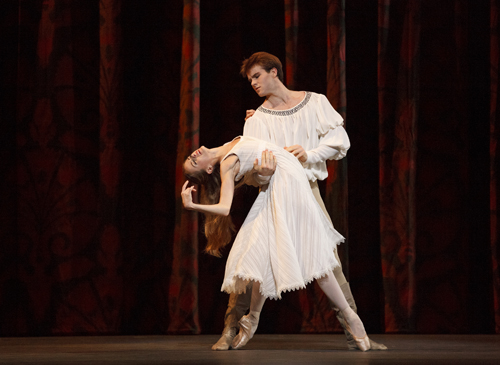
Part of the National Ballet of Canada's 60th anniversary season includes a newly choreographed, and hence world premiere, of Romeo and Juliet which I saw on Nov 20, 2011.  The choreographer is Alexei Ratmanky and it was enchanting.

My opinion of Prokofiev, based on very limited experience with his music, is that his best work is in ballet, and Romeo and Juliet trumps his score to Cinderella.  Maybe if dance was put to Symphony #5 (the only other of his works I've listened to in its entirety) I'd appreciate it more as well.

Heather and McGee as Romeo and Juliet
(national.ballet.ca)
The cast I saw included first soloist McGee Maddox as a buff, sexy Romeo, who lifted his Juliet like a doll.  He seems to have a number of lead roles this season (he's also the Prince in the upcoming Nutcracker) so perhaps a principal dancer promotion is in his future.  From what I saw, I'd say it's well earned.  Heather Ogden is beautiful and portrayed a dainty, naive Juliet.  You could believe the character development from the lighthearted playing with Lady Capulet (Joanna Ivey) and her Nurse (Alejandra Perez-Gomez) at the start to the desperately in love and heartbroken women by the finale.

The costumes were of the early Renaissance period with the ladies in long dresses and the men in puffy sleeved, rich fabric short shirt/jackets and leggings.  In one of the crowd scenes the women appeared to float across the stage since their feet were hidden and they moved so smoothly.  Really an incredible effect!

http://tapeworthy.blogspot.com
I'll just mention a few of dance highlights.  In Act 1 Romeo and his friends, Mercutio (Jonathan Renna) and Benvolio (Christopher Stalzer), attempt to sneak into the ball held by the Capulets.  The costumes with each leg of their pants a different colour added an element of humour, as did the music.  They danced all together, in pairs, and in and around each other, wearing masks of course.  Nothing at all sissy about these guys!

The balcony scene pas de deux in Act 2, obviously one of the most famous scenes in any Shakespeare play, was danced as a true partnership.  The man's job included more than just showing off the ballerina and included a variety of steps.  It was like the choreographer knew which ones would make me think "oh that was so neat, let's see it again" and repeated most of those moments.

Near the beginning of Act 2, where there's a townspeople scene that included dancers credited as Carnival Men.  These were 4 guys dressed in black and white and danced to a section of music that had a wicked clarinet part!  Apparently it's called "Dance with the Mandolins" Watching the clarinetists in the pit was amazing.  It was fast, and short, and so precisely played!

Tybalt
The sword fighting was another highlight.  Tybalt was played by principal dancer Jiri Jelinek, and you couldn't ask for a better personification.  You could tell he meant business just by the way he strutted across the stage.  It took several draws of his sword before I realized there was no sheath, yet just the way he held in by his side in one hand, it looked like it actually was hanging and he was just resting his hand on the hilt.  Jonathan Renna also acted his character well.  In fact he received a very loud ovation at the end.  He was witty and taunting towards Tybalt when fighting, just asking for it!  His first death scene was long, drawn out, very stereotypical milking the moment on stage.  It completely suited the fact that shortly after he jumped right up again as if to say "rumours of my death have been greatly exaggerated".  When he was finally killed, it was a less melodramic.

The thrust that kills Tybalt was exceptionally realistic.  A bit of the magic was lost in that he could be seen visibly breathing after he was dead.  Romeo and Juliet on the other head were completely still when they died.  Although they hadn't just danced quite as demanding a scene.  I don't recall in the play where they are actually alive at the same time in the vault.  I was expecting Romeo to find Juliet, expect that she really was dead, drink poison and die.  Then Juliet was to awaken, find him dead and stab herself.  However, after Romeo has poisoned himself but before he dies Juliet woke up.  Talk about a heart breaking moment when you realize you jumped the gun, could have lived happily ever after, and yet are dying.  The poignancy of the moment wasn't lost on the audience.

The final bows begin with Heather and McGee which was a nice touch, reassuring anyone unfamiliar with the story (is there anyone still out there like that?) or any children (there were quite a few in the audience) who might think they were really dead, that all is well.
Juliet's Bedroom scene (national.ballet.ca)
A wonderful afternoon at the ballet was had by all, even if the Four Seasons Centre was quite cold.  I think they could do with turning up the heat/down the air conditioning.  The draft at my feet left them frigid.

Monday, May 30, 2011

Billy Elliot: The Musical

Toronto has had its own company of Billy Elliot: The Musical since March 1, 2011.  I took the chance to take it in Victoria Day weekend, May 22 to be exact, and it turned out to be a particularly special performance.  Just prior to curtain it was announced that the boys who play Billy are carefully selected and train for months prior to appearing.  We were in for a significant performance as it was the world premiere of the newest Billy, Ty Forhan.  (See here for an article about his thoughts on being Billy)

I had listened to the London cast recording, but purposely avoided seeing the movie or searching for a plot summary as I wanted to truly experience everything first hand.  It resulted in quite the emotional experience.

J.P Viernes

Ty Forhan
May 29 I had the opportunity to see the show again from a closer vantage point than my earlier balcony seats, although it was off to the side.  At this performance J.P. Viernes was Billy.  First off it took some more imagination to fit an Asian boy into the English family portrayed by Armand Schultz as Billy's father and, on the 29th, the blond David Light as older brother Tony.  J.P did have the accent down though.  Ty's appearance on the other hand would have fit that mix of performers beautifully.  His older brother the week before was played by Patrick Mulvey.  Acrobatics wise and perhaps for overall quality of dancing (his turns stayed impeccably centred) I'd give the edge to J.P, but at 14, compared to Ty's 12, he's had 2 more years of training.  Both had an appealing singing voice that maintained strength though the entire show.  Accounting for everything, mostly my personal preference, and maybe because it had the inherent "wow" factor of my first time, I preferred Ty as Billy and Patrick as Tony.  Although I appreciated that David seemed to lose the thick British accent on occasion as it made the dialogue easier to understand.

Solidarity
(www.shedoesthecity.com)
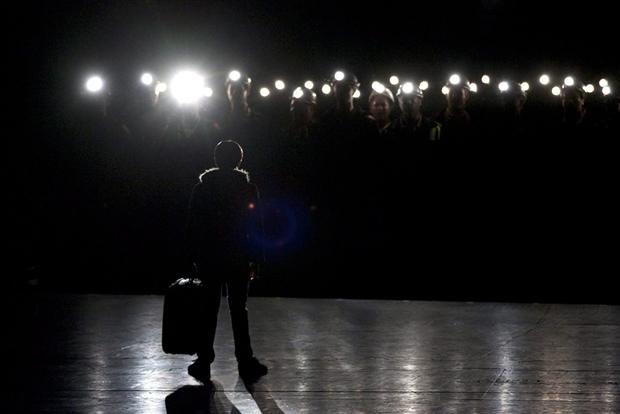
Now that the overall comparison is out of the way, I'll mention a few other highlights.  There will be further Billy comparisons in how they handled certain dances though, just warning you.  The choreography between the miners and police during "Solidarity" was the first moment that made me gasp as they jumped back and forth over batons.  The juxtaposition of placing the miners and police against the girls ballet class was striking, making this one of the great ensemble numbers.

Lightening the story after the heaviness of "Solidarity" is "Expressing Yourself" with Michael (a closeted "poof") and Billy.  Wearing his sister's clothes, Michael (Dillon Stevens the 22nd, and Jack Broderick the 29th) dresses up Billy in the most horrendous combination of patterned skirt, shirt, and sweater.  The idea to have them dance with a dress on a hanger as a partner works amazingly well as does the big finish with the oversized dancing dresses and even a pair of trousers joining in their big performance number.

Having accepted extra dance classes "Born to Boogie", follows the emotional letter song.  Emotional songs tend to be quiet, which doesn't help all the people who are trying to clean themselves up after sniffling through it (myself included).  The coughs and throat clearings are quite audible after these sections.  More with Ty than J.P I noticed the number of times Billy has to change shoes throughout this number.  He goes from running shoes to ballet slippers to tap shoes and back to runners for the backflip off the piano (which makes complete sense, I sure wouldn't want to land in ballet slippers or slip in taps).  I held my breath during the section with jump ropes.  Ty nailed the entire segment, jumping in with Mrs. Wilkinson, and tapping throughout never missing the rope.  Unfortunately it didn't go quite as well for J.P, but it didn't detract too much.   I image the shoe changing and starting of the jump rope sequence are sections the conductor watches very carefully and is prepared to put in a few bars repeat if needed to give Billy more time to finish.


www.cbc.ca
Leaping right back into the emotionally charged aspect of fights on the picket line and how it affects Billy leads to a very rhythmic (as all tap numbers should to be) "Angry Dance".  It begins with Billy in his bedroom which becomes disconnected from the set and spins around centre stage as he throws everything out of it before climbing down and being joined by the miners with plywood boards, and the police with their plastic shields and batons.  Power is the best word to describe this as Billy throws himself around and even onto the police shields.

"Merry Christmas, Maggie Thatcher" is a twist on the traditional greeting to say the least :)  Interesting the word "merry" is used, since in Briton the expression is "Happy Christmas".  Billy's dad, shows he does have a soft side, and is still dealing with sorrowful emotions as well during "Deep Into the Ground".  Armand Schultz does a great acting and singing job through the entire show.  He is able to express a lot of emotion with few words.

a2view.wordpress.com
The ballet duet to Swan Lake between Billy and his older self (Samuel Pergande who's trained with multiple ballet companies) was a highlight.  What a role for a kid!  You get to sing, dance, and fly!  I mean who could ask for anything more and they're only 12-14.  How do you follow that career wise?  Ty had a more dreamlike feel to his interpretation while J.P (and older Billy) were grinning throughout making it more about the pure joy of dancing.  Here the more refined acro aspect of J.P showed through in the cartwheels over chairs.  Initially I was thinking this was probably one of the few times a pit orchestra played Swan Lake, however being able to see the conductor on the 29th revealed it's a recording they dance to since he remained seated the whole piece.  It's unfortunate pit orchestras have been reduced to the size where they are incapable of producing the grandiose sound Swan Lake requires.

The "show stopping" number opening night was quite likely "Electricity", Billy's big solo number.  It's no wonder they alternate between 4 or 5 Billy's, it's such a full role!  The disembodied voices at the audition add an extra "scary factor" to how auditions would be.  Again Ty and J.P seemed to approach this differently, well the beginning part anyway.  Ty started out with an angry feeling, he spit out the words in reply to the "how does it feel when you dance?" question.  This makes sense to me, it had an honesty of "you've just repremanded me, are being sugary sweet in asking the question, and now you want me to explain something I don't understand".  Alternatively J.P emphasized the "I don't really know" aspect without the same element of frustration and anger.  Both boy's dancing was extremely impressive.

Spoiler Alert!
The ending when Billy is getting ready to leave for the Royal Ballet school with the entire town behind him, even though the strike is over and the minors have lost everything, is the second major tear jurking moment.  Particularly at the second viewing, I noticed that when Billy and his dad are packing the suitcase, his dad is teaching him how to fold the clothes.  Something small, simple, and otherwise insignificant that adds a whole other dimension to the layers of feelings.  He totally loves his son, and really is supportive of his dancing.  The minors singing while descending into the mine with the clattering of the cage stirs all kinds of thoughts I won't go into but it's a good thing they bring everyone back for a more upbeat finale or people would be leaving in tears.

That concludes the performance aspect comments.  In other notes, I continue to find the sets in productions I've seen recently so versatile.  Here with the extra piece for Billy's room removed, his house becomes the community centre, and an extra side segment with a mirror and closet creates Michael's room.  With everything moved out and a brick wall at the back the stage becomes the streets, or with a black background it's a mine entrance.  A fancy curtain and bare stage create the theatre for the Royal Ballet auditions.  Of particular interest was the complete reversal of a fence that let the audience change sides from the miners shouting at those crossing the picket line, to the scabs doing the crossing, without leaving their seats.  I was surprised at the amount of swearing, especially in a show children will see.  It is about miners after all, not fishermen, but evidently bad language transcends occupation.

I'm not sure I'd second the advertisement quote of "if you only see one musical this summer, make sure it's Billy Elliot" with as much enthusiasm as they do, but not knowing of any other high quality musicals on the current calender, it is definitely work checking out.  And if you're at all prone to tears, remember the tissues!

Saturday, March 26, 2011

"Everything is Beautiful at the Ballet"

Piotr and Sonia Rodriguez
(from National Ballet of Canada website)
March 9 was the opening of the National Ballet of Canada's newly re-staged version of Don Quixote.  Based on the Cervantes novel (which also inspired The Man of La Mancha) and set to a bubbly, high flying score by Ludwig Minkus it was a thoroughly enjoyable evening!  Having recently watched A Chorus Line, the title of this post is a line that came to mind several times throughout the night.

Prior to all ballets at the Four Seasons Centre for the Performing Arts is a ballet talk.  The one for this series of performances was hosted by ballet master and Don Quixote re-stager, Lindsay Fischer.  I've attended his talks before, and find them very insightful and preparatory for the following ballet.  This evenings was no exception.  He always has some interesting insight into the human spirit.  He candidly admitted to having started the book prior to a previous production, never finishing it, but forged through when Karen Kain asked him to create some new dances for this version.  Near the end he discussed how ballet is great at demonstrating relationships but not so good at expressing text.  As a result there is a fair amount of mime.  He gave us a quick primer demonstrating "I love you", "married" and one of Don Quixote's lines of "I am a seeker after nobility, and beauty, and piety.  But you don't find those women very often."  Just standing there talking, he could be anyone, but as soon as he moved his arms in demonstration there was no doubt he was a dancer!  Talk about fluidity! Full talk linked here.

I was wondering if I would understand the story, but even without the talk or reading the plot summary in the program, I needn't have worried.  The story line was quite easily followed through the dancing which was amazing.

Piotr and Greta (from Toronto Star)
The principal dancers for the evening were Greta Hodgkinson as Kitri and Piotr Stanczyk as Basilio the barber.  Basilio was scheduled to be performed by Guillaume Cote making his debut in the role.  When the announcement was made about the change prior to the performance there were audible groans and disappointed noises from the audience.  Admittedly I was looking forward to a debut performance, but really enjoyed Piotr's.

I was sitting in Ring 3, in a single chair off to the side which turned out to be an awesome location.  I could see into the orchestra pit, had a great view of David Briskin conducting (who also on occasion uses a sweeping beats 3-4, maybe it's a ballet conductor thing), and the clarinetist Max Christie (who had some lovely solos in Act 2).  Mr. Christie even managed to roll out his wrists while still playing.  I couldn't see who was in the concertmaster seat, but the program has Benjamin Bowman listed as being on leave and Akemi Mercer as the guest concertmaster.  Mr. Bowman was just announced as concert master last season, and suddenly he's on leave?  After being blown away by his performance in the ballet I attended last season (that blog is here), I was hoping to see him again.

Piotr from 2006 production
(from National Ballet of Canada website)
As for the actual dancing, well I'm certainly no expert, but I was impressed with the dancers sense of rhythm which they demonstrated through claps and snaps in addition to dance.  There's a scene were Don Quixote thinks a windmill is a gypsy and attacks it.  The windmill wasn't terribly convincing with big palm branches for blades.  The pyrotechnics after he knocks the blades off with his spear were cool though.  This then leads into Don Quixote's dream sequence where he imagines his love Dulcinea looks like Kitri who dances with wood nymphs (it's ballet, you must suspend belief).  This scene reminded me of the "Waltz of the Snowflakes" from The Nutcracker.  The dancers were all in white stiff tutus and the style seemed similar,  very pretty and dream like so the point was made.

The ballet had all the elements of a good story, acting, music, and energetic dancing by all parties.  I'm looking forward to attending more ballets.

Saturday, November 27, 2010

Back to the Ballet with Cinderella

Other than The Nutcracker, I don't think I've been to a full ballet with sets (which for the ball were sort of art deco style), fancy costumes (kind of flapper/1920's with white pointe shoe versions of Dorothy's ruby slippers), and a whole 2 hour story telling experience.

Sonia Rodriguez as Cinderella (all photos from National Ballet of Canada website)
That changed Nov. 18 when I took advantage of the National Ballet of Canada's DanceBreak program and ended up with Ring 3 seats to Cinderella.  In a surprise twist to the evening, Sonia Rodriguez danced the part of Cinderella.  I've wanted to see her perform for a while, so that was a great switch.  When I was on a Sergei Prokofiev kick a while back, I listened to the score and didn't particularly like it, but seeing the dance and watching the music being played completely changed my perspective.  The conductor for the evening was Martin West, a guest conductor from the San Francisco ballet.  Unfortunately I couldn't really see through heads to watch him very much.  Additionally I wasn't able to spot the new concertmaster Benjamin Bowman.  After seeing him perform last season as a guest soloist, I was hoping to see him again, but he didn't seem to be there.  The clarinetist though was amazing!  I had a great view of him, and will assume it was principal Max Christie.  There are so many clarinet solo type lines throughout the score and his tone, clarity and speed was perfect.  Ohhh to be able to play like that!

We arrived just in time for the pre-ballet chat with Ballet Master Lindsay Fischer.  His explanation provided more depth to the story than I ever thought possible.  While still a fairy tale, at the hands of choerographer James Kudelka it has become so much more.  Some may consider what Lindsay said reading too much into a simple story, but I like it!  Cinderella has become more than just a nice girl who doesn't do anything and ends up getting a fancy, rich life with a prince.  Instead she remembers what it's like to be loved, and shares that love with other around her.  Even after being tormented by the stepsisters and ending up on the floor crying, she offers hospitality to the old women (aka: Fairy Godmother) who can barely bend over.  A reminder that with all our problems, there's someone with more, so be grateful for what we do have and share it.

The stepsisters are not portrayed in drag as other productions sometimes have them, but maintain a self-centered attitude, unwilling to expand their horizons to anyone else.  I agree with Lindsay that it's better to chuckle at their comical ways recognizing the humour in having done similar things ourselves, rather than laughing at them, which makes us no better than how they treat Cinderella.  For example, when learning to dance (some funny moments, particularly in odd looking lifts with the dance instructor prior to the ball) or trying to attract the attention of a particular guy (they have great solos at the ball with their escorts trying to prevent them from throwing themselves at the Prince).
At the Ball

Lindsay also brought out the theme of conformity,  that today people want to conform to what society says is best, keeping up with the Jones, and getting their 15 minutes of fame.  All the ball attendees (particularly the stepsisters) are quite eager to pose for the photographer at the beginning of the ball in Act II.  The awkward movements, particularly of the men, gives a mechanical feel.  Indicating these people aren't the real thing, they're putting on what they think society wants so they can get ahead but aren't being true to themselves.  Outward beauty is the goal, rather than the inward beauty Cinderella has that extends out from her touching others.  Indeed as the garden fairies return near the end of the ball (prior to the Prince and Cinderella's pas de deux I think) they have fans and the "fake" attendees get blown away in the wind, leaving Cinderella and the Prince.  A reason was also proposed for why the Fairy Godmother tells Cinderella to leave the ball by midnight.  That being, if you stay too long amongst people who value only the material things, if can affect you as well, hence the reminder of midnight to not be negatively influenced by these people, but stay true to yourself.

Guillaume Cote as the Prince
In the end, the Prince goes around the world (which is a phenomenal sequence of dances with the Prince and his aides against a blue sky and white cloud background, where they meet individuals from various places - a Spanish dancer, a Japanese girl in a kimono, even an Amelia Earhart take off) trying to find Cinderella, and eventually finds her in his own backyard.  They reject the wealth and fame the world has to offer, content with the simplicities of a small wedding and life.  James Kudelka is quoted in the program about his creation saying, "...the ballet [shows] the possibility of creating a new and intimate world that has nothing to do with being rich and famous.  That's why it's not about the Prince elevating Cinderella to glory, as in traditional versions.  In a way, she elevates him."  Here's hoping that being open to new experiences and sharing with those around us will result in everyone meeting their special someone.  (PS:  to whoever my someone is, I'm still waiting to meet you :) )

Wednesday, November 24, 2010

TSO at the Weston

Way back on Nov. 14 (hence this will be a whirlwind review since I'm 3 concerts behind) I continued what is turning into a real music month by attending a Toronto Symphony concert in a new location with a new friend.  Several times throughout the season the TSO vacates Roy Thomson Hall in favour of the George Weston Recital Hall at the Toronto Centre for the Arts.  While paying the parking meter I ran into a few musicians actually.  I would have expected parking to be provided for them, but they were parking on the street and paying like the rest of us.  tsoundcheck tickets aren't usually offered for concerts at the Weston, but I guess they had a lot of empty seats, so we were able to attend for the cheap rate :)  Our seats were on the floor level however, and near the front which limits what you are able to see of the actual orchestra.  The stage is smaller and the musicians seemed a bit squished in places, but they were able to squeeze in a piano at centre stage for Dvorak's "Piano Concerto in G Minor".

The program opened with Glinka's lively "Overture to Rusian and Lyudmila" (a really fast version is linked here) then the piano concerto performed by  Natasha Paremski.  She played Rachmaninov's Piano Concerto #2 last season (May 2009) with guest conductor Xian Zhang, as a blonde and now is looking just as pretty as a brunette.  But that's beside the point, boy can she play!  All I know of Dvorak's is the "New World Symphony" (#9 I believe), and Peter Oundjian mentioned in his introduction that part was quoted in the concerto, I tried hard, but not knowing what part to listen to, I clearly missed hearing the quote.

Next came an odd piece.  A cello concerto written by Witold Lutoslawski in 1969/70.  I'd say I'm still working on furthering my appreciation of music from the classical and romantic eras and haven't expanded to contemproary yet because I didn't like it.  There was practically non-existent melody, lots of dissonance, and conflict.  That's the point actually.  The composer wrote "The relationship [between soloist and orchestra] is one of conflict...the orchestra provides the element of intervention, interruption, even disruption."  My favourite part was the all out brass interruption section.  Not pretty but forceful.  Colin Carr was the guest cellist, and he called this work one of the best pieces not just for cello but ever.  Well, I'm glad he has an appreciation for it, but it was lost on me.   He was extremely energetic in his playing however, going so far as to knock the first row violins music off the stand.  Good thing it was at the very end and they had finished playing.

Lastly was what I had wanted to attend for...Stravinsky's "Suite from The Firebird".  Only discovering at the NACO Gotta Dance concert a few weeks ago that The Firebird was a ballet (I don't know what I thought it was before, but I've recognized some of the themes for a while, as they tend to crop up in various places.  Fantasia and TSO Halloween concerts for example.  Oh and of course youtube.  Here are parts you may recognize) I was quite looking forward to this.  I wasn't disappointed, although it would have been more thrilling to be able to have a view of the full orchestra not just the front rows.  I have since listened to the full ballet music and it's all great!  Obviously the themes in the Suite are most recognizable, but I love the intensity and the beauty of the various sections.  Since it's a ballet it's a given there's a Prince, and he rescues Princesses with the help of this bird.  It's ballet, plots are what they will be, it's all about the music anyway :) and this ended the concert on a high note!

Sunday, November 21, 2010

NACO Off to a Dancing Start

Gotta Dance opened the NAC Orchestra Pops season on Nov. 4-6.  I'm sure this program has evolved and variations are done different places but back in 2000 Gotta Dance was also part of the season, in what could have been one of Maestro Everly's first performances with the NAC Orchestra.  Anyway, the orchestra and now Principal Pops conductor Jack Everly got a strong welcome by the audience as they began with what I've come to expect and adore at these events, an original Jack Everly arrangement titled to match the program as the "Gotta Dance Prelude".  I picked out "Shall We Dance" from the King and I, "Hernando's Hideaway" from The Pajama Game, and "I Could Have Danced All Night" from My Fair Lady.

Next came the first set of ballet music from two of Tchaikovsky's (lol, just noticed they typo'd his name in the program!) ballets: the very famous "Sleeping Beauty Waltz" (of which a vocal version is in Disney's movie and "A Chorus of Hits"), and the "White Swan" pas de deux from Swan Lake.  This was Tchaikovsky's first ballet and was a failure in it's first staging partially because the score was considered too symphonic!  Making it perfect for a symphony orchestra :)  Jack (side note:  I have an enormous amount of respect and admiration for Mr. Everly, but for the sake of brevity and having heard him introduce himself as "Jack" I'm going to start using that for these posts recognizing that we're really not that familiar and no disrespect is intended) did a brief summary of the plot preceding the pas de deux where the Prince ("there's always a Prince") goes hunting at night.  At night...hunting...bows and arrows...good thing no one requires ballets to be plausible.  However, there was a full moon and evidently "set and lighting designers love a full moon" (considering he also studied set design in university, I'd say he has the knowledge to know).  Enter Patrick Lavoie and Jillian Vanstone, artists with the National Ballet of Canada, who performed the pas de deux exquisitely.  My dance friend attended with me, so I take her word on this!  Personally I think they deserved more rousing applause, but people seemed to prefer the still to come Lombard Twins.  The "Berceuse (or Lullaby) and Finale" from Stravinsky's Firebird were part of the second half.  It appeared that Jack didn't look at a score for most of the ballet pieces, which isn't surprising given the 14 years he spent focused on that repertoire.

The stage techies then came out and "rolled up the lake" (the flooring that had been put down for the ballet dancers) getting heckled by Jack that it was taking them so long, as he described the plot of The Band Wagon.   There's so much back story that could be discussed to set up "Dancing in the Dark" though that the stage techies could have taken ages.  The movie version starred Fred Astaire and Cyd Charisse, (which is great, I highly recommend it!), while Fred and his sister Adele starred in the original Broadway musical.   Jack mentioned the autobiographical nature of the movie and Astaire's life and the original movie orchestration (which they used!) by the amazing Conrad Salinger at MGM who gave everything he did a distinct sound.   From reading Astaire's autobiography I also remember him being worried that Charisse was too tall for him as a dance partner, although with the park bench and deep knee bends used through the actual dance in the movie, it was rather hard to tell.

Next things switched from the orchestra to the "song and dance man".   Jack mentioned Dick Van Dyke as one of the last in a long line featuring the greats like Donald O'Connor (one of my favourites) and Gene Kelly (who he actually almost forgot to include).  Stephanie Cadman and Mark Cassius took on the rolls of Albert and Rosie (on Broadway played by Van Dyke and Chita Rivera) to perform "Put on a Happy Face" from Bye Bye Birdie.  Quite likely the Broadway original was better than the movie version, although Van Dyke did reprise his role and made the movie watchable.  Mark Cassius was cheery enough and succeeded in drawing his lady and the audience into the song.  He was also very pleasant and considerate when I met him in the lobby after the show (thanks to him and Stephanie for their autographs!).  Stephanie also returned in white tie and tails during the second half for a tap solo to "Shakin' the Blues Away", incorporating such quick turns she shook her hair loose of it's pins.

Dancing continued tango style with ballroom dancers Nikolai Pilipenchuk and Natalia Skorikova (who've been on Dancing with the Stars) performing to Porter's "Begin the Beguine".  Not having looked at the program just before the show and having forgotten this piece was on it, I spent the time marvelling at their dancing while trying to figure out what the song was!  Finally at intermission I was able to stop wracking my brain.  In the second half, they put their acting skills to further use in the more serious "Libertango" by Astor Piazzolla (linked to the YoYo Ma version, did you know he made a whole CD of Piazolla's music?  It's a good listen).

The Lombard Twins combination of what I'd call tap/hip hop/popping seemed to be the top audience pleaser.  They performed to "Escualo" in the first half and "Chant and Fugue" in the second, both by Piazzolla.  Concertmaster Yosuke Kawasaki had his work cut out for him with all the violin solos throughout the evening and shed his jacket for what seemed a pretty demanding roll in "Escualo" which I'd say he executed beautifully.

The orchestra took centre stage again with a suite from "Slaughter on Tenth Avenue" from Rodgers and Hart's 1930's production On Your Toes.  I'm familiar with this from it being featured in the Rodgers and Hart biopic Words and Music which had Gene Kelly (who also re-choreographed the ballet for the movie and changed the ending to have the dance hall girl and hoofer get shot) and Vera-Ellen dancing the rolls.  Check it out.

Post intermission was another Everly arrangement of "Big Band Dance Hits".  The beginning seemed to quote "Everything's Coming Up Roses" from Gypsy and the wonderful "In the Mood" also featured prominently.  The orchestra even got to shout something out in the middle, which from my own experience and from having asked the conductor himself, is often a challenge to get them to do.  They seemed to embrace it though, but I couldn't make out what was actually said.

"Jellicle Ball" from Andrew Lloyd Webber's long long running show Cats was included in the program as well.  From Jack's slightly cynical introduction I'd say he isn't a big fan of the musical, referring to how there's "always a touring production of those pussycats somewhere".  However, he conducted the piece with his usual enthusiasm and energy, and while there may be a non-existent plot (honestly I've never seen the show, however I listened to a full cast recording the week following the concert and wasn't that impressed.  Maybe it needs the context of the performance, but I'd tend to agree with reviewer Mark Andrew Lawrence "Happily the finale arrived and we are told (finally) what the point of this show is: "A cat is not a dog." I lost three hours of my life to learn that???" --full review here) the "Jellicle Ball" is a fun piece of music.

The concert concluded with "Lord of the Dance" a fantastic piece with full orchestra!  The O'hare Irish Dancers and students from the Sue Fay Healy School of Irish Dance provided the lively soft and hard shoe step dancing.

Post concert, the conductor and most of the guest dancers were kind enough to chat and sign autographs in the lobby.  Judging by the number of people waiting to share a quick word I'd say Jack is extremely well liked it Ottawa.  It was an honour to speak briefly with him and many thanks for the autograph etc. as well! It made my night :D

Sunday, June 20, 2010

Day of Firsts with Ballet and Bruckner

Thursday was a great day!  I was able to enjoy an afternoon and evening of culture :)  There is nothing better than taking advantage of the deals offered to young adults in the city of Toronto and my entire day cost less than one full price ticket to either the National Ballet of Canada or the Toronto Symphony.  For all you other young folk out there check out DanceBreak and tsoundcheck.

So lets start with the ballet.  What caught my attention was West Side Story, which is why I wanted to go.  Other than The Nutcracker I've never been to the ballet, and quite honestly I don't much care for the National Ballet's current version of The Nutcracker, and find the Royal Winnipeg's much more entertaining.  But I digress.  Since this was my first experience, I did a bit of research.  Primarily this consisted of reading the ballet notes online and listening to the music.  The other two ballets on the program were a new commission by Finnish choreographer Jorma Elo called Pur ti Miro and Jerome Robbin's Opus 19/The Dreamer.  Pur ti Miro is set to Beethoven's "Violin Concerto in D, movement III: Rondo", and "Consecration of the House Overture", while "Pur ti Miro" is from "L'incoronazion di Poppea" (The Coronation of Poppea), an opera by Claudio Monteverdi.  The Beethoven pieces were easy enough to find on youtube (versions of the concerto by Itzhak Perlman as well as a rather young Pinkus Zukerman and the Overture), and are quite lyrical and lovely to listen to by themselves.  I particularly like the joyous aspect of Perlman's performance.

Opus 19/The Dreamer is danced to another violin concerto in D major, this one by Sergei Prokofiev (who incidentally also wrote the music for the ballets Romeo and Juliet and Cinderella).  I found this on a CD from the library and honestly did not like it at all.  The ballet notes described the piece as a "brilliant concerto...dissonant, bittersweet, [an] oddly compelling work with its blend of romanticism and modernity".  Well I got the dissonant part, but not the compelling.  So I was expecting to enjoy at least the music in the first ballet and of course Bernstein's score to West Side Story.

I picked a seat in the front row, since I've never sat in the front row of any performance, and I wanted to be able to see the orchestra.  Well I needn't have worried about the second part because the pit at the Four Seasons Centre is more in front of the stage than under it making for a wonderful view from the audience.  At times there was far too much going on to take it all in with the dancers, orchestra, conductor, and even singers, providing visuals.  Through my research I also found out there was a pre-ballet talk about the various works and I'm very glad I went.  Ballet Master, Lindsay Fischer provided insight into the choreography, story lines, and artists through a very engaging and heart felt talk.

The surprise of my experience was how something can completely change when you put movement to it.  I thoroughly enjoyed Opus 19/The Dreamer.  The violin soloist, Benjamin Bowman, was phenomenal in both Pur ti Miro and Opus 19.  So, I would probably have had a new appreciation for Prokofiev's piece just with that; however, add the abstract story of the ballet and it was incredible.  The music and movement fit so well that it all came alive!  Abstract or not I understood more of the searching and yearning to fit in showcased in Opus 19, than I did the more narrative story of Nero, the emperor, and Poppea, his mistress, in Pur ti Miro.  Granted the pas de deux between Tanya Howard and Jiri Jelinek was beautiful and the lifts throughout were breathtaking, but I didn't feel like she really loved him.  Maybe she didn't and that's the point, but he looked at her loving, while she looked at him almost with distain.

West Side Story was fun, and lively and everything it should be.  The conductor, David Briskin, was enjoyable to watch, sang along at parts and at times had a similar beat style to my favourite conductor :)  One dancer fell in "The Prologue" as the guys were skidding across the stage, although he was up again so quickly you almost had to second guess if it actually happened.  I imagine that's a very shocking experience for a dancer.  A nice job was done of singing and acting "America" by Jordana Damec as Anita and Stephanie Hutchison as Rosalia.  These dancers are obviously very multi-talented!

Several hours later, the evening began at Roy Thomson Hall for what was originally marketed as Yannick and Yundi.  Yundi, a Chinese pianist who recently won the Warsaw Chopin competition was to play Chopin's "Piano Concerto No. 1 in E Minor", with Yannick Nezet-Seguin conducting.  The evening was completed with Bruckner's 9th Symphony.  Unfortunately, Mr. Nezet-Seguin (who I was looking forward to seeing) was unable to make it due to scheduling conflicts, so with 9 days notice another French-Canadian conductor Jean-Marie Zeitouni, stepped in.  He conducted "The Messiah" this past Christmas.

This was also my first experience with Bruckner.  I've heard various interviews which give the impression he is the epitome of classical music, and while technically I'm working backwards by hearing his final, unfinished symphony first, might as well start with the one that would showcase all his experience.

There was a fair amount of dynamic contrast and the piece progressed at a lively tempo, so it certainly wasn't boring.  Near the ending there were repetitive notes in the strings and horns which got a little dry though.  The sound from the four French horns sounded so much louder than usual, which I assumed was because I was sitting in the choir loft directly above them (great place to watch the conductor from and Mr. Zeitouni was very expressive making it quite entertaining).  Then when leaving I noticed there were four other horns sitting behind them!  No wonder the principal clarinet (side note: he appeared to use a synthetic reed) put in an ear plug when the volume increased.  It was also neat to see that of the full stand of mallets/sticks laid out the timpani player used at least 4 different sets.

In conclusion, I think I like Bruckner and will go searching for his other symphonies.  Unfortunately, both the TSO and National Ballet seasons are drawing to a close, so for the summer months this blog might expand more to CD/movie reviews.  Stay tuned!