Friday, November 30, 2012

Montreal Symphony in Toronto

New Maison Symphonic.  Similar in look to The Four Seasons
Centre in Toronto.   They are both designed by architect
Jack Diamond (www.azuremagazine.com)
This season, in addition to having an exchange of venue with the National Arts Centre Orchestra, the Toronto Symphony also has one with the Montreal Symphony Orchestra.  On November 21, the MSO was at Roy Thomson Hall, and the previous Sunday the TSO was trying out the new Maison symphonique in Montreal.

The evening of the 21st started with the always interesting pre-concert chat hosted by Rick Philips.  This evening he had MSO conductor, Kent Nagano as a guest.  They discussed Haydn's work and how it has fallen off the programming radar of the larger orchestras in recent years.  Nagano described how he had this great idea to do a Haydn cycle.  He was all excited and pitched it to the box office and marketing departments.  Unfortunately they were less than enthused not being sure how to sell that sort of concert.

(www.last.fm)
The Haydn on our program was Symphony No. 94 "Surprise".  It's one of the first of the last group he wrote (104 symphonies in total) referred to as the London Symphonies.  Getting the okay to actually program a series of Haydn works, the next issue to tackle by Maestro Nagano was, what do you pair with them?  His choices for the "Surprise" were "An Orkney Wedding, with Sunrise", and "Le Sacre du printemps" ("The Rite of Spring").  He programmed these selections because they also have dance themes that can be bombastic and beautiful, and perfectly complete ideas and ones that leave you hanging.

The symphony opened with an Adagio cantabile first movement and light airy theme.  The second movement begins innocently enough, although I imagine the entire audience was on the edge of their seats awaiting the "surprise".  The sudden fortissimo about 30 seconds in occurred, but I was underwhelmed by it.  The pianissimo just before the section was so excellent that I think the forte could have had a real punch to it, but given the anticipation of the moment I was expecting more.

I believe at least part of "An Orkney Wedding, with Sunrise" was on a TSO program not that long ago. (The Last Night of the Proms from June 2011 to be exact)  The comma in the title makes me giggle, as if the piece was too short so the "with sunrise" was an afterthought.  The humour in this piece has to do with the deterioration of the dance theme as it goes from the flute, clarinet, oboe, bassoon and violin depicting the results as the amount of whiskey ingested by the wedding guests increases.  I like how the strings can mimic the sound of bagpipes.  The final call of the real bagpipes, decrescendo as the night fades and crescendo as morning breaks completes the picture.

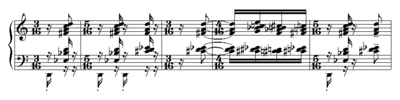
4 bars from the Rite of Spring, 4 change in time signature
The "Rite of Spring" ending the evening in startling fashion.  Honestly I didn't know much about it other than the changes in time signature are legendary.  In the pre-concert chat I was reminded it was actually a ballet, the premiere of which was also legendary for "provoking the most notorious riot in twentieth century music" (as per the program notes).   I wasn't sure what to expect, but really wasn't expecting what it was or the subject matter (Part 2: The Great Sacrifice involves maidens performing secret rites with one doomed to die).  There were disjointed melodies that seemed to come out of nowhere and disappear without feeling complete.  Some of them were beautiful and lyrical while some of them were very dissonant.   The dynamic range was well varied.  I can now say I've seen and heard another of the classics.

Sunday, November 25, 2012

Beethoven Triple Concerto

There's a wonderful magazine in Toronto about all things music called The WholeNote.  Each month they publish, there's a Music's Child feature.  On this page is a picture of a musician as a child, and a rhyme or short clue about them.  Readers then take their best guess as to who the person might be.  The remainder of the page contains an interview with the previous month's "child".  Very rarely do I have any idea who the person is, however September's was the new Toronto Symphony Concertmaster Jonathan Crow.  On a lark I sent in my guess.  I was surprised when I got an email saying that I had been one of the people to guess right and would I like tickets to the TSO concert that would feature Jonathan Crow in Beethoven's "Triple Concerto" for piano, violin and cello.  I readily accepted.  So thank you very much to The WholeNote for treating me to a night of music!

The concert on Nov. 15 was headed by TSO conductor Peter Oundjian and in addition to featuring Mr. Crow, had guest pianist Andre Laplante, and guest cellist Shauna Rolston, Canadian's all!  However, before the Beethoven, there was a piece by Pierre Mercure called "Triptyque".  Written in 1959 it was pretty good for contemporary music.  I'd like to see the score and actually compare the opening Adagio with the concluding Adagio since the final one is the exact reversal of the first, or retrograde in musical terms.

Soloists
Up next was the Beethoven.  It's an interesting choice of instruments to feature and the only concerto Beethoven wrote for multiple solo instruments.  The more prominent of the solo parts is also given to the cello, rather than the violin or piano.  The dynamic contrasts in the orchestra were exceptional, the pianissimos were barely heard.  Of the trio I think I liked the piano part the best, even if it was limited.  I heard the piece described as having some of the bubbliest music Beethoven wrote, I'm not sure I'd go that far, but it was all pleasant with a fun trading/echoing of parts between the instruments.  It was also funny that even standing on the podium given to the cellist, Ms. Rolston was about the same height as Mr. Crow who was standing on the floor.  His violin looks so small in his hands.

The evening concluded with the not often played Shostakovich "Symphony No. 12" subtitled "The Year 1917".  I've heard recordings of Symphony No. 11 and found it emotionally exhausting with the heavy and sad subject matter.  No. 12 used a few of the same themes and while the slow movements were smooth and mesmerizing I liked the finale.  The power that crashed over you with 8 basses, 5 horns, 4 trumpets, 3 trombones, 3 oboes, 3 bassoons, loud timpani and cymbals, and a full compliment of violins, violas, and celli all playing at the same time was thrilling.  It also woke me up enough for the drive back home.  It was a great conclusion to a long day.    Thanks WholeNote!
Full stage and full house, great to see
(http://thereckoner.ca)

Friday, November 23, 2012

Alice's Adventures In Wonderland

Last season the National Ballet of Canada premiered Alice's Adventures in Wonderland, and it sold out!  So I was very pleased they decided to bring it back this year for a longer run and made plans not to miss it.

Opening with Carroll reading to Alice and her sisters
(Photo by Cylla von Tiedemann)
The evening began with the always enlightening and philosophical ballet talk by Lindsay Fischer, ballet master.  He took the audience through the various tableaus that form the basis of the story.  It began with Alice and her sisters playing while her mother is preparing for a grand tea party.  Because ballet isn't ballet without a love interest with which to dance a pas de deux, Alice and Jack, the gardener's boy, like each other.  However social norms of 1862 time period and Alice's mother, forbid her from having anything to do with Jack.  This is particularly true after she gives him a tart in return for the red rose he mistakingly put in with the white ones for her mother.  What I particularly loved was that Lewis Carroll was a guest at this party.  The "real life" part of the story wove in how the book of Alice's Adventures in Wonderland actually came about.  Carroll wrote them at the request of his friend's daughter Alice, after he was entertaining the girls for the day and told them these great stories.

Aleksandar as the White Rabbit
(Photo by Cylla von Tiedemann)
Suddenly at this party things begin to change, Carroll becomes the White Rabbit (both parts played by Aleksandar Antonijevic) and Alice follows him down the jelly dessert in the middle of the table, an interesting twist on a rabbit hole, to Wonderland.  Multi media was used well throughout the performance.  It really gave the feeling of falling into or rising out of a hole without going over the top or being overused.  The scenes of growing, shrinking, crying and floating through tears, of which my best recollections are from the Disney movie, were all there.  Sonia Rodriguez played Alice at the performance I saw and did a wonderful job of acting the little girl who eventually learns about life and grows up.

The action truly never ended.  The idea that in a good movie you don't even notice the music was so true here.  A shame in a way because the music was so good, but it fit the dance and story so well it melted in rather than stood out.  The orchestra was big with the percussion filling the entire back of the pit and there were two harps!  The White Rabbit theme reminded me of segments from Bernstien's West Side Story score.  After a crazy scene in a fiery kitchen hidden behind the innocent needlepoint claiming "Home Sweet Home", Jack returns, only as the Knave of Hearts now, with a tray of tarts.  They hide in the cottage while the bad tempered Queen of Hearts (Alice's mother) looks for him to chop off his head.

Eventually the magician at the garden party appears as the Mad Hatter.  If one wants to read into the meanings behind what Alice could be learning with each encounter, the Hatter teaches Alice about time.  One doesn't grow up just by waiting out time, because time can be divided however one wants.  This is demonstrated to great effect by having the Mad Hatter tap dance!  When was the last time you saw anything other than ballet slippers and pointe shoes at a ballet?  It was great.  In fact Rick Mercer even got in on the action for The Rick Mercer Report, where he learned a little tap.  Check it out here.

Sonia as Alice and the Cheshire cat
(Photo by Bruce Zinger)
Alice meets the cheshire cat who exists in pieces held by dancers dressed in black, so his various parts glow in the black light.  Here the mime conversation, as explained by Mr. Fischer, was the cat asking her where she wants to go.  Her response is anywhere but here.  The cat replies, then it doesn't matter which road you take.  Philosophy on the simple level, yet she learns that it's not the road that matters but you guide your own path.  Alice also takes part in the croquet game with the Queen complete with dancing flamingo croquet mallets.  In the Queen's court the corps du ballet costumes were so well done with the card tutus.
Corps as cards
(Photo by Bruce Zinger)

Jiri as the Caterpillar
(Photo by Cylla von Tiedemann)


One of the final characters Alice meets is the caterpillar, danced by Jiri Jelinek.  An exotic dance, that reminded me in a way of the Coffee dance in The Nutcracker.  It even had a more refined version of 'the worm'.

The Queen and card dancers not doing so well
(http://xlablog.blogspot.ca)
In the garden the Queen wants to display her dancing skills and has trouble finding any willing partners.  The four gentlemen reluctantly agree and each tries to get out of it by having the other take their place.  Coined the "tart adagio" (a take off of the "rose adagio" in Sleeping Beauty) it takes the real life worry of the rose adagio suiters who don't want to screw up for the prima ballerina playing Aurora, and converts that into the situation of these gentlemen not wanting to screw up and hear the horrible "off with their heads" cry.

To add some tension the Knave is accused of stealing the tarts and he and Alice have a reprise of the pas de deux from the opening tea party scene.  I like when the choreography repeats, especially a really intricate move, and this dance had that and was beautifully executed by Guillaume Cote who was playing the Knave.  Eventually Alice decides to stand up to the Queen for him, and say the Knave didn't steal any tarts, she gave it to him.  By taking a stand she pushes over the house of cards and they come falling down as she falls back up the rabbit hole and back to real life.

The ending was very well done.  It jumped to modern times with Jack and Alice, now a couple, reclining on a bench when Alice suddenly wakes up and describes the dream she just had about the book she was reading.  A gentleman walks by and Alice seems to think he's familiar.  He takes their picture, and then sits down on the bench vacated by Alice and Jack.  The curtain falls as he scratches his ear in the fashion of the White Rabbit leaving one with the question, was it really only a dream?

Sunday, October 21, 2012

A Whirlwind of Music

Shamefully this is being written in November and back dated a month (wow, so behind) so it shows in the correct month drop down menu.  So way back on Oct. 14 the Toronto Symphony offered a Whirlwind of Music program.  We started in Germany with the first movement of Mendelssohn's "Italian Symphony No. 4", then moved on to Italy for Vivaldi's "Concerto for Bassoon in F Major" and Rossini's "Overture to William Tell".  After intermission we went to Austria for the "Overture to the Magic Flute" by Mozart, then back to Germany for Mendelssohn's "Konzertstuck No. 1 for Two Clarinets", before finishing the trip with the second and fourth movements of Beethoven's "Symphony No. 7".

Joshua Weilerstein
The concert was conducted by the incredibly energetic (ah, the joys of youth) Joshua Weilerstein.  He's accomplished a lot in his 24 years, completing graduate studies in conducting and violin, assistant conductor of the New York Philharmonic, and has had conducting gigs all over the world with orchestras such as the BBC Symphony, Los Angeles Philharmonic, and Danish National Symphony to name a few.  He had an excellent rapport with the audience, provided interesting tidbits about the pieces and added humour by defining an intellectual as one who can "list to the William Tell Overture without thinking of The Lone Ranger".  True not a quote created by him (wikipedia credits it to Jack Guin of the Denver Post) but fun nonetheless.

Michael Sweeney
Highlights of the concert for me started with the bassoon concerto.  I enjoy the sound of the bassoon, but often find it difficult to pick out from the full orchestra unless it has an obvious melodic line.  So it was really nice to hear principal bassoonist Michael Sweeney take centre stage.  In fact it was an embellished version of the concerto that Mr. Sweeney created himself.  A rather prolific concerto writer with over 500 to his credit and more than three dozen for the bassoon, I've always liked that Vivaldi probably wrote most of these works for the female students at the Venetian orphanage where he worked.

L: Valdepenas, R: Zhai
The spotlight continued to be on principal players when new TSO clarinetist YaoGuang Zhai joined the veteran Joaquin Valdepenas for the "Konzertstuck (or Concert Piece) for Two Clarinets".  What impeccable tone, articulation and ability they both have that showed off the versatility of this wonderful instrument (sorry, I'm biased since that's my instrument too).

Clearly I'm no intellectual because I thought of The Lone Ranger, but I had no idea the "Overture to William Tell" had four sections and is 12 minutes long!  As a whole it's a great piece, and a shame so much gets forgotten about because of the popularity of the final gallop.  It opens with a section called Prelude: Dawn featuring only the cellos and basses, then the full orchestra joins for the Storm.  The third section, Call to the Cows, is the pastorale calm after the storm and features the English horn, before  transitioning to the brass filled finale.

It was a lot of variety packed into an fun filled afternoon concert.

Sunday, October 14, 2012

Some Enchanted Evening with the TSO

Tuesday evening the Toronto Symphony opened its Pops Concert Series with new Principal Pops Conductor Steven Reineke at the helm for an evening of Rodgers and Hammerstein hits.  At first glance in the new, all glossy pages program (which had the side effect of condensing the piece order list to 1/2 a page!) I wasn't entirely thrilled with the pieces listed.  It seemed like a rehash of what's typically done at Pops concerts.  However my opinion changed once things got started.  While some of the these pieces are well worn and typical fare the vocalists made them come alive again!  Additionally some pieces often done by soloists were done by the choir combination of the Orpheus Choir of Toronto and the University of Toronto MacMillan Singers.  There were even a few included that often get overlooked.  "We Kiss in a Shadow" for example,  I don't recall ever hearing before. Obviously it's been a LONG time since I've watched The King and I.

The arc to the evening was chronological.  Reineke briefly described the plots of each musical and mentioned some of the historical significance Carousel and South Pacific had being the first to include subject matter regarding abuse, sexism and racism.

Ashley and her husband Daniel
looking lovely at their wedding
( www.patsybrownblog.com)
I have no complaints about any of the singers, they all had good voices, Ashley Brown though is spectacular!  Just wow!  She looked stunning as well in two lovely gowns.  Total side note: I couldn't help noticing a ring I didn't remember before.  Turns out she's been married almost a year (thanks google) and congrats Ashley!

I've heard her before and was so excited she was going to be coming to Toronto.  In fact all the singers were making their TSO debut.  In addition to Ashley was Aaron Lazar, and it was great to see Canadian talent on the program with Jonathan Estabrooks (see his interview regarding this concert here).

The choirs were highlighted as well, beginning with "It's Grand Night for Singing".  They also got to show off their whistling skills in their other main numbers "There is Nothin' Like a Dame" and "I Whistle a Happy Tune".  "Nothin' Like a Dame" was probably the most enjoyable selection as they passed around a mike singling out individual lines.  There was one guy in the front row who stood out even before his solo with his apparent enjoyment and great expressions.  It's great fun watching people like that.  Back in the audience, I don't think the young gentlemen in front of me had heard the song before because he was cracking up at some of the more humerous lyrics.

Carousel was apparently Richard Rodgers favourite musical and is Reineke's as well.  Here Ashley embraced a variety of vocal styles from the twang of "June is Bustin' Out All Over" to the serious romantic "You'll Never Walk Alone".  Later in The King and I section she shared the loving romantic "I Have Dreamed" with Jonathan for probably my favourite piece of the evening.  Such a wonderful combination of melody and voices.

Jonathan (operatoonity.com)
While a bit repetitive with the gestures in "Soliloquy", Jonathan showed impressive stamina throughout the 7.5 minute long song, which follows the character's wondering over all the fun he could have with a son, lamenting that his child may be a girl,  deciding that might not be so bad after all, and resolving to do all he can to support her!  I think it's one of the first times I haven't been bored by the full version and the ending was just as powerful as the start.

Aaron Lazar
(www.phototv.fr/aaron-lazar.html)
South Pacific selections in the second half allowed Aaron to reprise his Lt. Cable days (he performed the part at the Hollywood Bowl) with a nice rendition of "Younger than Springtime".   Jonathan got the ever popular "Some Enchanted Evening".  If I closed my eyes at the start of "A Wonderful Guy" I could have sworn it was Kelli O'Hara singing.  It diverged from there, but Ashley started out so similarly.

It's always nice when the orchestra gets its chance to be centre stage as well.   Here they were featured in the opening "Orchestral Interlude" which included segments of songs that weren't elsewhere in the show such as "Everything's Up to Date in Kanses City" (from Oklahoma) and "Shall We Dance?" (from The King and I).  The second half opened with the "Waltz" from the 1957 made for TV movie Cinderella.  Rodgers and Hammerstein took that project just to work with Julie Andrews and we all know what became of that collaboration.  It was a nice to hear the waltz live with full orchestra and I had forgotten that "10 Minutes Ago I Met You" was part of it.  I couldn't resist quietly singing along.  It was actually the Lesley Anne Warren remake from 1965 that I grew up watching and remember having to fast forward the commercials.

Hill Twirl
(www.the-sound-of-music-guide.com)
The evening concluded with the final R and H collaboration The Sound of Music.  The "Prologue and the Sound of Music" performed were the arrangement from the film.  It's been a while since I watched it but the start of "Prologue" sounded like dissonant contempoary music at times, with the flitty flutes (reminiscent of birds) and chime of church bells.  The horns calling with the mellow opening line "what will this day be like, what will my future be" in "I Have Confidence" was just enough to pull it back into context.  When Ashley walked to the front of the stage to start "The Sound of Music" I was so hoping she'd do the Julie Andrews twirl at the top of the hill, but she didn't.

After Jonathan's "Edelweiss" solo he invited the audience to participate in the second time through.  Nothing beats singing with full symphony orchestra!  The vocalists then all joined together for the concert conclusion "Climb Ev'ry Mountain".

After a standing ovation and several sets of bows, the orchestra returned to their seats for an encore (yay!) of "Do Re Mi".  At the first line from the choir of "Let's start at the very beginning" there was applause and cheers from the audience!  I absolutely agree it would have been no trouble to sit through the entire concert again.

I will venture that the A-list of symphonic pop artists isn't huge (well ok, maybe it is, but I've only been exposed to a limited number, so still think it's small) and Reineke and Ashley have worked together before so let's hope that this is only the beginning of her collaborations with the TSO.  Hmm, how about a dream team concert?  My votes go to Hugh Panaro, Ashley Brown and Ben Crawford...could you imagine an evening with them...heavenly!

Kudos also to the sound mixer.  It was perfect!  The singers didn't sound over amplified that I've sometimes noticed before, and their voices were melded beautifully with the orchestra.

Tuesday, July 31, 2012

Beauty and the Beast

NETworks touring production of Disney's Beauty and the Beast was recently in Toronto.  This one I wasn't going to miss.  I have fond memories of the previous incarnation back in 1995 at the Princess of Wales Theatre.  That might have actually been my first time in that theatre.  The recent version was brought by Dancap, not Mirvish and there were some large differences.

By its nature a touring production is generally not as elaborate as one settling into a location for a more lengthy run than a few weeks, but being familiar with the latter it's hard to get the preconceived notions out of my head.  Additionally I am intimately familiar with the music on the Broadway cast recording, so the first thing that hit me was the lack of lush and full sound in the overture.  With a grand total of 6 strings (2 each of violin, cello and bass), 2 brass (trumpet and French horn), 6 reeds, keyboards, and percussion in the pit, there's just no competing with the larger orchestra that would have been used in studio.  Next up was the different narrator in the "Prologue".  The haunting voice and ending vocal sneer at "for who could ever learn to love...a Beast?" was sorely lacking.

The village set
(toronto.broadwayworld.com)
The smaller, simpler sets worked well enough, just not what I was expecting.  The curtain as the castle door was rather flimsy looking given it is suppose to be a fortress, and the town street of three houses/businesses that kept swirling around had a dizzying effect.

tower/balcony during
rehearsal
(www.revamp.com)
The inside of the castle had twisted vine type stairs that were interesting since at first glance you weren't sure how it would be used, the stairs were hidden within the twists.  However, these flipped around regularly as well, making it look like they were making the most out of the little they had.  It worked for the Beast's "If I Can't Love Her" solo to close Act One when he climbed the tower inside then the set flipped around and it wasn't that hard to imagine he was outside on a balcony.

various portals during rehearsal including colourful books
(www.revamp.com)
In contrast, the second act library scene lost the grandeur of a huge library by having brightly coloured books on portal drapes fly in.  There was only a small shelf of books behind Belle and the Beast during the reading of King Arthur that fit the characteristics of the rest of the sets.

Be Our Guest number
(toronto.broadwayworld.com)
As scenes go "Be Our Guest" was the one that most closely resembled the original I remember, complete with audience showering ticker tape.  What I did miss was Cogsworth calling out "oh no, not the kick line" just before the end.

Emily as Belle
(www.showbizdeluxe.com)
The costumes were impressive, particularly Belle's golden ball gown.  The enchanted objects were pared down slightly which didn't have a negative effect except for Cogsworth.
L: Costume on Broadway
(disneymusicalgallery.tumblr.com)
R: Costume similar to tour
(www.news4uonline.com)

The brown velour type material looked a bit tacky, and I think a larger real clock portion could have helped.  However, James May was a great Cogsworth.

Michael as Lumiere
(toronto.broadwayworld.com)
Lumiere's flaming hands used the 'blow air on material with an orange light to create fire' type look (a more technical description I'm sure exists I just don't know what it is).  This could have been more convincing if the colour wasn't quite so orange and if the flame extended further beyond the wick.  While Michael Haller had the candlestick characteristics down, he also added a rather thick French accent making him difficult to understand at times.

Matt as Gaston
(toronto.broadwayworld.com)
I was not disappointed by the vocal talent though.  Matt Farcher as Gaston had the necessary biceps, cleft in his chin (real or drawn in, it was hard to tell) and a glorious voice (my favourite of the voices actually) which made "Me" and "Gaston" some of the highlight numbers.  Of course the dancing in the bar has stuck with me since I saw the original show.  I love the idea of having the mugs act like tap shoes for the hands.  Fantastic choreography!

Dance in the bar (toronto.broadwayworld.com)
Jimmy Larkin as Lefou was very bouncy and I'll guess it was the same actor who gave the enchanted carpet his athletic twists and flips in"Be Our Guest".  I found William A. Martin unconvincing in the role Maurice.  His gray hair and bushy eyebrows looked fake which probably didn't help, but I just didn't buy him as Belle's father.

The lovely Emily as Belle and Dane as the Beast
(broadwaycritic.files.wordpress.com)
As for the title characters...Emily Behny was a true beauty in the role of Belle.  Her voice could sound a bit shrill at times, but perhaps that was due to a microphone/amplification issue.  She soared over the final notes in "Home" effortlessly.  There was also an extra song in the second half I hadn't heard before.  After the Beast lets Belle go and she's back at the cottage with her father she sings "A Change In Me".  It was added in 1998 when Toni Braxton played Belle and it stayed in the show.  It shows Belle's character has been changed as well, not just that of the Beast.

Dane as the Beast
(toronto.broadwayworld.com)
And how about that Beast...while I wouldn't perhaps classify Dane Agostinis as your drop dead gorgeous leading man (although he looks more so the part in real life than as the Prince at the end, probably the long haired wig), I enjoyed his voice and portrayal of the Beast.  When he got to the low register in "If I Can't Love Her" I got shivers.  The higher ending of the song didn't come quite as naturally and I'm not sure I completely believed he was tormented at having no hope of loving someone.  He didn't seem devastated enough, but I'll take that rather than having it over acted.

In conclusion I'm glad Dancap had the show stop in Toronto and I'm glad I took the opportunity to see it.  If the rumours I've heard are true that Dancap isn't going to continue next season, their contribution to the Toronto theatre scene will be sorely missed.


Monday, June 25, 2012

Diamond Jubilee Proms

The Toronto Symphony 90th anniversary season concluded (well practically, there was one more concert featuring the guest trumpet soloist a few days later) June 20th with the standard The Last Night of the Proms.  This year there was the added theme of celebrating the Queen's Diamond Jubilee year.  As I've been very lax in getting this written, it covers highlights only.

Conductor Bramwell Tovey, who was absent last year, was back and making her TSO debut was trumpeter Alison Balsom.  Rounding out the cast were soprano Laura Whalen and baritone James Westman.

The concert opened with a special appearance by the Fort York Honour Guard and Fife and Drum group who stood guard on stage during "O Canada" and "God Save the Queen".  The orchestra then continued with the "Crown Imperial March" which is one of my favourites.  Maestro Tovey was very engaging with the audience, particularly the late comers as he started to tell us about the piece "most of you have just heard".  He also promoted the volunteer committee's flag selling efforts at every opportunity.

One of the most humorous parts of the evening was when he asked those in the audience who were bearers of the large flags where they were from.  The first few who proudly displayed the Union Jack or St. George's Cross were from Lake Simcoe, Bobcaygeon and Toronto.  It took a few more people to find a true Londoner.  Perhaps the best response, that even had the orchestra laughing, was "Quebec".  Tovey replied he was looking forward to hearing them sing the finale "Jerusalem".

Alison Balsom
(beta.wosu.org)
Ms. Balsom, wearing a lovely white gown, started her part of the evening festivities with the well known "Trumpet Voluntary" then moved onto the "Prayer of St. Gregory".  What an amazingly beautiful sound!  When she returned in the second half, this time in a stunning red dress, with "Casta Diva Variations from Norma" by Vincenzo Bellini I think everyone's jaw was on the floor by the end.  How anyone can play that many notes with so few breaths is astounding.  I don't know of many trumpet guest soloists, and she's definitely one worth having back.

The red, white, and blue wardrobe theme was concluded by Ms. Whalen who had the blue gown and for the finale wore the Kate and Prince William flag from last year's concert as an additional shawl. Not to be outdone was Mr. Westman.  After demonstrating his vocal skills with "The Lost Chord" and "When Britain Really Ruled the Waves" he complemented his Union Jack handkerchief by revealing his Canada flag boxers.

Luba Goy as Queen (cbc.ca)
A special guest appearance was made by Queen Elizabeth II herself (in the form of Royal Canadian Air Farce actress Luba Goy).  She was accompanied by several hobby horse riding RCMP officers who managed to keep a straight face while she chatted with Tovey and indicated "60 years is a long time to be on the throne".  It took a second for the double entrendre to sink in and the audience laughter to start.

Mr. Tovey arranged several selections for the evening including "A Novello Rhapsody" consisting of parlour songs such as "I Can Give You the Starlight", "Waltz of My Heart", "Music in May", and "We'll Gather Lilacs" by Ivor Novello sung by Ms. Whalen and Mr. Westman.  In a tribute to Mr. Tovey's mother who passed away last year and the World War II veterans, of which there were a few in the audience, he played the piano in his own arrangement while Ms. Whalen sang "(There'll Be Bluebirds Over) The White Cliffs of Dover".  It was a tender, touching and quiet rendition that would have been easier to be sucked into without the distracting coughing from the audience.

The concert was bittersweet in that The Last Night of the Proms tradition is going on hiatus for a few years.  It was 20 years ago that Bramwell Tovey made his TSO debut, and I'm not sure how long after that the Proms started, but he's probably been the conductor of the concert since it's inception.  He shook hands with not just the concert master but all the front row players, then went to the bass row which consisted of the older veteran players he's probably known for most of those years.

I've only attended twice, but I like that the concert is a mix of Canada Day and Remembrance Day combined.  It's fun, and funny, but with its share of poignant and important moments as well.  The Wed. evening performance was quite full and I expect it will be missed next year.  So in the words of the encore song, until the Proms and the next TSO season return, "I'll Be Seeing You".

Thanks to everyone who made the 90th season a joy to attend!