Saturday, April 23, 2011

Broadway's Leading Men Reprise

Jack's back!  I expect it's not unplanned that Maestro Everly avoids Canada during the winter months.  Technically Indianapolis (where he spends December conducting Yuletide Celebration) and Baltimore (which had a February Pops concert) aren't exactly "southern" states, and this past year Indianapolis had snow before Toronto, but I know if I had the chance to visit regions south of the Mason-Dixon line (he's also Principal Pops Conductor of the Naples Philharmonic in Florida), I'd pick January-February to do that over May-June.

Ben Crawford
(dripbook.com)
But it's April, the beginning of spring, and hence a return of Jack to the National Arts Centre in Ottawa, accompanied by the cast of Broadway's Leading Men.  I was quite excited when the NAC website posted the official program and it had Ben Crawford listed rather than the artist previously announced.  With that I decided to take in the April 9 performance.

Brynn O'Malley
(Broadway World)
Additionally, I figured Brynn O'Malley wouldn't be sick twice, so "Love Duets" would be included.  And really the music is so great, it's totally worth seeing twice! (for the first time review go here).

Heath Calvert
(heathcalvert.com)
Indeed "Love Duets" was included and featured 7 different pieces.  Not quite the "875 romantic songs" promised in the tongue in cheek intro, but exquisitely performed by cast.  Heath Calvert proved here he's the epitome of the romantic leading man, and his voice melded so well in the duets with Brynn.  These included "People Will Say We're in Love" from Oklahoma! and "All I Ask of You" from The Phantom of the Opera.  Even Jacob Clemente (taking a week off from Billy Elliot on Broadway to do the Ottawa series of concerts) got in on the action with a solo performance of "Thank Heaven for Little Girls" from Gigi.  There's something about giving a song to a performer for the soul purpose of taking it out of context that adds humor and somehow works with the audience.

Jacob Clemente
(friendsofbilly.com)
In case you didn't read the previous post, Jacob is 13, and the song was originally sung by Maurice Chevalier at the age of 70.  This tactic was used earlier, with equal effect, when Jacob sang "Summer Nights" from Grease in the "Leading Men Medley".

Highlights of these concerts are what I've dubbed "Everly Interludes".  These would be the times when Jack faces the audience to introduce the pieces, or even to promote the upcoming season.  The promotion always occurs this time of year, and he has this half serious/half sarcastic way of reminding everyone that "we love subscriptions.  Individual tickets are nice, but we love subscriptions".  His description of next season (prefaced by a smiling "It's going to be great!  Of course you haven't heard me say that before?") included the finale which is "featuring the music of ABBA".  This triggered an instant "Oooooo" from the audience.  And just because it was so good, he said it again, and on cue was rewarded with an even stronger "Oooooo".  His response? "You're so easy" :)

I don't know if there was a different audience vibe, or the evening was going better personally, but Jack was much more talkative than in Naples.  Following "Seventy-Six Trombones" he announced it was National Trombone Week (turns out it actually was when I Googled it afterwards) and the trombone section waved their slides in acknowledgement of audience applause.  Jack proceeded in a bit of a deadpan voice and, glancing at the viola section, said that "next week is International Viola Week, so we'll all be celebrating that".  In keeping with violas being the brunt of most orchestral jokes (could someone tell me why?) there was little audience reaction and we went from being "so easy" to a "tough room".

Ted Keegan
(phantomlasvegas.com)
The other great part of "Everly Interludes" is the music history that just pours out.  I always learn something interesting.  For example I didn't know that Oliver! was included in David Merrick's many Broadway production credits.  Or that the "West Side Story Overture" (which was now part of the real program, not a last minute substitute as in Naples) was actually Leonard Bernstein's original but in out of town pre-Broadway tryouts Jerome Robbins (director and choreographer and one of the original idea men for an updated Romeo and Juliet story) decided that the show shouldn't open with a traditional overture, and it was dropped.  Bernstein's friend Maurice Peress gave it a symphonic treatment.
Personally I love the arrangement.  It leaves out the over done "Maria" and since that song is already included in this program as a solo for Ted Keegan, it was nice to not have it revisited in the "Overture".

Searching for songs afterwards led me to some new places this time.  There were a few pieces I didn't know from the medleys and on this hearing scribbled down enough of the words that internet searches proved helpful.  This highlights another aspect of Jack Everly concerts that are intriguing.  The music is not a rehash of what everyone knows.  The songs I didn't recognize turned out to be "Anthem" from Chess, "Muddy Water" from Big River: The Adventures of Huckleberry Finn, "Wait Till You See Her" from By Jupiter, and "My Heart is so Full of You" from The Most Happy Fella.  A rather eclectic group.  Chess is from the same composers as Mamma Mia! (ie: former ABBA members) with lyrics by Tim Rice and was created in the early 1980's.  The song is actually about the character's homeland of Russia, yet out of context with no background knowledge I thought it was about a girl, and that context fits too.   Big River, also from the 1980's, has a much lighter storyline and from youtube searches seems to have quite a history in amateur productions.  Jumping back in time, By Jupiter was the last full length work by Rodgers and Hart, making its Broadway debut in 1942 starring Ray Bolger (best known these days as the Scarecrow in the Wizard of Oz).  Between these two time frames came Frank Loesser's The Most Happy Fella, which has enjoyed several revivals since the 1956 beginnings.  I've since listened, several times, to the 2008 in concert recording of Chess, featuring Idina Menzel and Josh Groban, and am now interested in seeing the production when the London cast comes to Toronto for the 2011-12 Mirvish season.  So it's all connected.

I couldn't completely leave the NAC orchestra out of a review, and they continued to be amazing throughout the evening.
Sitting where I was limited my view of those in the back, and in this regard they tended to slip further to the back of my mind when another performer was involved, which typically doesn't happen when I can see more of them.  In their stand out orchestra only pieces however, it was an opportunity to really listen and pick out what instruments were featured, like the horn solo in West Side Story.  Whoever was sitting on the end seat in the 2nd row of violas (from checking bios with pictures on the NAC website, I think it was David Thies-Thompson) was quite enjoyable to watch.  He seemed to be having a good time along with concertmaster Yosuke Kawasaki who was almost out of his chair on several occasions.  The beginning of the "Les Miserables Medley" had so much going on it sounded like the orchestra wasn't together at times.  No one (that I could see anyway) had a worried expression flash across their face, so I'll put it down to delay of sound reaching me, and my lack of knowledge :).  Thanks to all the gracious performers for another wonderful evening at the NAC!

Monday, April 11, 2011

A Celtic Celebration or Cape Breton Ceilidh

Cape Breton Island (www.mccullagh.org)
My TSO week rounded out with a Pops concert on April 5 featuring guest conductor John Morris Russell (JMR for short, and newly named conductor of the Cincinnati Pops) and guest artists the Barra MacNeils!  When first announced it was titled A Celtic Celebration, which somehow in the weeks leading up to the performance was renamed to Cape Breton Ceilidh.  Maybe they were hoping to capture more interest and sell more seats, since there were lots empty on Tuesday evening.  I always find it disappointing to look around the hall and see sections with only half a dozen people (the right Parterre for example).  The TSO is a phenomenal group, and true Pops concerts draw a different crowd, but that crowd is suppose to just be different not fewer.  Hopefully the Wed. performance produced closer to a full house.

The set up for the orchestra was different.  There was a piano between the violins and the conductor and a fewer number of strings in general.  This made for salutes from JMR towards concertmaster Mark Skazinetsky in recognition of the orchestra rather than the traditional handshake.  I had trouble getting into this concert.  The opening "Fantasy on Scottish Melodies" didn't have enough lively melodies to get me instantly engaged.  It was well played but didn't radiate energy to me via the music.  JMR was a bundle of energy throughout the evening and it got better at the end of the first half.

Two of the Barra MacNeils added their vocals to the more upbeat "An Irish Party in 3rd Class" from Titanic.  The classic "Londonderry Air" or with a twist of French as JMR's son apparently calls it "London Derriere" (also commonly known as "O Danny Boy") was played beautifully, but is another slow, soothing piece.  Maybe to try and inject some life into the audience (or maybe just me), the "Irish Medley Sing Along" featuring "MacNamara's Band", "My Wild Irish Rose", "Sweet Rosie O'Grady", "Harrigan", and "When Irish Eyes are Smiling", came next.  The singing wasn't very audible from my seat.  Maybe the other attendees were like me and didn't know most of the tunes, or had forgotten them since St. Patrick's Day.  One does wonder if this concert could have been programmed a bit closer to that day to cash in a bit more on the theme.  The highlight for me in the medley was "The Irish Washerwoman" instrumental.  JMR descended the podium, danced a wild jig that made me worry for his balance, and this theme and energy got me involved.

A re-orchestrated version of "Simple Gifts: A Celtic Dance" making it's world premiere, followed and featured the Gilchrist Canavan Irish Dancers.  Made famous by Michael Flatley and Lord of the Dance this was a good closing to the shorter than normal first half.

The second half featured the Barra MacNeils.  There is no doubt they are a very talented family covering  the piano, fiddle, accordion, guitar, flute, some sort of small bagpipe type thing, percussion, and throwing in vocals and even step dancing for good measure!  Again it seemed to take a while for the audience to be drawn in.  The first attempts at having them clap along fizzled shortly after it started.  Maybe it was the laid back Cape Breton personality and introductions to pieces that weren't terribly engaging that took a while for the audience to connect with.  Although the the one that involved one of the brothers practicing his Gaelic and having someone reply in kind was entertaining.  Highlights of their set for me were "Longest Day" written by one of the MacNeils about the summer solstice, "Caledonia" beautifully sung by Lucy, "Puirt-a-beul" (aka: Mouth Music) and the final "Step Dance Medley" where 4 of the siblings got in on the dancing action along with a reprise by the Irish Dancers.  Even JMR was featured in that piece, playing the spoons :)  By the end they had the audience, and me, with them.

Thursday, April 7, 2011

What Makes it Great?

The second in my week of TSO evenings was What Makes it Great?  Beethoven Symphony 1.  Part of the Exposed Concert series, the concert takes a piece of music, dissects it in the first half by taking the audience inside the music, and then the orchestra performs the full piece in the second half.  The whole idea I think is incredible, there's always so much going on in music that I wonder what I'm missing.  This idea is obviously something that guest conductor Rob Kapilow believes in, and his enthusiasm is infectious.  Interestingly enough, the latest (March 29, 2011) NACOcast interview is with him!  I'm an avid follower of the NACOcast, although a bit behind at the moment.  When I first saw that a new episode was posted, the name of the interviewee didn't mean anything.  However, when I saw it again today, it clicked and I listened right away.  His insights and ability to throw out quotations is impressive.

As for the concert, things were somewhat different as soon as you walked into the hall.  The usual conductors podium was a larger platform with a keyboard set up off to the side.  The orchestra was also noticeably smaller than Wednesday night, given that Beethoven didn't have as much to work with.  The only percussion used is the timpani and since trumpets didn't have valves when Symphony 1 was written their note range was limited, so they are used sparingly.

www.robkapilow.com
Mr. Kapilow (having listened to the NACOcast, he doesn't like the title "maestro"), walked out on stage to standard applause and quickly began an introduction to himself and Beethoven.  He has a rapid fire way of speaking, and the difficulty of keeping up with note taking were I a student in his lecture hall struck me.  He never slowed down and everything he demonstrated had meaning.  One quotation (courtesy of his former composition teacher Nadia Boulanger) that would be repeated multiple times throughout the evening was, "A genius can not help but be original.  Therefore a genius need only attempt to imitate to be original."  Given that this was Beethoven's first symphony, there's some throw back to Haydn tendencies that audiences of 1800 would have recognized.  But in Beethoven's genius, he can't help but be original through the imitation.

Beethoven was about what an idea could become, rather than what it currently was and his ideas and developments are laid out on top of the music, not hidden.  Mr. Kapilow described this as Beethoven's music "becoming, not being".   He explained the history of what audiences would have expected to hear at the debut of the symphony by incorporating his own "boring" segments of music for the purpose of counteracting the surprises in what Beethoven actually wrote.  He made everything completely understandable and easy to follow for a general audience, while not alienating those with more musical background.  Quite honestly, I don't think I stopped smiling the entire evening.

The decomposition started with the third movement, technically a scherzo given the tempo, but called a Minuet and Trio in homage to the Haydn and Mozart symphonies which came before.  He took the first few bars, a theme of 4 notes (hmm, seems like a theme with Beethoven, opening of Symphony 5 anyone?), and demonstrated how Beethoven condensed it naming the rhythms "short long, short long, short short short short long" so everyone totally "got it".

Another example of condensation, is in the second movement; the second violins start with fugue type theme, then cellos take over with 6 notes, followed by the basses playing only the first 4 notes.  But now it's determined to not be a fugue but has developed to a full theme.

The evening was not without humour either.  The first movement begins with two chords (not in C major, the key of the piece, incidentally) which sounds like an ending.  Indeed the orchestra played the 2 chords, stood up and bowed :)  The start of the fourth movement has the strings playing a scale, adding an extra note each time which Mr. Kapilow explained as them searching for the right note but not being able to find it.  The cellos (ok, technically celli) then try to "help" in the search.

These are just small demonstrations that I recall, hopefully correctly.  As enthralled as I was with the presentation, most examples have slipped through the recesses of my mind already.  Too much information...I should have taken notes :)

To close, I leave you with this thought from Mr. Kapilow, there's a great difference between hearing and listening.  To make classical music exciting, "all you have to do listen".

Saturday, April 2, 2011

TSO Goes to France

This concert, on March 30, marked the start of 3 trips to the TSO in 1 week.  They programmed a lot of good stuff all together this week.  Officially titled Thibaudet Plays Liszt, the program was almost exclusively music by French composers (except for Liszt who was born in Hungary) and featured French pianist Jean-Yves Thibaudet, and conductor Stephane Deneve.

Opening with a lesser known work by Paul Dukas (of "The Sorcerer's Apprentice" fame) "La Peri, poeme danse" is a ballet and was the final score Dukas wrote.  It had light airy moments, lots of trembling strings, and frantic sections.  Frantic and fast were recurring themes of the evening.  However, the beginning of this piece threw me for a loop because I recognized it!  The opening brass fanfare is used in the Walt Disney World "Impressions de France" music from EPCOT which I have heard many, many times.  I went back and found the fanfare buried about 7 minutes in.  So now I know one of the composers used in the compilation.  For an interesting fanfare performance check this out.

Next Maestro Deneve introduced "The Shining One", a piece written for Jean-Yves Thibaudet by Guillaume Connesson, which apparently captures Mr. Thibaudet's style of playing.  Technically a contemporary work, in that Mr. Connesson is still living, still I really liked it!  Maybe "new" music is growing on me.  Anyhow, the title is from a superhuman character in the fantasy novel The Moon Pool from 1912 written by Abraham Merritt who was "the [American] equivalent of our own Jules Verne" according to Connesson.  Indeed there were times throughout that it had a very sci-fi feel to it.  Maybe that's why I liked it.  The thought crossed my mind that it might fit into Sci-fi Spectacular quite well.


A quick side note about the performers.  My first thought when Maestro Deneve appeared was that he looked like Penn Jillette (not just with the hair but his stature as well), the outspoken magician from Penn and Teller. Although his personality when he spoke seemed the exact opposite.  Obviously well liked by the orchestra, he was engaging to watch even if his hair was somewhat distracting (it's now even longer than in the photo).  He's the current music director of the Royal Scottish National Orchestra, a post which TSO music director Peter Oundjian will fill beginning next season.

Mr. Thibaudet walked out on stage in a slim cut suit, and pointy shoes (what can I say, my seat was on the main floor, I was at shoe level) and all promo photos of him I've seen do not do him justice.  They seem so somber, yet he was smiling and seemed genuinely happy to be there, giving the Maestro a hug after his performances and acknowledging the orchestra.  For comparison, on the left is the picture in the program, and on the right one I found with a quick google search.  Personally, I think the right is much more flattering.

Back to the performance, oh wait, it's time for intermission.  Typically a dull time of the evening, but tonight William Littler was chatting in the lobby with Canadian composer Gary Kulesha on the subject of contemporary music.  A few of this thoughts, which follow, made a lot of sense to me.  Since recordings have become so prevalent, people have come to like what they know, and aren't always willing to take a risk on something new.  He said that people don't "get" contemporary music on a first hearing, so there needs to be something in there that will make them want to hear it again.  Heck, I have that problem with classical and even pops music sometimes!  I previously blogged about not particularly liking Frank Loesser on first hearing.  But it contained something that made me listen again, and it's amazing what can grow on a person.  Additionally he gave permission to not like new music.  People often feel they should like it when it's ok to say, I didn't really enjoy that.  When asked about how players respond to new works, Mr. Kulesha catagorized it this way:  5-10% of an orchestra will love playing new music, 20-30% will absolutely despise it, and the rest are professionals and will just play it.  However, he also brought out that playing new works makes players better.  Apparently the TSO typically plays slightly behind the beat of the conductor, yet in new works can have razor sharp precision and be right on top of it.

Post intermission was "Totentanz for Piano and Orchestra".  With the main Dies irae (Day of Wrath) theme running through it and lots of keyboard gymnastics to watch, I quite enjoy this piece.  It was performed at the TSO's Halloween concert as well and was one of the main reasons I wanted to come to this concert, to hear it again by a well known pianist.

The evening concluded with "La tragedie de Salome" by Florent Schmitt.  Originally written as a ballet and limited to the 20 member pit orchestra, when Schmitt had the opportunity it 1910 to expand it using full orchestral colours, he did so; also shortening the score by half to create the current symphonic poem which he dedicated to Stravinsky.  Stravinsky quite liked the work, echoing parts in his "Rite of Spring".

It has some of the frantic and fanatic elements mentioned earlier, but also great contrasts.  Played in two movements, the first ended with such power that there was some applause.   Considering some pieces with movements don't pause between them, I was wondering if it was the conclusion as well.  Without fully turning around Maestro Deneve held up 2 fingers indicating that there was still another part to go.  He didn't seem upset, some orchestra members looked amused, and it did lighten up the mood a bit before settling into the conclusion.

Saturday, March 26, 2011

"Everything is Beautiful at the Ballet"

Piotr and Sonia Rodriguez
(from National Ballet of Canada website)
March 9 was the opening of the National Ballet of Canada's newly re-staged version of Don Quixote.  Based on the Cervantes novel (which also inspired The Man of La Mancha) and set to a bubbly, high flying score by Ludwig Minkus it was a thoroughly enjoyable evening!  Having recently watched A Chorus Line, the title of this post is a line that came to mind several times throughout the night.

Prior to all ballets at the Four Seasons Centre for the Performing Arts is a ballet talk.  The one for this series of performances was hosted by ballet master and Don Quixote re-stager, Lindsay Fischer.  I've attended his talks before, and find them very insightful and preparatory for the following ballet.  This evenings was no exception.  He always has some interesting insight into the human spirit.  He candidly admitted to having started the book prior to a previous production, never finishing it, but forged through when Karen Kain asked him to create some new dances for this version.  Near the end he discussed how ballet is great at demonstrating relationships but not so good at expressing text.  As a result there is a fair amount of mime.  He gave us a quick primer demonstrating "I love you", "married" and one of Don Quixote's lines of "I am a seeker after nobility, and beauty, and piety.  But you don't find those women very often."  Just standing there talking, he could be anyone, but as soon as he moved his arms in demonstration there was no doubt he was a dancer!  Talk about fluidity! Full talk linked here.

I was wondering if I would understand the story, but even without the talk or reading the plot summary in the program, I needn't have worried.  The story line was quite easily followed through the dancing which was amazing.

Piotr and Greta (from Toronto Star)
The principal dancers for the evening were Greta Hodgkinson as Kitri and Piotr Stanczyk as Basilio the barber.  Basilio was scheduled to be performed by Guillaume Cote making his debut in the role.  When the announcement was made about the change prior to the performance there were audible groans and disappointed noises from the audience.  Admittedly I was looking forward to a debut performance, but really enjoyed Piotr's.

I was sitting in Ring 3, in a single chair off to the side which turned out to be an awesome location.  I could see into the orchestra pit, had a great view of David Briskin conducting (who also on occasion uses a sweeping beats 3-4, maybe it's a ballet conductor thing), and the clarinetist Max Christie (who had some lovely solos in Act 2).  Mr. Christie even managed to roll out his wrists while still playing.  I couldn't see who was in the concertmaster seat, but the program has Benjamin Bowman listed as being on leave and Akemi Mercer as the guest concertmaster.  Mr. Bowman was just announced as concert master last season, and suddenly he's on leave?  After being blown away by his performance in the ballet I attended last season (that blog is here), I was hoping to see him again.

Piotr from 2006 production
(from National Ballet of Canada website)
As for the actual dancing, well I'm certainly no expert, but I was impressed with the dancers sense of rhythm which they demonstrated through claps and snaps in addition to dance.  There's a scene were Don Quixote thinks a windmill is a gypsy and attacks it.  The windmill wasn't terribly convincing with big palm branches for blades.  The pyrotechnics after he knocks the blades off with his spear were cool though.  This then leads into Don Quixote's dream sequence where he imagines his love Dulcinea looks like Kitri who dances with wood nymphs (it's ballet, you must suspend belief).  This scene reminded me of the "Waltz of the Snowflakes" from The Nutcracker.  The dancers were all in white stiff tutus and the style seemed similar,  very pretty and dream like so the point was made.

The ballet had all the elements of a good story, acting, music, and energetic dancing by all parties.  I'm looking forward to attending more ballets.

Saturday, March 12, 2011

Electronica Meets Orchestra

March 5 was the second of three concerts in the 7th season of the Toronto Symphony's New Creations Festival.

Essentially works by composers who aren't dead.  Given my previous experience with contemporary music I was skeptical I'd enjoy this.  But John Adams, who's name I've come across in various other orchestra calenders and arts critics reviews, was conducting (his TSO conducting debut) and one of his own works was included,  so I figured, why not try something new?  The performance included 3 pieces: "Torque" by Gary Kulesha (a prominent Canadian composer), "Liquid Interface" (Canadian Premiere) by Mason Bates and "City Noir" (Canadian Premiere and TSO co-commission) by John Adams.

The first that hit me when I walked into the hall, was the amount of stuff on the stage!  I've never seen so many percussion instruments!  There were about 5 different xylophones, glockenspiels, vibraphones etc.  Most interesting were a big white drum like what you'd put ballots in to mix them up for a draw (used in "Liquid Interface" which may be classified as a wind machine) and a little room of  pot lids.  Ok, well not really but that's what it looked like (see photo).  Also 2 harps, and by the end of the evening 6 French horns, 4 clarinets, and 4 trumpets.

Pardon my poor grammar, but for my enjoyment factor 2 out of 3 ain't bad.  Being a casual concert, there was a host, in this case TSO Music Director Peter Oundjian, who introduced the pieces, which is especially nice to have for contemporary items.  He mentioned Mr. Kulesha's passion for fast cars (a Porsche Carrera specifically), and "Torque" growing out of that.  Indeed in the program notes the composer admits that the "image of rapidly rotating wheels (or tires) was in my mind throughout the writing of the work.  This may or may not have had something to do with the fact that I was shopping for a new car during the creation of this composition.  And it may or may not be related to the fact that I acquired a very fast car halfway through the writing process...", that car no doubt being the Porsche.  I really liked this piece!  Indeed the image of a car existed throughout and I was thinking it would fit in well with the Disney Hollywood Studios stunt car show.

Mason Bates (TSO website)
Next the "electronica" for the evening appeared.  If all contemporary pieces were like "Liquid Interface" I think I could say I like contemporary music.   Things with a clear theme really help.  In this case, that theme was water.  But as composer Mason Bates said in his description of the piece the temperature continues to rise throughout so you get water in all forms, not just liquid.  Mr. Bates, located between the strings and percussion, added the electronic bits, often with a techno type beat, via a laptop and large keypad.  It started with ice and real sounds of Glaciers Calving (also the name of the first movement).  Conductor John Adams had an ear piece for this first movement and when asked by Peter Oundjian afterwards said it was a click track for precision.  "Scherzo Liquido", the second movement, had electronic water droplet sounds and if I recall correctly ran right into the third and fourth movements.  "Crescent City" included hurricane, thunderstorm, and ocean parts which "relaxes into a kind of balmy, greenhouse paradise where we end the symphony in "On the Wannsee"" (from composers program notes) which featured ambient dock sounds recorded on Lake Wannsee.  The symphony concluded with the water evaporating.  Throughout there were snippets of melody that could be followed which I particularly enjoyed.  What I've heard previously in contemporary music is the use of random beats and rhythmic contortions to drive the piece, giving one the idea a pretty melody is dead.  I'm glad that's not he case.  The percussionists, particularly Mr. Rudolph (who also played a mean washboard) and the other mallet keyboard players, got a workout with 4 mallets quickly moving all over the keys.  Quite exciting to watch.

John Adams (johnadamscomposer.com)
After a quick musician change with additional horns, and several principal musicians arriving (such as oboe, trombone, trumpet, and French horn) there was a short chat between Mr. Oundjian and Mr. Adams about the creation of the piece.  Apparently "City Noir" was commissioned for the first concert by the LA Philharmonics new music director, Gustavo Dudamel.  So Mr. Adams combined the Los Angeles hollywood feel and his enjoyment of noir films into a piece that he said is similar to a movie score but without the breaks that usually come for the dialogue just when the score is getting interesting (for an interview with him about the piece go here).  I'd say interesting is a good word for it.  It followed more closely the rhythmic drive I mentioned before at points which tends to be when I get distracted.  Perhaps a noir movie accompanying it would have helped me.  There were well executed solos by a guest saxophonist, Timothy McAllister and principal musicians Andrew McCandless (trumpet) and Gordon Wolfe (trombone).  I also enjoyed watching Adams as a conductor.  His beat patterns were mostly easy to follow and there was no lack of energy or enthusiasm from him.  At the conclusion of the piece the musicians eagerly joined in the applause which I tend to use as a gauge for how well they liked the person on the podium.  I'd say he was a welcome guest conductor and indeed Mr. Oundjian had said previously that the orchestra had enjoyed rehearsals and hoped he would come back again soon.

As a first time attendee to the New Creations festival, I look forward to reading more about what next years might have in store.

PS:  I came across this as well.  The TSO got great reviews in the New York Times!

Sunday, March 6, 2011

Winter Escape with the Naples Philharmonic Orchestra

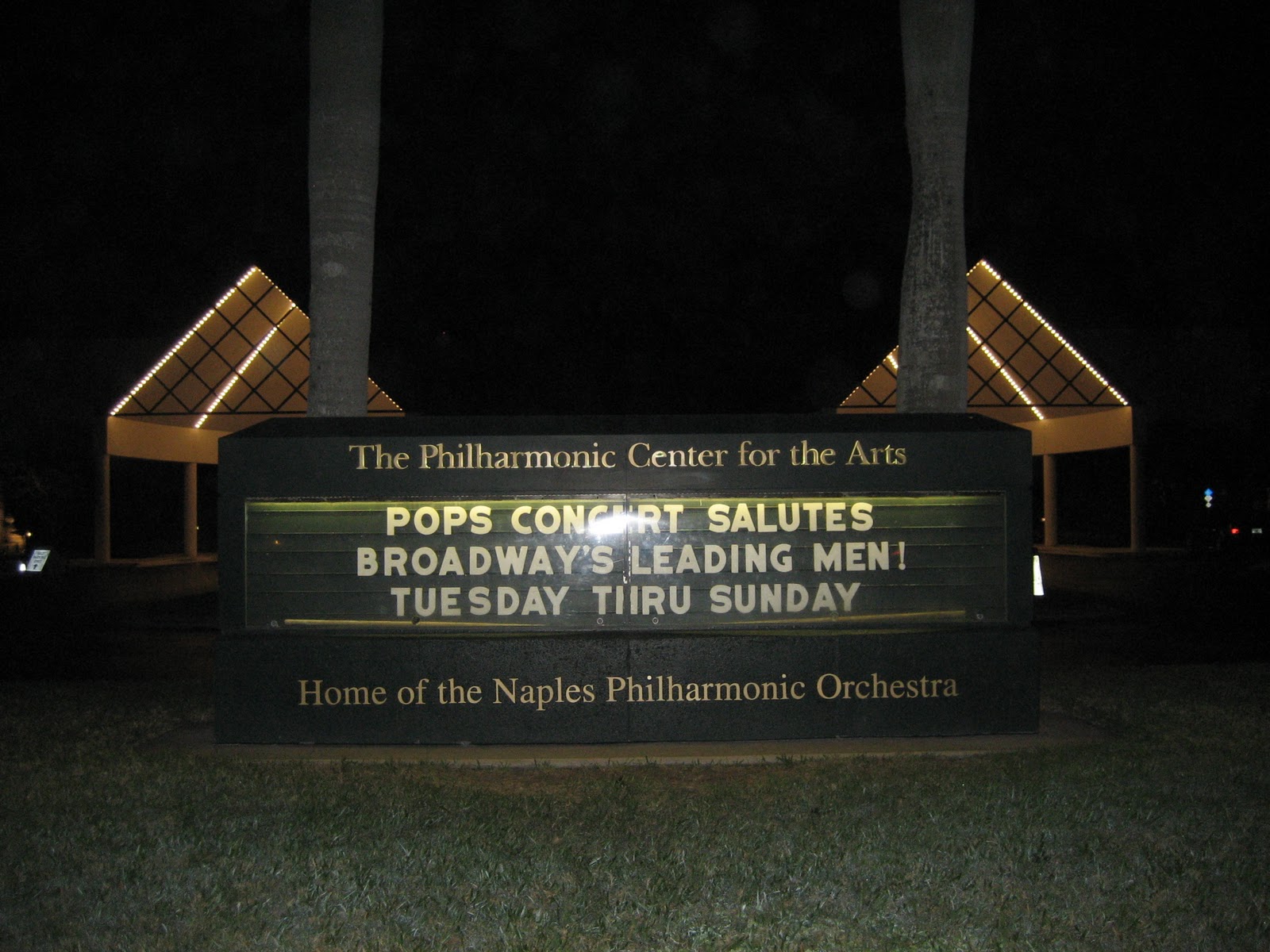
February 22 I had the opportunity to experience yet another orchestra.  Knowing I was going to be escaping the cold weather at home and heading for the warm climate of Florida I planned ahead and discovered that the Naples Philharmonic was performing Broadway's Leading Men, conducted by none other than their Principal Pops Conductor Jack Everly!  How perfect is that?  Warm weather and what's guaranteed to be an enjoyable show.

Outdoor Box Office
A short note about The Philharmonic Centre for the Arts, which is both an art museum and the concert hall for the orchestra.  It's an intriguing place.  The first thing that hit me was free parking!  Something you never have in Toronto!  Second to that was the outdoor box office.  It's amazing what gets done in warm climates that I would never even consider!

Inside there were a few rooms with sculptures to peruse, alas no picture taking was allowed so the art images are from the Phil's website.

The best pieces (in my totally unqualified to judge opinion) were on the stairs going up to balcony level.  They were musical in nature and one was titled "Symphony for the Deaf" and was a mass of various instruments.

The somewhat creepy Sentinels were in the lobby rather than outside in the garden area (maybe they get taken in for the winter).

The Sentinels
The funky red chandelier by Chihuly reminded me of Medusa and hung in the area above some other sculptures.

Chihuly Red
Our seats were in one of the side boxes.  Hayes Hall is carpeted in lush forest green, and each box only has 8 seats.  There's a rather exclusive feeling associated with opening the heavy full door (no curtains here) from the hall into the box.  The seats were decently comfortable as well.  The box directly across the theatre from ours had only 2 people but other than the back edges of the orchestra seating it appeared to be a fairly full house.  The orchestra seemed rather squished on the stage and I'd put the average age as quite young.  It was nice to see a strong female contingent particularly in the woodwind and brass sections.

The performance opened with a signature Everly arranged "Overture" which included, among others, themes from "If I Were a Rich Man" played by concert master Glenn Basham, "Where Is the Life That Late I Led", "Ol' Man River", and "The Impossible Dream".  The overture itself covered over 5 different musicals.  The following four pieces introduced each of the leading men vocalists.  Jacob Clemente, the 13 year old current Broadway Billy Eliot, sang and tap danced through "When I Get My Name in Lights" from The Boy From Oz; Ted Keegan, a former Broadway Phantom, sang "Maria" from West Side Story; Heath Calvert, another Broadway veteran, gave a well sung but rather plain rendition of "This is the Moment" from Jekyll and Hyde; and Ben Crawford (same one mentioned in previous Yuletide post) wowed the crowd as Prof. Harold Hill announcing "Ya Got Trouble" from The Music Man.  Perhaps I was underwhelmed by "This is the Moment" because I had read reviews of Ashley Brown's Broadway with the Indianapolis Symphony Orchestra from the weekend before which had Ben Crawford's rendition garnering an ovation.  So I was expecting him to also perform it here.  However, I don't think either of the other gentleman could have put across "Ya Got Trouble" in quite the same excellent fashion.

The orchestra was featured playing "Selections from Oliver" before the leading lady, in the person of Brynn O'Malley, took the stage in a nod to Julie Andrews with "Le Jazz Hot" from Victor-Victoria.

Closing the first half was the other Everly arrangement of the evening, "Leading Men Medley".  He has this amazing ability to cover the best parts of a song and fit them all together so well that you hardly notice the transitions between them.  Out of the 10 songs covered there were only 2 I didn't recognize.  The orchestra introduction was "Luck Be a Lady" which led to "Guys and Dolls" sung by Ted, Ben, and Heath.  Following was "Oh What a Beautiful Morning" and "I Have Dreamed" before Jacob joined them in a leather jacket singing "Summer Nights" from Grease.  The song has some interesting chuckle moments coming from a 13 year old.  A mini John Travolta he's not, I'd say his dancing is superior to singing, but he's still got a huge career ahead of him.  Ben took over with "Some Enchanted Evening" which HAS to have bass singer for the song to have weight (for example), and it was perfect.  Camelot and My Fair Lady were featured through "If Ever I Would Leave You" and "On the Street Where You Live" before they finished together with a vocal of "The Impossible Dream".  Talk about a great closing to the first half.

Intermission was interesting.  Typically nothing happens on stage.  The odd musician may remain and practice some parts, and the librarian swaps out the music on the conductors podium, but that's about it.  There was much more activity this evening however.  Two gentlemen (presumably at least one was the librarian) placed a green notice and piece of music on each stand.  My own wild speculation abounded, but really the only reason for adding more music to an already full concert is that something is being replaced.  Indeed after "Seventy-Six Trombones" highlighting the brass section particularly, Jack turned to the audience and all was explained.  Brynn was very much under the weather and unable to perform the "Love Duet Medley" (she would return for the finale), so to feature the orchestra and since no leading men concert would be complete without West Side Story they were going to replace it with the  "Overture to West Side Story" (played much better than this link, but I believe it was a very similar arrangement).  He continued with, "the orchestra has not rehearsed this.  See you at the end".  Unrehearsed or not, they must have been familiar with the music because Jack did not slow it down.  In fact it was one of his most lively conducted numbers of the night!  The transitions between sections of the piece may not have been as clean or tight as they could be and I'm not sure if all the percussion was bang on (although with the off beats it's hard to tell at the best of times), but there was a lovely horn solo in "Somewhere".  Given the extremely energetic "mambo" shouts from the orchestra the enthusiasm from the podium paid off.  Jack's breathlessness at the end was well deserved.

Jacob continued to demonstrate his dancing skills in "All I Need is the Girl" from Gypsy, before Ted tapped back into his Phantom days performing, as described by Jack, "the most romantic song from the musical".  I really liked the arrangement which began with the imposing instrumental "The Phantom of the Opera" as Ted walked out slowly to centre stage before it softened into "Music of the Night".  It's been a long time since I've seen the Phantom, yet his rendition took me back.  All the nuances were there right down to the wrist motion at the "close your eyes and surrender" line.  "Selections from La Cage aux Folles" was inexplicably dropped, yet the musical was still represented with Ben's "I Am What I Am" rendition.  *sigh* he has a voice one could happily listen to all night.

The evening of great music concluded with the powerhouse from Les Miserables.  A medley of "Look Down"and "At the End of the Day", as part of the orchestral intro; "On My Own" exquisitely sung by Brynn, I would never have been able to tell she wasn't felling well; "Stars" (one of my favourite lines in the whole musical is "and so it has been, and so it's written on the doorway to paradise that those who falter and those who fall must pay the price", I just love the melody there) where Ben got to return to his Javert understudy days; Ted matched Brynn with a poignent "Bring Him Home"; and the entire cast and a 14 voice male chorus joined in for the powerful "One More Day" and "Do You Hear the People Sing?" finale.  I wonder if this will be part of the Do You Hear the People Sing? concert celebrating the music of Boublil and Schonberg which Jack's debuting with several orchestras (NACO and Baltimore so far) for the 2011/12 season?  If so, it's definitely worth going to see.

Broadway's Leading Men is also making a stop next month in Ottawa with the NAC orchestra.  It is however going to lack Ben Crawford.  But hopefully will include a healthy Brynn and some great love songs.  So GO!