Wednesday, June 20, 2012

TSO Goes Outside!

For the first time in a decade the Toronto Symphony ventured outside the comfy confines of Roy Thomson Hall.  They didn't go very far, just next door to Metro Square (well ok, David Pecaut Square, it was renamed last year), but it was a departure from the norm none the less.  From what I saw and heard, it was a departure welcomed by fans.  But let's go back a bit.

June 17 was the finale of the 6th annual Toronto arts festival called Luminato.  This year is also the bicentennial anniversary of the War of 1812 which has sparked interest both north and south of the border.  It's a war both sides think they won.  In Canada it's remembered because we got to DC, burned down the White House and repelled an American invasion.  In America it's remembered for the defence of Fort McHenry in Baltimore which inspired the writing of their National Anthem.  So I was eagerly awaiting the results of a co-commissioned piece from the TSO and Baltimore Symphony Orchestra (BSO) by Philip Glass, a native of Baltimore.  How would this play out with both sides thinking they're the victors?  How patriotic a piece would an American write and would it be something Canadians could really care about?  But really there isn't anything wrong with each side winning.  No one really wins in a war, and it ended with each side occupying some of the others territory which was ultimately given back, so let's celebrate that both sides developed a stronger national pride and call it a day.

An added quirk was that this piece was receiving a joint world premiere.  Not that you'd know that from the BSO promo material, although various other US articles have mentioned the TSO.  But the 7pm BSO concert of other American music included the Glass piece as well.  It would have been fun to be a fly on the wall to see if the TSO was mentioned at the BSO concert.  They were in Toronto.

After welcoming and thank you speeches from Luminato people, and concert master Jonathan Crow (very cool to see him back again for this concert) led the orchestra tuning, the concert opened with Aaron Copland's "Fanfare for the Common Man".   Eventually the camera crew figured out what shot showed the brass so their image finally made the screen.  Hidden at the back of the orchestra with all the audience on a rather flat ground limited our view substantially.  There were a few brief imperfections, but I love this piece and it didn't hurt the overall grandeur of it.

(From Luminato facebook page)
Upon conclusion we heard piccolos in the distance.  Was this aural competition or part of the show?  The answer quickly provided itself as the players and honour guard complete with muskets marched in and up to the stage.  The audience and part of the orchestra stood while both the Canadian and American national anthems were performed (you can bet that didn't happen in Baltimore!).  I know there are some Americans in the orchestra, but I'd guess that "The Star Spangled Banner" isn't a piece Canadian Maestro Peter Oundjian has often been called upon to conduct.

As the soldiers marched away CBC personality Tom Allen announced them as the "Fort York Honour Guard ladies and gentlemen, keeping out invaders for 200 years".  And we're very thankful they did :)

Philip Glass
(www.colineatock.com)
Finally it was time for the much anticipated "Overture for 2012".  There was a video introduction by composer Philip Glass who could not have looked less energetic or enthusiastic for the piece.  Does he dislike it that much?  My gut reaction: seriously dude we helped pay you for this, the least you could do is look happy we're debuting your work!  The piece itself wasn't bad.  It was typically minimalist with lots of repetition and a brassy melodic line that transfered a bit throughout the orchestra.  There was the underlying motor of the driving incessant, not quite arpeggio rhythmic patterns.  At times it got boring, and I was hoping for a change in pattern, often one came shortly after.  It was suppose to be a 12 min long piece and seemed longer than the closer to 5 it was, which I'm not sure is a good thing.  I'll second Tim Smith's comments in his blog regarding the BSO's performance "can we get some money back?"

Tom Allen, one of the highlights of the evening with his humorous and information introductions, returned with an invitation for the audience to imagine:  To imagine that we were to go home after the concert and find a job offer waiting for us.  The job is in New York and pays six times our current salary.  So we go, and then end up leaving for a church organist position in Iowa (I wonder if it was River City?).  This is what Dvorak did.  He discovered he didn't like city live and ended up in Iowa where the entertainment one summer was an Indian Medicine Man Snake Oil type show.  He went to every one to absorb the music and incorporated the themes into his most popular symphony.  That would be Symphony No. 9 "From the New World".  The TSO then played the 4th movement.

Moving onto some Canadian music, the first piece was by Malcolm Forsyth (incidentally the father of NAC Orchestra principal cellist Amanda), and was inspired by his first trip to the barren beauty that is Canada's far north.  The orchestra played "The Dance" from his orchestral suite Atayoskewin which is the Cree word for "sacred legend".  Youtube lacked a quick search result for the piece, but the NAC musicbox came through.  Take a listen here.  At times it reminds me of Copland's "Rodeo", particularly the first few bars.

View of audience from the back of the stage
(from Luminato facebook page)
Mr. Allen then tested our knowledge with a multiple choice question, who wrote the music for Lord of the Rings?  Was it John Williams, someone else I don't remember, or the Canadian Howard Shore who won three Oscar's, scored the film Mrs. Doubtfire, and suggested the name "The Blues Brothers" to Dan Aykroyd and John Belushi?  Not a tricky question to figure out.  They played a short suite excerpt from Lord of the Rings.  Having only seen the movies once I'm not familiar with the music.  It was good, but perhaps I'd find it more epic if I knew it better.

Maestro Oundjian dedicated the next piece to all the cyclists who go wizzing around the city.  Less than 4 bars in I figured it out as "The Flying Theme" from ET.  Very fitting :)

Tchaikovsky's "1812 Overture" is a masterpiece (well in my opinion).  Mr. Allen began by describing an invasion by a force that thought they'd get in, meet little resistance, take over, and be out of there by winter.  I, along with others I'm sure, assumed he was talking about the War of 1812, until he continued by saying that was what happened with France and Russia.  France thought it would be no problem to take Moscow, and Tchaikovsky's piece is celebrating the Russian defeat of Napoleon and his army. "But the parallels are similar.  So when you hear "La Marseillaise" that's them, and the bold brassy trombones, that's us!"  I'm not sure if the TSO played the full version (the recording I have runs 17 mins and includes the rarely performed vocal part), although it sounded like they did, and it didn't feel like 17 mins.  I'm also not sure if the carillons in the final section were recorded because I couldn't see if there were chimes on stage, but if it was live they were perfect.  Often I find the sound of the bells random, but this fit and the balance was superb.  They got to the climax and would you believe it FIREWORKS shot off behind the stage!  Who needs military cannon fire?  These were impeccably on the beat, and could not have have been better!  The finale even had a few extra shots that exploded in the air rather than just the single straight up shooting star type.  A Capitol Fourth (which concludes with an abridged version of the "1812 Overture" every year as the fireworks begin) could not have done it better!!
1812 Overture Finale Fireworks
(from Luminato facebook page)
The audience was on their feet immediately, not a begrudging out of obligation or slow standing ovation from this crowd, it was the real thing.  We were treated to an upbeat encore that I couldn't name but had a stick in your head tune that stayed with us all the way home.

I hope concerts like this become a tradition with Luminato and the TSO, there was a great turnout, great music, and thankfully the rain almost held off, but the few sprinkles only resulted in the opening of umbrellas, people didn't leave.  A testament to a thrilling evening of music.

Wednesday, May 16, 2012

I Heard the People Sing

This weekend I headed back up the corridor (as VIA Rail calls it) to Ottawa for the NAC Orchestra's tribute concert to composer Claude-Michel Schonberg and lyricist Alain Boublil.  Known to pretty much everyone as "those guys who wrote Les Miserables".  While that has been their greatest success so far, they've done a lot more as well.  In preparation for attending the Canadian debut, (the concert has already played in at least Indianapolis, Baltimore, Dallas, and Pittsburg) I went searching for cast recordings.  Miss Saigon (1989) I listened to in its entirety (all 1 hr 47 minutes of it) while stuck in traffic last week and Martin Guerre (1996) the following day.  The Pirate Queen (2006) I couldn't find on CD so borrowed a childrens book that gave me the story line since it's based on the real Irish chieftain Grace O'Malley.  So I felt somewhat prepared.  Nothing beats a performance LIVE though!

All the vocalists were making their debuts with the NAC orchestra and what a line up of stars familiar with the material.  Starting with the most experienced, Terrence Mann was the original Broadway Javert in Les Mis, Lea Salonga created the role of Kim in Miss Saigon, Eric Kunze was Marius on Broadway (opposite Lea Salonga's Eponine) and Chris in Miss Saigon, Kathy Voytko was the standby Grace for The Pirate Queen, and Marie Zamora played Cosette in the original French production of Les Mis (and is married to the lyricist :) )

As always, the concert opened with an overture, no snappy title, just "Overture".  It was short with one line quotes of songs that would be expanded on later.  One that stood out was "Bring Him Home" which had a very high oboe part that Chip Hamann sent soaring.

The overture ran right into the Miss Saigon segment beginning with the chorus singing "Bui Doi".  An excellent choice to start.  It created the emotion and sense of longing covered in the plot and placed the musical firmly in the time around the Vietnam War.  Even not knowing anything about the story, it provided the background needed through lyrics like:

"Like all survivors I once thought, when I’m home I won’t give a damn 
But now I know I’m caught, I’ll never leave Vietnam.
War isn’t over when it ends, some pictures never leave your mind.
They are the faces of the children the ones we left behind.
They’re called Bui-doi.
The dust of life, conceived in hell and born in strife.
They are the living reminders of all the good we failed to do.
That’s why we know deep in our hearts, that they are all our children too"


Terrence Mann
(broadwayworld.com)
Of course this is also accompanied by a lovely melody sung by Terrence (check out Indy's version).  Wow, his voice!  I don't know what I was expecting when he walked out (not looking all that much like his program head shot), but if all he did was sing, it would have been worth it.  However he also provided much of the entertainment value of the evening.  

Jack compared Alain and Claude-Michel to Rodgers and Hammerstein then had the audience practice pronouncing their names.  We must have sounded pretty good as Terrence declared that we had "good French".  Jack's reply, "well we are in Ottawa not Thunder Bay, they're good at this stuff".  He then proceeded to describe that in addition to Miss Saigon being a modern version of Madame Butterfly (the only opera I'm interested in seeing and the Canadian Opera Company doesn't have it planned next season :( ) inspiration came from the craziness of beauty pageants and indeed that's where the title came from and what "The Heat is On In Saigon" is a precursor too.
Lea Salonga
(www.filipinoexpress.com)


Another inspirational source was a photograph of a mother trying to pass her child to an American soldier.  I'm pretty sure I've seen this photo and yet now can't find it.  Lea's performance of "I'd Give My Life For You" where Kim sings about her son was so heartfelt.  She then lightened the mood with a story about when the show was in rehearsals.  She was cast at 17 after a world wide search for a girl who could look 15 yet had the vocal chops to hit a high E flat.  Knowing nothing of love, the director one day got so fed up with her ineptitude in a love scene that he told her to get out of the bed, and proceeded to get in with the guy playing Chris and demonstrated how to make love to a man, as Lea said 
"a w k w a r d".    Then added that since then she's learned a lot on her own and having fallen in and out of love, the romantic songs have developed more meaning.  Her duet with Eric of "The Last Night of the World" couldn't have been better.  It was neat to see second clarinetist Sean Rice pull out a saxophone for the few sax solo lines.

Kathy Voytka
(michaelcassara.net)
Eric then introduced a song that will be added to the 2013 revival of Miss Saigon called "Maybe".  It's for the character of Ellen, Chris's wife once he returns to the US.  I get the feeling in the original development there were several songs tried and cut for this position in the plot where Ellen has just met Kim, so this is another chance to find the perfect one.  Personally I like the melody of "Now That I've Seen Her" from the original London cast recording, but I wouldn't say any more than "Maybe".  It was Kathy's first solo of the night and I continued to be impressed with the vocalists.   


She introduced Terrence again to sing "The American Dream", a song by the Engineer who would do whatever was needed for him to get ahead.  Right away this was going to be fun as Terrence put on a pair of sunglasses saying "check it out", and proceeded to pat the violas on the head, and twirl another's hair, before getting stared down by Jack and turned his affections back to the audience.  My favourite line of this song is "bald people think they'll grow hair, the American Dream".  It makes me smile every time.
Terrence as "the Engineer" with the ISO (Photo: Thomas J Russo)


On a personal note I'm very glad Miss Saigon was created.  Not that I've ever seen it or consider it my favourite musical, but because it resulted in the building of the Princess of Wales Theatre in Toronto.  A theatre big enough to hold a helicopter on stage was needed and so back in 1991 construction started.  The theatre opening with Miss Saigon in 1993.


Marie Zamora
(Photo: Maggi Wunschi)
Terrence joined together with Jack to describe how Alain or Claude-Michel (I'm afraid I can't remember which, probably both actually) liked musicals, and saw a bunch in London/New York because France had no musical theatre scene to speak of.  So they combined forces and decided "why not France, why not now", and started their first "small, in the box" venture with the topic of the "very simple" French Revolution.  "Small" being in jest of course as this work featured an orchestra of 52 with an additional 40 performers.  The musical was The Revolution Francaise, and as Jack slightly butchered the pronunciation of "Francaise" and went to repeat it, they both chimed in "I'm/You're from Thunder Bay".  Rehearsed or improvised (which I think it was) it got the appropriate audience laugh :) The song introduced the audience to Marie, who sang "Au Petit Matin" as Marie Antoinette the morning she learns she'll be going to the guillotine.  My French is no where near good enough to understand any of what she sang, but it didn't matter, her clear soprano got the point across.  


Eric Kunze
(erickunze.blogspot.ca)
Marie's French introduction to Eric for the title song in Martin Guerre I was actually able to follow.    I wasn't a fan of the recording, granted this was one of the better songs, and it got even better with Eric singing it.  I wasn't sold on his voice after the earlier duet, but really enjoyed the emotion and power he brought to this song.  The following duet with Marie "Live With Somebody You Love" sealed the deal.  The final song in the Martin Guerre section was "Land of Our Fathers".  The 1999 cast recording doesn't include this piece (unfortunately that's the only copy the library has. Actually I figured I was lucky to even find that one).  It was part of the London production from 1996 and according to wiki the show was reworked before coming to the US with 40% of the material being new.  Yet still never made it to Broadway.

Up next was a testament to the fact that what gets written doesn't always make the show.  Jack said that putting together a musical is like CSI, in the end you have a whole pile of dead bodies, or in the case of Alain and Claude-Michel, songs.  "I Saw Him Once" was originally a song for Cosette, however Les Mis was running about 3 hours and 40 minutes so something had to go.  Marie's lovely soprano fit it just right.  Lost from Miss Saigon was "Too Much For One Heart" because the director said "there is no good theatrical reason for Kim to sing ANOTHER ballad".  So it became the duet "Please", and Lea said they still regret the change.

The first half ended with a song that has been recorded a huge number of times (something like over 200)  and has over 5000 various versions on youtube.  Kathy and Lea sang yet another variation, inspired by Glee, of "I Dreamed a Dream".  Really I don't think the "popular" twists do the song justice.  It doesn't need any vocal ornaments, but can completely hold its own being sung straight.  But maybe I'm just a purist.

The second half opening Entr'acte was decisive Irish fiddle music.  I wonder if concertmaster Yosuke Kawasaki got some tips from Natalie MacMaster when she was there earlier in the season for the crazy solo he had very much in Celtic style.  Turns out The Pirate Queen came about because Riverdance producers approached Alain and Claude-Michel with the idea to dramatize the story of Grace O'Malley.  Kathy described Grace as a sailer and chieftain, who met the Queen and saved Ireland.  All in a days work.  She then sang "Woman" which is a great "I am woman" empowerment song.  Without missing a beat she switched to the other end of the emotional scale evoking vulnerability at she and Eric sang "If I Said I Loved You".  The "Finale" included the chorus and had the lead characters get married!  What's this a happy ending?  Well I don't know the whole plot, so maybe someone else dies and it's a mixed happy ending like Les Mis, but a happier conclusion than Miss Saigon.

Marie Zamora
(www.mariezamora.info/blog.html)
The opening of the Les Mis overture began, and 30 seconds in abruptly stopped with Jack saying "But before all that...".  Talk about getting the audience on the edge of their seats with anticipation then pulling the plug!  It was while watching  a revival production of Oliver in London that Alain realized an epic novel could successfully be adapted to a musical.  Going home he started to re-read Victor Hugo's Les Miserables and ideas jumped off the page.  That's how it all started, and the first song they wrote was "On My Own" or more accurately "Mon Histoire".  Marie started in French with Lea joining in with the English...quite a combination that worked very well.

No need for plot summaries here, Lea, Kathy and Marie adopted the characters of factory workers upset at Fantine, a unknowing audience member being cast in the part as they directed their anger to her, in "At the End of the Day". (See following link from ISO performance.  Same cast except for Stephanie J. Block replacing Kathy and Peter Lockyer in place of Eric)

Terrence continued to be the comic relief of the evening, this time accompanied by Kathy as they embodied the inn-keeping Thenardiers.  After kicking Eric out for not having any money, Kathy turned her charms on Jack while Terrence did a little pick pocketing.  Yosuke was enticed by her as well and joined in the dancing unlike Zach de Pue who played it straight (just watch until after "At the End of the Day", it's hilarious!)

Marie, Eric, and Lea reprised roles they've played (Cosette, Marius, and Eponine respectively) for a beautiful version of "In My Life".  The backdrop grew darker and white lights appeared when Terrence returned for "Stars".  What a treat to hear it from the Broadway original Javert!  There was a bit of echo added to the mic, which added a different dynamic, but I don't think the singers needed it.  The song was created to provide background on why Javert is so obsessed with finding Valjean.  I can't imagine Les Mis without it, it's my favourite song.

Perhaps the most iconic piece, which probably has more renditions than "I Dreamed a Dream" is "Bring Him Home".  The version I'm most familiar with is Colm Wilkinson's who originated the role in London and on Broadway, but I think I preferred Eric's rendition.  The start of the challenging high note had an ever so slight wobble, but was quickly corrected and ended beautifully.

The entire cast reassembled for "One Day More".  A powerhouse arrangement, similar to the one at the end of Broadway's Leading Men actually, that had the people on their feet almost instantly.  After applause for the vocalists and the orchestra, none other than Alain Boublil himself took the stage for a bow.  It was a nice touch he was there for the Canadian premiere.
Final bows with Alain
(unfortunately Lea out of frame on far right)
But really they couldn't leave without singing the concert title song, and as the orchestra started again, and the audience took their seats the finale of "Do You Hear the People Sing" began.  The lyrics are invitational and it was all I could do not to join in, it just felt like the audience should have replied with "yes we'll join in your crusade, we will be strong and stand with you...".  In any case I left the theatre singing and I'm still catching myself humming it and other songs from the show.  It was a wonderful concert.  If anyone at the TSO is reading this, add it to the list of those I highly recommend bringing to Toronto!

Monday, May 14, 2012

Out of This World Finale: The Planets

My week of practically living at the TSO concluded on May 10 with the last in their series of concerts that included "space" music.  This one highlighted "The Planets" by Gustav Holtz.

The concert, conducted by music director Peter Oundjian, opened with "Canzon per sonare" by Gabrieli. It's a really cool piece just for brass.  Originally written for 4 trumpets and 4 trombones, it was performed by 2 horns, 4 trumpets and 2 trombones placed on either side of the choir loft!  It's an example of antiphonal music where a musical setting is played alternately by two groups, hence the placement of the instrumentalists.  It was one of the highlights of the evening.

Joaquin Valdepenas
(www.music.utoronto.ca)
Switching from brass to woodwinds, the next piece was John Corigliano's "Concerto for Clarinet and Orchestra" with the solo performed by TSO principal clarinetist Joaquin Valdepenas.  The composer was in the house and was invited on stage to describe the piece.  His father was concertmaster of the New York Philharmonic and personally knowing the clarinetist, Stanley Drucker, and his skills Corigliano decided on a piece that used the entire orchestra, had an unprecedentedly difficult opening cadenza and a slow movement filled with emotion involving a duet between concertmaster and soloist.  Apparently when first presented to Mr. Drucker he looked at the opening, closed the score and said "I can't play this".  Obviously he learned it, and with something like 150 notes in the first few measures (I haven't seen the score, this was the comparison given), it's become something like running the 4 minute mile...once one person has done it everyone wants to.  Mr. Corigliano said he's been in universities where students will stick their heads out of practice rooms and say "listen to this", then play the opening cadenza.

It's an interesting piece.  There's a lot going on and it fit my definition of "good contemporary music" by having enough there I'd listen to it again, however I was really more engrossed in watching Mr. Valdepenas play, what quality of sound over ALL registers.  The final movement continued the antiphonal theme by having some of the brass (at least 3 of the horns and likely the trumpets) separated from the orchestra.  In my section of mezzanine we had a French horn player at the back.  Definitely a different way of hearing things.  I expected to be deafened but sometimes wasn't even sure if they were playing.

While I wanted to hear the clarinet concerto, my real reason for going to the concert was "The Planets".  Pretty much every year in high school our band teacher would pull out "Jupiter", we'd badly sight read through it (as I recall the clarinet fingerings in the opening were rather tricky) and she'd collect it and put it back on the shelf.  Such a shame really, because I think with some work we might have gotten in playable.  The centre slow section always went better than the beginning :)  Going back even further my first memories of "Jupiter" was at the Ice Show one season at Canada's Wonderland.  I believe it was a pirate theme routine that used the music.  Wow, useless information, think what important stuff I could remember if I could forget things like that!  Point being, the piece and I have a history and I really like it.  However, I've never heard all seven movements (Earth is excluded and Pluto wasn't a planet in 1914-1916 when the piece was written and interestingly enough has recently been removed from the list again).

It begins with "Mars: The Bringer of War", then a very contrasting movement with "Venus: The Bringer of Peace".  "Mercury: The Winged Messenger" is light and peppy and probably my second favourite.  Then is the famous "Jupiter: The Bringer of Jollity".  Things slow down dramatically after that, and since I was already tired, I found it incredibly easy to just close my eyes, enjoy the sounds, and started to drift off.  "Saturn: The Bringer of Old Age" is incredibly beautiful.  "Uranus: The Magician" picks up in tempo and has sounds that reminded me of the suite from "The Day the Earth Stood Still".  Neptune has always been my favourite planet and "Neptune: The Mystic" is slow, calm, and relaxing, but perhaps since I'm not as familiar with these last few, they tended to blend into each other.  The conclusion of Neptune with the ladies chorus singing offstage and slowly fading away as the door to the stage is closed gave the feeling you were floating away the with the voices.  Unfortunately I couldn't just float back home to bed, driving required waking up again.

Thursday, May 10, 2012

Gershwin and Beyond

(www.online-inquirer.com)
May 6 I was back at Roy Thomson Hall for Gershwin and Beyond.  It was to be conducted by Joana Carneiro however due to a shoulder injury she was unable to lead the series of two concerts.  Substituting was American Edwin Outwater.  He had conducted a concert earlier in the season I had wanted to go to but didn't so it was nice to have another opportunity.  Until I read his bio I didn't realize he's the music director of the Kitchener-Waterloo Symphony.

The concert opened with Bernstein's "Overture to Candide", which seems to be the selection of choice for opening light classics concerts.  As usual it was joyously played.  Really I don't mind if it's performed a lot, it's one of my favourites.

(hurdaudio.blogspot.ca)
In the introduction to "The Chairman Dances: Foxtrot for Orchestra" Mr. Outwater explained it was part of John Adams opera Nixon in China.  It comes from Act 3 when the President and Chairman Mao, along with their wives are dancing, probably at a ball.  He described the piece as starting with a bit of important business going on, then switching to a classic 1950's Hollywood sound before concluding with percussion sounds reminiscent of an old record with the needle sliding off and up.  It was funny as the young conductor indicated "well that's what I've been told.  I don't know records." :)  The ending didn't really sound like the needle lifting to me, but maybe I just need to hear the real thing again for comparison.  The record I remember playing as a kid was You're a Good Man Charlie Brown and I think the old record and player is still around somewhere.

The first half ended with the always enjoyable "Rhapsody in Blue".  Written by George Gershwin I believe originally for 2 pianos, it was actually orchestrated by Ferde Grofe.  It's true that this piece has become widely recognized.  As Mr. Outwater said "people know it from all sorts of places, like the tunnel between Terminal 1 at Chicago's O'Hare; Neon and Gershwin you might say."  So true!  Admittedly when I haven't been in a hurry in Chicago I've enjoyed a leisurely stroll through the tunnel.  But it wasn't always the soothing, relaxing piece we consider it today.  In its day it would have had things to make the previous generation gasp.  The guest pianist was Todd Yaniw, who I would consider a prodigy having made his debut with the Edmonton Symphony at 13.  Now 26, he's recently received a Master's degree from Rice University studying with another TSO regular Jon Kimura Parker.  As always, it opened with the fantastic clarinet solo by YaoGuang Zhai.

O'Hare Tunnel
Opening the second half was a fanfare inspired by Copland's "Fanfare for the Common Man", but written by Joan Tower and titled "Fanfare for the Uncommon Woman".  Back in March the Baltimore Symphony had a program which included both of these.  A good idea, although I think the "Common Man" would have overshadowed the "Uncommon Woman" merely by being more recognizable.  It was a good fanfare, one I'd like to hear performed again.

Barber's "Adagio for Strings" has been paired by the TSO with "Rhapsody in Blue" before.  It's always a stirring piece but it bothers me that people find the quietest pieces and moments within them to start coughing.  Someone should do a study on the reasoning behind why one cough triggers 15 more from other people around the hall.  I have to force myself to focus on the music, get sucked back into the beauty and try to ignore what's going on around me.  No one clapped though in the spot where there's a pause when people sometimes think the piece is over.

(www.sheetmusicplus.com)
The finale was by Aaron Copland, "Four Dance Episodes from Rodeo".  As part of his intro, Mr. Outwater said something akin to the following "Copland's music is considered by conservative politicians in my country to be an example of pristine America.  I guess they didn't know he was a gay, Jewish socialist from Brooklyn!"

The piece is in four movements Buckaroo Holiday, Corral Nocturne (a pun on chorale), Saturday Night Waltz, and Hoe Down.  The first and finale are fast and light hearted and my favourites.  I haven't seen the suite performed before, but would love to again.  The audience clearly enjoyed it and applauded after each movement which was considerately acknowledged by the conductor rather than just ignoring it; the benefit of a casual concert I suppose.  There was even a burst of applause in the middle of Hoe Down, although the indication from the podium at that point was a skeptical expression as if to say "we're not done yet".  It was great to hear the audience enjoying it, and I'll guess the orchestra didn't mind too much, they had just yelled "yee haw" :)

Tuesday, May 8, 2012

Toronto Symphony Goes Sci Fi

April was a LONG month.  I think I survived it out of anticipation for the series of Toronto Symphony Orchestra concerts May 1-2.  I wonder if when they planned the timing of this concert they knew all the "space-y" things that were happening that week.  For example, it contained the day when Star Wars aficionados get to say "May the Fourth Be With You" and this weekend was the return of the super moon, when the moon is at its closest point to Earth.  Bring Jack Everly to the podium, and I'm very easy to please otherwise, but add to his knowledge, charm, and energy a program of science fiction music...well I'm so glad May finally arrived!


Sci Fi Spectacular did not disappoint.  Perhaps a disclaimer first.  I've seen this concert before, and thoroughly enjoyed it.  However, I don't think it has sounded better than the three (yes I went to all of them with various friends...have to keep getting more people hooked on the symphony and Pops is my methodology :) ) shows over the two days.

Where to start!  How about with night one.  It was good, but not great, there was no knock your socks off feeling.  Half way through the opening "Star Wars: Main Title" I felt like it was loosing steam.  Cymbal crashes and trumpet fanfares just didn't have the power and volume I was expecting.  Perhaps evidence of the single rehearsal these programs typically have (I'll assume the same is true here and they rehearsed Tuesday morning with the first concert that night) there were moments of slight staggered entrances from basses and muddled brass entries.  It was nice to see some principal players that don't always do the Pops concerts in attendance.  Including both principal clarinetists!  The reason they were there became clear in the second half, keep reading.

These small issues worked themselves out, and I was thrilled with the volume Wednesday afternoon.  Perhaps I just needed to sit closer.  With seats in L4 right over the strings, the trumpets and horns were gloriously clear, all entrances sounded precise (save one, more on that later), and I could see the music!

A Jack Everly program is not complete unless it includes one of his own arrangements.  "Lost in Syndication" filled that role and included themes from at least nine different sci fi television shows.  I doubt this concert will be shelved any time soon but in short there's a contest of sorts related to the contents of this piece, so answers to that helped me figure out some of the themes, but people seem to always recognize and name the same four ("X-Files", "The Jetsons", "The Twilight Zone", "Lost in Space").  I also recognized both "Stargate SG-1" and "Atlantis" (I think) which left three more.  I was at a loss for how to determine them.  Problem solved when one of the violinists was warming up with this piece open!  Talk about picking themes from various eras and locations, the second segment was "Space 1999" a British show from 1975 which lasted two seasons and had a different theme in season 2.  The one played was season 1 and in a much improved orchestration to the original.  "My Favourite Martian" and a brief quote of "The Outer Limits" were the remaining two.  My playlist can now be completed!

http://etart.tumblr.com/
As Jack pointed out the show really was a tribute to John Williams, with his music making up half the program.  Concerts drive me to the library and this was no exception.  After the NAC version in 2009 I sought out Somewhere in Time and rewatched all the Star Wars.  Thursday I went to get ET: The Extra Terrestrial.  All I remember of seeing this as a child was one scene where the house is all in plastic quarantine and it freaked me out so much I've never watched the movie again.  I think it's time for a re-watch with a new perspective.  Besides having ET described as a "little guy who got back to the ship too late, but just wants to go home, and all he had to do was call and the others would come get him" (paraphrased, the direct quote was much more eloquent) is just too endearing to not want to see how the  details of the story play out.  It's not hard to tell why it's one of Jack's favourite all time scores, and he conducted with a "palpable sense of involvement" (to borrow a great phrase from Baltimore Sun writer Tim Smith).  The TSO played it beautifully garnishing them what looked like a heartfelt thank you and rousing audience applause.

http://blog.myromancestory.com/
2008/04/somewhere-in-time-
revisited.php
From the poignant flying theme and action, we moved to pure romance involving time travel.  Christopher Reeve plays the fellow who falls in love with a leading lady from another time (Jane Seymour), and Christopher Plummer as "Captain Von...oops I mean the villain" also stars.  John Barry is probably best known for his James Bond music, but the love theme from "Somewhere In Time" is him at a romantic best.  The movie is based on the book "Bid Time Return" which was optioned by Universal and actually got made.  (Total aside that image is exactly like the one at the end of Anne of Green Gables: The Sequel with Anne and Gilbert on the bridge, right down to the angle of his neck!)

Supermen (George, Christopher, and my personal preference, Dean Cain)
Taking us back another year to 1978 Jack described how Christopher Reeve revitalized the super hero/comic book genre by not being the slightly pudgy George Reeves Superman from the earlier TV show.  He then threw out the random factoid "did you know that George Reeves was one of the Tarleton twins in Gone with the Wind?" I couldn't hear the reply from someone in the audience but it caused Jack to laugh at himself saying "I've got no where else to go with that" and pulled things back on track with the "Superman March".  Not the first time that happened either.  Earlier in the day when he mentioned Reeves by name it was followed with "there's a quiz later, take notes, I'm just full of this stuff".  And maybe that's why I enjoy these concerts so much, it's live and never the same twice.

As a special guest was Lt. Sulu from the original Star Trek, Mr. George Takei!  The wonderful music "literally transported" him down from the Enterprise and he provided some background on what was going on at the time Gene Roddenberry was creating Star Trek.  The ship was to be a metaphor for Spaceship Earth with Uhura representing Africa, Sulu Asia, Kirk North America, with Chekov from Russia and Scottie from (where else?) Scotland to round things out.  Given the civil rights movement, Cold War, and Vietnam War happening in the real world, combining this group of people and showing how diversity could work together was a pretty radical concept for the time period.  He also pointed out that with James Doohan (Scottie) and William Shatner (Kirk) both being Canadian, Canada was really over represented :)

After using the phrase "infinite diversity in infinite combinations" as many times as possible, Mr. Takei introduced a "crew member with an angelic voice who had just beamed down, Lt. Kristen Plumley".  Ms. Plumley arrived in original series uniform and they chatted about the "star ship Thomson" feeling like home with the "mothership" hovering above.
Inside Roy Thomson Hall
She also mentioned the diversity of Toronto architecture and, having had a chance to see the ROM by the Wednesday evening performance, had one of the best lines of the night when she compared the building to a crashed spaceship!  The audience laughter and applause was enthusiastic in what I will take to be agreement (mine sure was).  I hadn't considered that before, but what a good description!
Royal Ontario Museum
(www.vectorvault.com)
She stuck around to sing the vocal line in the original series theme with Mr. Takei's wonderful deep voice adding "Space, the final frontier..." but you know the rest :)  Then the orchestra took over with the best arrangement (by Calvin Custer) I've heard of Trek themes (Some wonderful soul has provided proof of this here...go TSO!).  Deep Space Nine and Voyager come alive when one gets to watch it played by a full orchestra...ah, just stunning music!

dacouchtomato.blogspot.ca
The second half opened with the "Theme from 2001: A Space Odyssey".  The movie where you left the theatre saying "wow, that was fantastic, but what was it about?"  Jack discussed how it's common for directors to put a music temp track to a movie to give composers an idea of the type of music they would like (composers of course hate this).  Anyhow Stanley Kubrick put a temp track of classical music together and showed it to Alex North, the composer.  North went away and composed a 90 min symphonic score.  He came back, Kubrick said thanks, it was put with the film, and as far as North was concerned that was that.  Then the movie was released, with the original temp track.  Apparently North and Kubrick parted never to speak again.  The Alex North score has been released, so that's now added to my "to listen to" list.  At the matinee this piece wasn't blooper free.  In fact it had the most glaring oops I've heard from the TSO.  The last three notes were meant to be separated,  whether conductor liberty or an actual rest in the music I don't know, but someone (in the cellos perhaps? it was definitely strings) missed the break between the third and second last notes and came in early.  One time only mistake, that night it was perfect.

In keeping with the theme of aliens coming to earth, Richard Dreyfuss had "encounters, close ones, of the third kind" and the TSO provided the appropriate suite of music.  The violins made these incredibly eerie sounds by holding a note then sliding their fingers up or down the string.  So creepy!  The five note theme makes an appearance as well, although plays a much expanded role in the movie.  This piece is so much better live than any recording I've found.  In order to hear the fading out of that five note theme as it's transfered between the woodwinds at the end, you have to have the volume way up, or be in a very quiet location.  Seeing it performed though, you know exactly where it is!  What I don't remember hearing was the brief quote of "When You Wish Upon a Star" which is in recordings.  According to wikipedia Spielberg wanted that to play over the closing credits, but was denied permission.  Perhaps that's why Kristen Plumley sang it as a solo, so not that out of place after all.

With the brief introduction of "this next piece is the most poignant and profound that John Williams wrote" audience snickers from those who had read the program started.  At the opening clarinet trio of "Cantina Band" from Star Wars, the rest of the audience joined in realizing the tongue in cheek nature of that description.  Clarinetists Joaquin Valdepenas, YaoGuang Zhai, Joseph Orlowski, and bassoonist Fraser Jackson precisely played the lighthearted, cooky piece which had a fantastic drum solo as well.

Takei and Plumley from same concert
with Detroit Symphony in March
(http://michiganradio.org/)
The evening returned to a somber note with six short selections from the 1951 movie "The Day the Earth Stood Still".  George Takei returned to give Klaatu's departure speech, which has elements as relevant today as when they were written over 60 years ago!  Jack gave a brief plot summary of the aliens who come to earth, land in Washington, DC ("because it's Hollywood so where else would they land?") and as Klaatu exits his ship and reaches for a gift, he's shot since the people have seen his ship coming on radar and are terrified.  The rest of the movie is about how people deal with fear.  This was the first Hollywood score by Bernard Hermann who went on to become famous with his music for Hitchcock films.  He actually started in radio on the East Coast and did "War of the Worlds" with Orson Welles.  When Wells went west for Citizen Kane, he took Hermann with him.  There are times when at the end of a piece in that moment just after the conductor relaxes and before the applause starts when there's a feeling of awe that hangs (This is not the same silence or feeling that comes from wondering whether the piece or just the movement is over and whether one should clap).  It's a silence when the "wow what did we just hear" thought bubbles can almost be seen over people's heads.  I've heard it last longer, you could easily pick out the one person who started clapping first, but this piece had that moment.  In fact it was actually my TSO newbie friend who commented on it.  It's a wonderful thing to experience and quite difficult to describe.

Even harder to describe is the energy that existed by the end of the Wednesday night show.  I've heard it said performers feed off audience energy, and I'm sure that's what was happening.  Even I felt energized by it.  I mean this music is demanding particularly the brass parts.  Although you wouldn't know by listening, the mark of the master is making what's hard appear easy and that was the TSO.  When was the last time four trumpeters were on the stage and playing the entire concert, or five French horns?  Kudos to trumpeter James Gardiner!  This was now the end of the second show that day and it ended even stronger than it started.

Jack also seemed more animated and that was poured into "Duel of the Fates" and "Throne Room and End Title" from the Phantom Menace and Star Wars respectively.  The orchestra was game and it was clean, tight, powerful and thrilling when he broke out his glowing light saber baton!  The phenomenal and appreciative audience were quickly on their feet ending a fantastic final evening of music.  As always Jack graciously acknowledged the orchestra at every opportunity.
Final bows
My one disappointment with the ending was the lighting.  The NAC orchestra did this the best.  On the last cut, of the last piece when Jack finishes with the "light saber" in the air, the lights went out!  A darkened stage with just stand lights and this orange glowing baton creates a wonderful mental image as you walk out the door with "Duel of the Fates" and Sanskrit running around in your head.  The NAC also had lasers, but given the very open nature of RTH, I can understand possible logistic issues for that.  But a black out would have been so effective!

Originally when I saw it was the "Sci Fi" show coming this year, I was hoping for something different. But I'd forgotten what a wonderful showcase it is for pure symphonic music.  There's not a chance for the orchestra to be relegated to roll of back-up band for a singer, the whole evening keeps them front and centre.  Not to mention how the futuristic subject matter really did suit one of the last pops concerts for the 90th TSO season, having started with 100 years ago on Broadway.  Jack concluded by saying that it's always a pleasure to be back in Toronto, so even though he's not scheduled for next season, I hope talks are underway for the one after that!

For perhaps a less biased review, you can check out the National Post's opinion here.  Personally I'm shocked that they felt a Pops concert worthy of review, but if it draws more attention to the Toronto Symphony I'm all for it.

Thanks to all involved for a wonderful series of sci fi concerts!

Sunday, April 22, 2012

NAC Orchestra Fills Roy Thomson Hall

Continuing a 15 year tradition, last evening the National Arts Centre Orchestra from Ottawa returned to Roy Thomson Hall with a casual concert hosted by CBC personality Eric Friesen.  In a special treat, NACO music director Pinchas Zukerman was also a performer, featured on the viola in Telemann's "Concerto in G Major for Viola and Orchestra" and Bach's "6th Brandenburg Concerto".

Charles "Chip" Hamann
(Photo by Pat McGrath)
However, before being transported back to the era of Bach and Schubert we heard a piece by Quebec composer Jacques Hetu (1938-2010), commissioned by the NAC Orchestra in 1977.  Called "Antinomie", which is the opposition between one law or principle or rule.  It started with a lovely oboe solo by Chip Hamann introducing the theme and went downhill from there.  While I enjoyed it more than any of the pieces at this years New Creations Festival it still had a dissonant and "contemporary" sound at times.

Violin vs. Viola
In the chat before the Telemann Concerto, Eric Friesen asked Maestro Zukerman the difference between a violin and viola.  His response, "a viola burns longer".  I suppose he's heard them all.  Not dissuaded, Friesen asked again and about why the viola doesn't get more respect.  For the first time, I got an answer to the question I've had for ages.  For a long time it wasn't considered a solo instrument, in fact the Telemann is expected to be the first piece for the viola, and was composed around 1716-1721.  The viola also has different string tuning from a violin (C-G-D-A rather than G-D-A-E) making it a perfect 5th below the violin and a perfect octave above the cello, so it doesn't have the top of a violin or the bottom of a cello, making it a bit of an oddball, and the source of orchestra jokes.

Zukerman started playing the viola at 15, when at a summer camp his teacher said, "it'll be good for you".  He demonstrated different bowing techniques between how he'd play a violin vs. the viola.  Essentially the viola had longer strokes, and slower movements.

The actual piece, in 4 movements (I thought concertos were usually 3, but I suppose there are no rules) had its lively and slow sections.  It was neat that TSO cellist Winona Zelenka was sitting first chair and provided great support to Zukerman's viola solos which were almost like duets with the cello at times.  For years the TSO bassist was Joel Quarrington, who now plays with NACO, and they were chatting during the stage layout switches.  I wonder how much it actually feels like old times to be playing with someone you used to.

Principal NACO cello Amanda Forsyth joined for "Brandenburg Concerto No. 6", which is written for no violins.  Zukerman thought Friesen sounded too sad when he said that, rather than excited to not have the "screeching fiddles" (his term) around.  There were about 6 violas, 3 cellos, a bass and harpsichord.  I really liked the cello trio sound and the two violas chasing each other in a round, one started just a fraction of a beat after the other.  The violins were not missed as the typically lower, supporting instruments took centre stage with lively as well as darker sounds.

Christopher Millard
(www.siegelproductions.ca)
Franz Schubert wrote "Symphony No. 3 in D Major" at 18 years old in 1815!  It opens on a held single note, a D, similar to a Beethoven symphony where you aren't entirely sure what key you're going to be in.  However, the slow introduction gives way to a more lively allegro showcasing the wind section, specifically the clarinet, played beautifully by Kimball Sykes.  Actually the clarinet gets some great moments in duets with the oboe and bassoon.  Without lots of other things burying the sound, I was able to pick out Christopher Millard on the bassoon, I quite like the sound.

Being a casual concert there was a party in the lobby afterwards.  A few of the musicians were wandering around, I caught I glimpse of Zukerman, concertmaster Yosuke Kawasaki, associate Jessica Linnebach, and principal trumpet Karen Donnelly.  With Mr. Millard recently passing over the reins as host of the NACOcast I was hoping to see him and chat for a moment about it, but alas, no such luck.

Thanks for making another trip to Toronto NACO!  Looking forward to next year.

Friday, April 20, 2012

An Updated Fairy Tale

www.socalthrills.com
A movie about animated characters has gone, left and is now touring after Broadway.  Well there have been cats, phantoms, drag queens, beasts, beauties, nannies, so why not an ogre or two?

A touring company of Shrek: The Musical recently stopped by Toronto.  I debating for a long while whether I wanted to see it.  Finally after listening to the music on YouTube, which I found charming, I decided to go.  Before the performance I got a copy of the Broadway cast recording and listened to it repeatedly.  Having not seen the movie for quite some time there was enough in the songs to put the story line back together and I found all sorts of material that made me smile.

Merritt David Janes and the Duloc Dancers
(www.urbanmoms.ca)
The actual production included even more of these humourous tones that made the story entertaining for the adults, and particularly those familiar with other musical theatre.  For example, Shrek and Donkey sing "The Travel Song" which in the recording has a shout out to Puss in Boots, but also in the show had some animals spinning around a wheel while "Circle of Life" played.  The sets, particularly in this song were nothing fancy, a tad tacky compared to the others even, with just a piece of cloth being pulled clothesline style as the characters "walked" in front of it.  Otherwise, while still simple, the sets were effective, as trees moved around the stage, and one backdrop gave great perspective to Lord Farquaad's dungeon during "The Ballad of Farquaad".  I'm not sure if it's brought out in the movie or not, but on first hearing the line "Father was Grumpy" full of double meaning cracked me up, as did Mr. Janes' antics on his knees as the "compensating for something" (according to Shrek and Donkey) Lord Farquaad.  His ending of "What's Up Duloc" with the "no one's going to bring me down" quotation from "Defying Gravity" in Wicked was very prominent and there were moments from A Chorus Line in there too.  The Les Miserables allusion was impossible to miss in "Freak Flag" where the red Les Mis flag was replaced with a green one featuring a variation on the famous Cosette symbol, it was flown proudly at the end of "Freak Flag".

Andre Jordan (miami.broadway.com)
Andre Jordan was great at portraying the "chatty as a parrot, more annoying than a mime" sidekick.  He showed off his skills in the aforementioned "Travel Song" and I particularly liked his "I'll Cover You" and "Take Me or Leave Me" from Rent segments in "Don't Let Me Go".  Another example of the theatre references. (links are to the Broadway version with fancy turn table set)

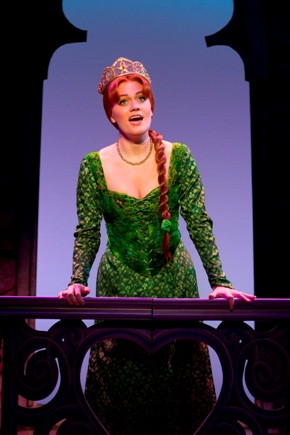
Liz Shivener
(www.dispatch.com)
When Liz Shivener as Princess Fiona launched into "I Know It's Today" (one of my favourite songs!) I thought I was listening to Sutton Foster from the Broadway cast.  She sounded so similar!  What at incredible voice and only 24 years old!  "Morning Person" with her over exuberance in singing with the bird and dancing with the deer were certainly unexpected from just listening to the music.  As were the tap dancing rats.  The rats on the dancers shoes were so good just peaking out under the curtain before "growing".  I have no idea what happened above the characters knees, I was too busy trying to identify tap steps from their feet.  It was hard to tell if they were wearing tap shoes, but the sounds didn't always seem to be matching the feet, so I'll guess the taps were dubbed in to give it a bigger sound.  Ms. Shivener was also very believable as a feisty princess.  Really I think Fiona was the highlight of the show for me.

Lukas Poost getting "shreked"
(arts.nationalpost.com)
But what about Shrek you say?  Well Shrek was an ogre, albeit with a very nice voice courtesy of Lukas Poost, another up and coming star at 23.  He had a booming sound in "Big Bright Beautiful World" was appropriately crude and charming throughout and both nailed and drew you in to "Who I'd Be" (link is Ben Crawford singing, who took over the roll on Broadway from Brian d'Arcy James.  I adore Ben's voice!  In real life it's way better than the quality here).  Shrek and Fiona's one-up manship duet "I Think I Got You Beat" reminded me of the Irving Berlin songs where the two sections are sung at the same time and magically fit together. Not to mention the quirkiness of both sets of lyrics: Shrek to Fiona "you're just whiny, I had a flaming hiney" (in reference to the "mobs with pitchforks, [who] burned [his] britches, see the scorches").  Personally Shrek's being sent away at 7, wins hands down over Fiona missing her prom.

I went to check out the orchestra pit during intermission and was surprised to find the conductor, Kevin Casey, chatting with kids in the front row and others who came for a look too.  Typically the orchestra doesn't seem to interact at all with the audience, especially the conductor.  He was asking them about their favourite musicals and how they liked the show so far.  Even the drummer got into it when one of the kids said they hadn't heard him, so he said he'd play even louder and break a few sticks.  One of the reed players (with about 3 saxes, a few clarinets, flute, and possibly something else) had a book beside his chair.  Joanne Fluke's "Blueberry Muffin Murder".  I don't think I've seen anyone else read that series besides me.  A good choice of fluff reading to pass the time you're not playing.  I didn't detect any missing sounds, so I guess he  didn't get too involved in the "who done it" to miss his entrances.

The show is fun, even if the scene with the Dragon got a bit repetitive with the going around in circles, probably a larger stage would have helped.  It's not a fantastic piece of Broadway marvel to break any new boundaries, and with the pop references who knows if it'll be fresh 10 years from now.  But as Shrek said it's about time fairy tales were updated and this update fits the bill.