Saturday, April 2, 2011

TSO Goes to France

This concert, on March 30, marked the start of 3 trips to the TSO in 1 week.  They programmed a lot of good stuff all together this week.  Officially titled Thibaudet Plays Liszt, the program was almost exclusively music by French composers (except for Liszt who was born in Hungary) and featured French pianist Jean-Yves Thibaudet, and conductor Stephane Deneve.

Opening with a lesser known work by Paul Dukas (of "The Sorcerer's Apprentice" fame) "La Peri, poeme danse" is a ballet and was the final score Dukas wrote.  It had light airy moments, lots of trembling strings, and frantic sections.  Frantic and fast were recurring themes of the evening.  However, the beginning of this piece threw me for a loop because I recognized it!  The opening brass fanfare is used in the Walt Disney World "Impressions de France" music from EPCOT which I have heard many, many times.  I went back and found the fanfare buried about 7 minutes in.  So now I know one of the composers used in the compilation.  For an interesting fanfare performance check this out.

Next Maestro Deneve introduced "The Shining One", a piece written for Jean-Yves Thibaudet by Guillaume Connesson, which apparently captures Mr. Thibaudet's style of playing.  Technically a contemporary work, in that Mr. Connesson is still living, still I really liked it!  Maybe "new" music is growing on me.  Anyhow, the title is from a superhuman character in the fantasy novel The Moon Pool from 1912 written by Abraham Merritt who was "the [American] equivalent of our own Jules Verne" according to Connesson.  Indeed there were times throughout that it had a very sci-fi feel to it.  Maybe that's why I liked it.  The thought crossed my mind that it might fit into Sci-fi Spectacular quite well.


A quick side note about the performers.  My first thought when Maestro Deneve appeared was that he looked like Penn Jillette (not just with the hair but his stature as well), the outspoken magician from Penn and Teller. Although his personality when he spoke seemed the exact opposite.  Obviously well liked by the orchestra, he was engaging to watch even if his hair was somewhat distracting (it's now even longer than in the photo).  He's the current music director of the Royal Scottish National Orchestra, a post which TSO music director Peter Oundjian will fill beginning next season.

Mr. Thibaudet walked out on stage in a slim cut suit, and pointy shoes (what can I say, my seat was on the main floor, I was at shoe level) and all promo photos of him I've seen do not do him justice.  They seem so somber, yet he was smiling and seemed genuinely happy to be there, giving the Maestro a hug after his performances and acknowledging the orchestra.  For comparison, on the left is the picture in the program, and on the right one I found with a quick google search.  Personally, I think the right is much more flattering.

Back to the performance, oh wait, it's time for intermission.  Typically a dull time of the evening, but tonight William Littler was chatting in the lobby with Canadian composer Gary Kulesha on the subject of contemporary music.  A few of this thoughts, which follow, made a lot of sense to me.  Since recordings have become so prevalent, people have come to like what they know, and aren't always willing to take a risk on something new.  He said that people don't "get" contemporary music on a first hearing, so there needs to be something in there that will make them want to hear it again.  Heck, I have that problem with classical and even pops music sometimes!  I previously blogged about not particularly liking Frank Loesser on first hearing.  But it contained something that made me listen again, and it's amazing what can grow on a person.  Additionally he gave permission to not like new music.  People often feel they should like it when it's ok to say, I didn't really enjoy that.  When asked about how players respond to new works, Mr. Kulesha catagorized it this way:  5-10% of an orchestra will love playing new music, 20-30% will absolutely despise it, and the rest are professionals and will just play it.  However, he also brought out that playing new works makes players better.  Apparently the TSO typically plays slightly behind the beat of the conductor, yet in new works can have razor sharp precision and be right on top of it.

Post intermission was "Totentanz for Piano and Orchestra".  With the main Dies irae (Day of Wrath) theme running through it and lots of keyboard gymnastics to watch, I quite enjoy this piece.  It was performed at the TSO's Halloween concert as well and was one of the main reasons I wanted to come to this concert, to hear it again by a well known pianist.

The evening concluded with "La tragedie de Salome" by Florent Schmitt.  Originally written as a ballet and limited to the 20 member pit orchestra, when Schmitt had the opportunity it 1910 to expand it using full orchestral colours, he did so; also shortening the score by half to create the current symphonic poem which he dedicated to Stravinsky.  Stravinsky quite liked the work, echoing parts in his "Rite of Spring".

It has some of the frantic and fanatic elements mentioned earlier, but also great contrasts.  Played in two movements, the first ended with such power that there was some applause.   Considering some pieces with movements don't pause between them, I was wondering if it was the conclusion as well.  Without fully turning around Maestro Deneve held up 2 fingers indicating that there was still another part to go.  He didn't seem upset, some orchestra members looked amused, and it did lighten up the mood a bit before settling into the conclusion.

Saturday, March 26, 2011

"Everything is Beautiful at the Ballet"

Piotr and Sonia Rodriguez
(from National Ballet of Canada website)
March 9 was the opening of the National Ballet of Canada's newly re-staged version of Don Quixote.  Based on the Cervantes novel (which also inspired The Man of La Mancha) and set to a bubbly, high flying score by Ludwig Minkus it was a thoroughly enjoyable evening!  Having recently watched A Chorus Line, the title of this post is a line that came to mind several times throughout the night.

Prior to all ballets at the Four Seasons Centre for the Performing Arts is a ballet talk.  The one for this series of performances was hosted by ballet master and Don Quixote re-stager, Lindsay Fischer.  I've attended his talks before, and find them very insightful and preparatory for the following ballet.  This evenings was no exception.  He always has some interesting insight into the human spirit.  He candidly admitted to having started the book prior to a previous production, never finishing it, but forged through when Karen Kain asked him to create some new dances for this version.  Near the end he discussed how ballet is great at demonstrating relationships but not so good at expressing text.  As a result there is a fair amount of mime.  He gave us a quick primer demonstrating "I love you", "married" and one of Don Quixote's lines of "I am a seeker after nobility, and beauty, and piety.  But you don't find those women very often."  Just standing there talking, he could be anyone, but as soon as he moved his arms in demonstration there was no doubt he was a dancer!  Talk about fluidity! Full talk linked here.

I was wondering if I would understand the story, but even without the talk or reading the plot summary in the program, I needn't have worried.  The story line was quite easily followed through the dancing which was amazing.

Piotr and Greta (from Toronto Star)
The principal dancers for the evening were Greta Hodgkinson as Kitri and Piotr Stanczyk as Basilio the barber.  Basilio was scheduled to be performed by Guillaume Cote making his debut in the role.  When the announcement was made about the change prior to the performance there were audible groans and disappointed noises from the audience.  Admittedly I was looking forward to a debut performance, but really enjoyed Piotr's.

I was sitting in Ring 3, in a single chair off to the side which turned out to be an awesome location.  I could see into the orchestra pit, had a great view of David Briskin conducting (who also on occasion uses a sweeping beats 3-4, maybe it's a ballet conductor thing), and the clarinetist Max Christie (who had some lovely solos in Act 2).  Mr. Christie even managed to roll out his wrists while still playing.  I couldn't see who was in the concertmaster seat, but the program has Benjamin Bowman listed as being on leave and Akemi Mercer as the guest concertmaster.  Mr. Bowman was just announced as concert master last season, and suddenly he's on leave?  After being blown away by his performance in the ballet I attended last season (that blog is here), I was hoping to see him again.

Piotr from 2006 production
(from National Ballet of Canada website)
As for the actual dancing, well I'm certainly no expert, but I was impressed with the dancers sense of rhythm which they demonstrated through claps and snaps in addition to dance.  There's a scene were Don Quixote thinks a windmill is a gypsy and attacks it.  The windmill wasn't terribly convincing with big palm branches for blades.  The pyrotechnics after he knocks the blades off with his spear were cool though.  This then leads into Don Quixote's dream sequence where he imagines his love Dulcinea looks like Kitri who dances with wood nymphs (it's ballet, you must suspend belief).  This scene reminded me of the "Waltz of the Snowflakes" from The Nutcracker.  The dancers were all in white stiff tutus and the style seemed similar,  very pretty and dream like so the point was made.

The ballet had all the elements of a good story, acting, music, and energetic dancing by all parties.  I'm looking forward to attending more ballets.

Saturday, March 12, 2011

Electronica Meets Orchestra

March 5 was the second of three concerts in the 7th season of the Toronto Symphony's New Creations Festival.

Essentially works by composers who aren't dead.  Given my previous experience with contemporary music I was skeptical I'd enjoy this.  But John Adams, who's name I've come across in various other orchestra calenders and arts critics reviews, was conducting (his TSO conducting debut) and one of his own works was included,  so I figured, why not try something new?  The performance included 3 pieces: "Torque" by Gary Kulesha (a prominent Canadian composer), "Liquid Interface" (Canadian Premiere) by Mason Bates and "City Noir" (Canadian Premiere and TSO co-commission) by John Adams.

The first that hit me when I walked into the hall, was the amount of stuff on the stage!  I've never seen so many percussion instruments!  There were about 5 different xylophones, glockenspiels, vibraphones etc.  Most interesting were a big white drum like what you'd put ballots in to mix them up for a draw (used in "Liquid Interface" which may be classified as a wind machine) and a little room of  pot lids.  Ok, well not really but that's what it looked like (see photo).  Also 2 harps, and by the end of the evening 6 French horns, 4 clarinets, and 4 trumpets.

Pardon my poor grammar, but for my enjoyment factor 2 out of 3 ain't bad.  Being a casual concert, there was a host, in this case TSO Music Director Peter Oundjian, who introduced the pieces, which is especially nice to have for contemporary items.  He mentioned Mr. Kulesha's passion for fast cars (a Porsche Carrera specifically), and "Torque" growing out of that.  Indeed in the program notes the composer admits that the "image of rapidly rotating wheels (or tires) was in my mind throughout the writing of the work.  This may or may not have had something to do with the fact that I was shopping for a new car during the creation of this composition.  And it may or may not be related to the fact that I acquired a very fast car halfway through the writing process...", that car no doubt being the Porsche.  I really liked this piece!  Indeed the image of a car existed throughout and I was thinking it would fit in well with the Disney Hollywood Studios stunt car show.

Mason Bates (TSO website)
Next the "electronica" for the evening appeared.  If all contemporary pieces were like "Liquid Interface" I think I could say I like contemporary music.   Things with a clear theme really help.  In this case, that theme was water.  But as composer Mason Bates said in his description of the piece the temperature continues to rise throughout so you get water in all forms, not just liquid.  Mr. Bates, located between the strings and percussion, added the electronic bits, often with a techno type beat, via a laptop and large keypad.  It started with ice and real sounds of Glaciers Calving (also the name of the first movement).  Conductor John Adams had an ear piece for this first movement and when asked by Peter Oundjian afterwards said it was a click track for precision.  "Scherzo Liquido", the second movement, had electronic water droplet sounds and if I recall correctly ran right into the third and fourth movements.  "Crescent City" included hurricane, thunderstorm, and ocean parts which "relaxes into a kind of balmy, greenhouse paradise where we end the symphony in "On the Wannsee"" (from composers program notes) which featured ambient dock sounds recorded on Lake Wannsee.  The symphony concluded with the water evaporating.  Throughout there were snippets of melody that could be followed which I particularly enjoyed.  What I've heard previously in contemporary music is the use of random beats and rhythmic contortions to drive the piece, giving one the idea a pretty melody is dead.  I'm glad that's not he case.  The percussionists, particularly Mr. Rudolph (who also played a mean washboard) and the other mallet keyboard players, got a workout with 4 mallets quickly moving all over the keys.  Quite exciting to watch.

John Adams (johnadamscomposer.com)
After a quick musician change with additional horns, and several principal musicians arriving (such as oboe, trombone, trumpet, and French horn) there was a short chat between Mr. Oundjian and Mr. Adams about the creation of the piece.  Apparently "City Noir" was commissioned for the first concert by the LA Philharmonics new music director, Gustavo Dudamel.  So Mr. Adams combined the Los Angeles hollywood feel and his enjoyment of noir films into a piece that he said is similar to a movie score but without the breaks that usually come for the dialogue just when the score is getting interesting (for an interview with him about the piece go here).  I'd say interesting is a good word for it.  It followed more closely the rhythmic drive I mentioned before at points which tends to be when I get distracted.  Perhaps a noir movie accompanying it would have helped me.  There were well executed solos by a guest saxophonist, Timothy McAllister and principal musicians Andrew McCandless (trumpet) and Gordon Wolfe (trombone).  I also enjoyed watching Adams as a conductor.  His beat patterns were mostly easy to follow and there was no lack of energy or enthusiasm from him.  At the conclusion of the piece the musicians eagerly joined in the applause which I tend to use as a gauge for how well they liked the person on the podium.  I'd say he was a welcome guest conductor and indeed Mr. Oundjian had said previously that the orchestra had enjoyed rehearsals and hoped he would come back again soon.

As a first time attendee to the New Creations festival, I look forward to reading more about what next years might have in store.

PS:  I came across this as well.  The TSO got great reviews in the New York Times!

Sunday, March 6, 2011

Winter Escape with the Naples Philharmonic Orchestra

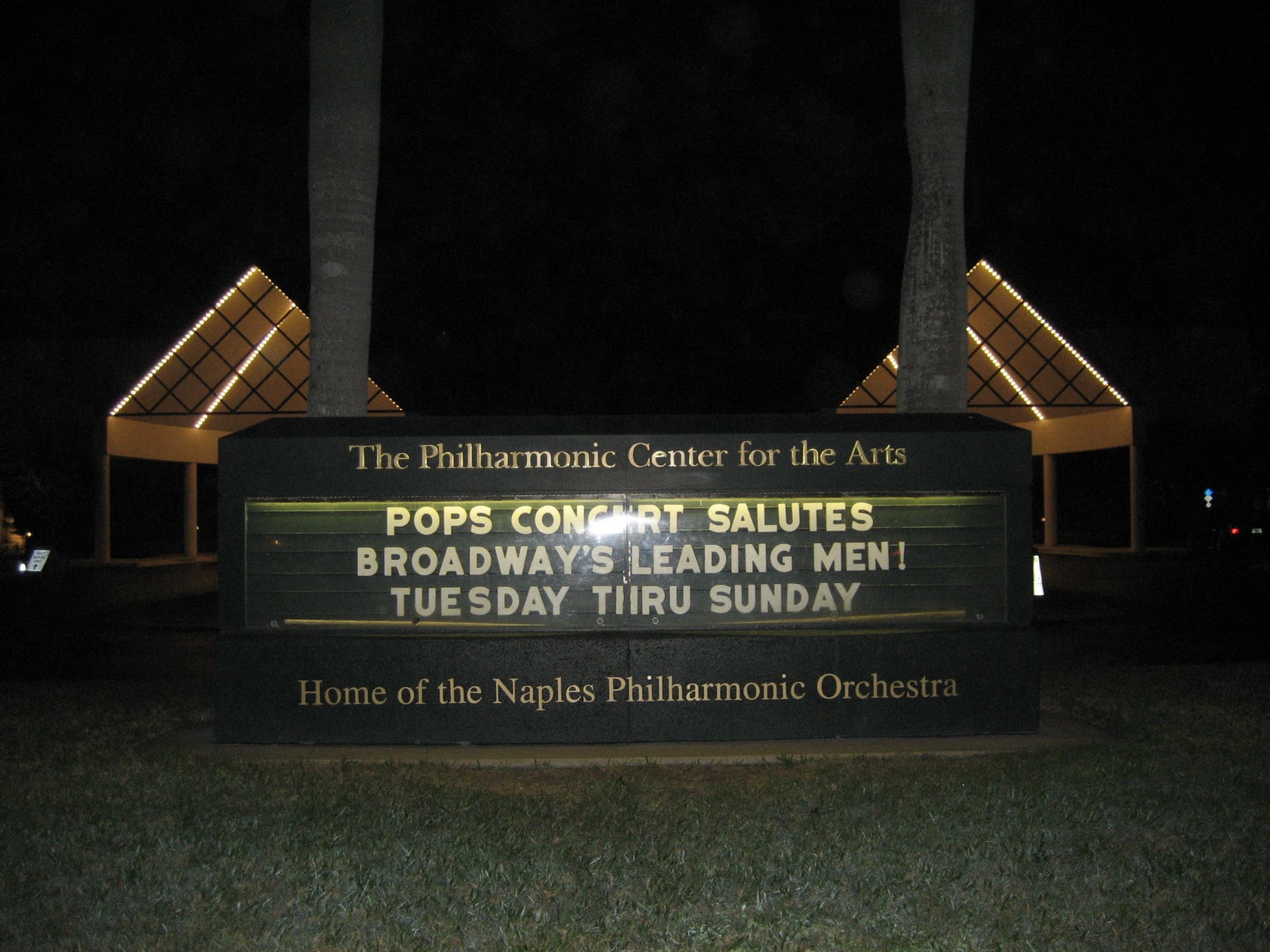
February 22 I had the opportunity to experience yet another orchestra.  Knowing I was going to be escaping the cold weather at home and heading for the warm climate of Florida I planned ahead and discovered that the Naples Philharmonic was performing Broadway's Leading Men, conducted by none other than their Principal Pops Conductor Jack Everly!  How perfect is that?  Warm weather and what's guaranteed to be an enjoyable show.

Outdoor Box Office
A short note about The Philharmonic Centre for the Arts, which is both an art museum and the concert hall for the orchestra.  It's an intriguing place.  The first thing that hit me was free parking!  Something you never have in Toronto!  Second to that was the outdoor box office.  It's amazing what gets done in warm climates that I would never even consider!

Inside there were a few rooms with sculptures to peruse, alas no picture taking was allowed so the art images are from the Phil's website.

The best pieces (in my totally unqualified to judge opinion) were on the stairs going up to balcony level.  They were musical in nature and one was titled "Symphony for the Deaf" and was a mass of various instruments.

The somewhat creepy Sentinels were in the lobby rather than outside in the garden area (maybe they get taken in for the winter).

The Sentinels
The funky red chandelier by Chihuly reminded me of Medusa and hung in the area above some other sculptures.

Chihuly Red
Our seats were in one of the side boxes.  Hayes Hall is carpeted in lush forest green, and each box only has 8 seats.  There's a rather exclusive feeling associated with opening the heavy full door (no curtains here) from the hall into the box.  The seats were decently comfortable as well.  The box directly across the theatre from ours had only 2 people but other than the back edges of the orchestra seating it appeared to be a fairly full house.  The orchestra seemed rather squished on the stage and I'd put the average age as quite young.  It was nice to see a strong female contingent particularly in the woodwind and brass sections.

The performance opened with a signature Everly arranged "Overture" which included, among others, themes from "If I Were a Rich Man" played by concert master Glenn Basham, "Where Is the Life That Late I Led", "Ol' Man River", and "The Impossible Dream".  The overture itself covered over 5 different musicals.  The following four pieces introduced each of the leading men vocalists.  Jacob Clemente, the 13 year old current Broadway Billy Eliot, sang and tap danced through "When I Get My Name in Lights" from The Boy From Oz; Ted Keegan, a former Broadway Phantom, sang "Maria" from West Side Story; Heath Calvert, another Broadway veteran, gave a well sung but rather plain rendition of "This is the Moment" from Jekyll and Hyde; and Ben Crawford (same one mentioned in previous Yuletide post) wowed the crowd as Prof. Harold Hill announcing "Ya Got Trouble" from The Music Man.  Perhaps I was underwhelmed by "This is the Moment" because I had read reviews of Ashley Brown's Broadway with the Indianapolis Symphony Orchestra from the weekend before which had Ben Crawford's rendition garnering an ovation.  So I was expecting him to also perform it here.  However, I don't think either of the other gentleman could have put across "Ya Got Trouble" in quite the same excellent fashion.

The orchestra was featured playing "Selections from Oliver" before the leading lady, in the person of Brynn O'Malley, took the stage in a nod to Julie Andrews with "Le Jazz Hot" from Victor-Victoria.

Closing the first half was the other Everly arrangement of the evening, "Leading Men Medley".  He has this amazing ability to cover the best parts of a song and fit them all together so well that you hardly notice the transitions between them.  Out of the 10 songs covered there were only 2 I didn't recognize.  The orchestra introduction was "Luck Be a Lady" which led to "Guys and Dolls" sung by Ted, Ben, and Heath.  Following was "Oh What a Beautiful Morning" and "I Have Dreamed" before Jacob joined them in a leather jacket singing "Summer Nights" from Grease.  The song has some interesting chuckle moments coming from a 13 year old.  A mini John Travolta he's not, I'd say his dancing is superior to singing, but he's still got a huge career ahead of him.  Ben took over with "Some Enchanted Evening" which HAS to have bass singer for the song to have weight (for example), and it was perfect.  Camelot and My Fair Lady were featured through "If Ever I Would Leave You" and "On the Street Where You Live" before they finished together with a vocal of "The Impossible Dream".  Talk about a great closing to the first half.

Intermission was interesting.  Typically nothing happens on stage.  The odd musician may remain and practice some parts, and the librarian swaps out the music on the conductors podium, but that's about it.  There was much more activity this evening however.  Two gentlemen (presumably at least one was the librarian) placed a green notice and piece of music on each stand.  My own wild speculation abounded, but really the only reason for adding more music to an already full concert is that something is being replaced.  Indeed after "Seventy-Six Trombones" highlighting the brass section particularly, Jack turned to the audience and all was explained.  Brynn was very much under the weather and unable to perform the "Love Duet Medley" (she would return for the finale), so to feature the orchestra and since no leading men concert would be complete without West Side Story they were going to replace it with the  "Overture to West Side Story" (played much better than this link, but I believe it was a very similar arrangement).  He continued with, "the orchestra has not rehearsed this.  See you at the end".  Unrehearsed or not, they must have been familiar with the music because Jack did not slow it down.  In fact it was one of his most lively conducted numbers of the night!  The transitions between sections of the piece may not have been as clean or tight as they could be and I'm not sure if all the percussion was bang on (although with the off beats it's hard to tell at the best of times), but there was a lovely horn solo in "Somewhere".  Given the extremely energetic "mambo" shouts from the orchestra the enthusiasm from the podium paid off.  Jack's breathlessness at the end was well deserved.

Jacob continued to demonstrate his dancing skills in "All I Need is the Girl" from Gypsy, before Ted tapped back into his Phantom days performing, as described by Jack, "the most romantic song from the musical".  I really liked the arrangement which began with the imposing instrumental "The Phantom of the Opera" as Ted walked out slowly to centre stage before it softened into "Music of the Night".  It's been a long time since I've seen the Phantom, yet his rendition took me back.  All the nuances were there right down to the wrist motion at the "close your eyes and surrender" line.  "Selections from La Cage aux Folles" was inexplicably dropped, yet the musical was still represented with Ben's "I Am What I Am" rendition.  *sigh* he has a voice one could happily listen to all night.

The evening of great music concluded with the powerhouse from Les Miserables.  A medley of "Look Down"and "At the End of the Day", as part of the orchestral intro; "On My Own" exquisitely sung by Brynn, I would never have been able to tell she wasn't felling well; "Stars" (one of my favourite lines in the whole musical is "and so it has been, and so it's written on the doorway to paradise that those who falter and those who fall must pay the price", I just love the melody there) where Ben got to return to his Javert understudy days; Ted matched Brynn with a poignent "Bring Him Home"; and the entire cast and a 14 voice male chorus joined in for the powerful "One More Day" and "Do You Hear the People Sing?" finale.  I wonder if this will be part of the Do You Hear the People Sing? concert celebrating the music of Boublil and Schonberg which Jack's debuting with several orchestras (NACO and Baltimore so far) for the 2011/12 season?  If so, it's definitely worth going to see.

Broadway's Leading Men is also making a stop next month in Ottawa with the NAC orchestra.  It is however going to lack Ben Crawford.  But hopefully will include a healthy Brynn and some great love songs.  So GO!

Sunday, February 27, 2011

NAC Broadway Across Canada: CATS

From Feb. 8-13 the North American touring production of Andrew Lloyd Webber's Cats stopped in Ottawa at the National Arts Centre.  First performed in London in May 1981, and moving to Broadway in 1982, a film version was made in 1998, and since 2003 it's been on tour.  Talk about a long history, and one filled with award winning highlights.  In 1983 it won 7 Tony's.  Most of which make sense, but "best book" I'm not so sure about.

We just made it to our amazing seats (row E, right in the centre) as the lights were dimming (thank you Winterlude road closures), but we made it!  I went with a dancer friend, and my conclusion is it's a dancers show.  She found the choreography a bit repetitive and not as interesting as previous versions, but agreed the acrobatics were mostly impressive, especially for a touring production where a lot of the performers would have a musical theatre background rather than be purely trained dancers.  The music is obviously good, although they hid the minimalist orchestra (~6 musicians on keyboards, guitar, bass and drums) behind the stage, and I do like a richer orchestra sound with real strings.  The make-up was fantastic, as was the ability of the performers to stay completely in character with decidedly feline motions.

"The Naming of Cats" was tricky to understand at times, given that about 27 people are saying the same thing at the same time, which diction wise is a challenge.  But overall the singing was extremely well done.  It's one of the first times I've understood the verse of "Memory", so kudos to Kathryn Holtkamp.  "The Jellicle Ball" is probably my favourite piece music wise, although I also like "Macavity" and "Mr. Mistoffelees".  The Rum Tum Tugger character was over the top, which I suppose is the point, and Matthew Taylor's characterization I'd say was a complete combination of Mick Jagger and Elvis Presley.

The changing of the set for the pirate play within a play of "Growltiger's Last Stand" was well done.  As was the spaceship light type thing which descended during the overture and reappeared to take Grizabella to wherever she gets "reborn".  Although I found its similarity to a UFO perhaps too amusing.  The lighting throughout was a highlight actually; from the flashing "eyes" during the overture, to the Christmas type strands they had running from the lower boxes to the stage.  I also had to chuckle at the the flying tire and the "a cat is not a dog" line in the finale, which the actors were singing in all seriousness yet seems so obvious.

Overall, I wouldn't claim it as my favourite show, but I had an enjoyable evening even if the plot is a bit sketchy, and I'm glad I took the opportunity to see the performance.  The score does come alive when accompanied by the action on stage.  Additionally, by considering the plot in segments, some of which don't have all that much to do with an overarching story of Grizabella being accepted, it was quite entertaining, and isn't that the point of a musical?

Saturday, February 26, 2011

NAC Orchestra at Roy Thomson Hall

The annual trip for the National Arts Centre Orchestra, under the direction of Pinkus Zukerman, to Toronto was Feb. 5 where they performed an almost all Beethoven program.  The pieces performed were Peter Paul Koprowski's "In Memoriam Karol Szymanowski", and the Beethoven's: "Symphony Number 2", and Piano Concerto No. 5 in E-flat Major "Emperor".  Jonathan Biss was the guest pianist.

Personally I went for the Beethoven Symphony, and that really was the piece I enjoyed most of the evening.  I did appreciate the introductions by CBC Radio personality Eric Friesen, and Maestro Zukerman was enthusiastic and personable in a way I had not expected.

The first piece demonstrated the composer's protest against war and oppression.  Being written in 1963, I classify it as modern music, which is an area I'm still working to appreciate.  It had its moments, but was not my cup of tea.

Then the Beethoven!  The introduction by Mr.'s Friesen and Zukerman were enthusiastic and engaging.  Asking for Maestro Zukerman's take on the piece, Eric (and the audience) were treated to a quick demonstration of why the fourth bar (apparently typically the weakest) was the strongest, as he cued the orchestra and the strings played from the start to about bar 5.  Looking to reference something at the end, Mr. Zukerman had to look at the music of concertmaster Yosuke Kawasaki, since the conductor music stand was empty.  He conducted without a score, so it's obviously a piece he knows well.  An interesting side note, they brought their own conductors podium, complete with what in Southam Hall is complementary red carpeting.  Given Roy Thomson Hall's primarily wood and beige tones, it was an interesting, but not completely out of place, accent.

The section I know best of Beethoven's 2nd is the opening of the fourth movement.  This contains the "back flip" theme, so named by Rick Phillips in his pre-concert chat.  It is used as the theme for the NACOcast, so I found it quite fitting it was the NAC orchestra performing the piece.  I believe the host of the podcast, Christopher Millard, was indeed playing first bassoon.  But in addition to the familiar theme, I quite enjoyed the entire symphony.

Some of the names I know
At intermission while chatting with the girl next to me, who had also come alone, I learned she was there for the final piece, the "Emperor" piano concerto.  She mentioned that her piano professor had said she needed more power to play Beethoven, and personally she preferred playing Mozart.  I'd have to say power was not a problem from the young guest artist.  Jonathan Biss comes from a very musical family and it turns out that Mr. Zukerman knew both his parents before they were married.   Some of the tunes throughout the concerto had a passing familiarity to them, but nothing really jumped out at me.  The second movement is beautiful and I can see why it could be used as a funeral song.

Post concert there was a group playing in the lobby for the "after party".  They were quite enjoyable, although completely different from the classical music just experienced.  It was a great evening, even if I didn't see Christopher Millard at said party to tell him how much I enjoy his podcasts.  I can tick another Beethoven Symphony off my list as well.  I'm not sure I have a favourite, the latest one I've heard seems to hold that position for a while.

Thanks for coming to Toronto NACO, hope to see you again next year!

Saturday, February 5, 2011

Mozart @ 255

Since at least 2005 the Toronto Symphony has been celebrating the month of Mozart's birthday with a Mozart festival, numbered based on what would have been his age.  This year I attended the last show of the series on Jan. 30 entitled Mozart's World.  The orchestra was set up differently from the usual layout.  The first violins were in the usual place, but the seconds sat on the opposite side of the stage facing them.  Beside the 1st's were the cellos, and then the violas beside the 2nd's with the basses behind the cellos.  I'm guessing with was the typical layout in Mozart's day?  Bassoons, clarinets, horns, minimal brass and percussion rounded out the rest of the orchestra, coming and going as called for by the pieces.

The concert opened with the overture to Les Horaces, an opera by Salieri!  Certainly part of Mozart's world, although as it turns out not as detrimental to Mozart as things like the movie Amadeus would have one believe.  For some great back story on Mozart and Salieri check out the Jan. 17, 2011 NACOcast episode.  As conductor Peter Oundjian said at the end of the overture "so you've now heard a public performance of music by Salieri.  It's really quite good.  The rest of the opera wasn't so we stopped here".

The afternoon also included one of Mozart's most famous pieces "Eine Kleine Nechtmusik", the "D major Concerto for Double Bass" by Johann Baptist Vanhal performed by principal double bassist Jeffrey Beecher, and Mozart's "Concerto in C major for Oboe", performed by principal oboist Sarah Jeffrey.  The performance concluded with Haydn's Symphony 8, "Le Soir".   I really enjoyed hearing the other 3 movements to "Eine Kleine", the opening Allegro is so familiar that it's easy to forget there's a Romance, Menuetto and Rondo which follow.

courtesy Silk Road Project site
The double bass concerto was awesome!  The music was very relaxing yet not sleep inducing.  Being in a lower range it didn't carry the way a flute can soar over the orchestra but the balance was well executed in that the orchestra didn't over power the solo and let Jeffrey shine.  Who knew the bass had the range that it did?  At times it seemed more in the range of the cello, and even higher when he was playing at the very end of the finger board.  I believe there was a cadenza at the end of each movement and he really demonstrated what an excellent bass player can do with the instrument.  It's a shame it's not used virtuosically (if that's even a word) more often.

William Littler, a journalist with the Toronto Star, hosted an intermission chat with Jeffrey in the lobby.  Peter Oundjian had mentioned he, as a violinist, looked at the bass like driving a city bus around a Formula 1 track.  Jeffrey modified this to how he thought of it more as a Hummer.  When asked why these bass pieces aren't performed more often, he slightly insulted previous bass players by saying perhaps they didn't gain as much skill as they could have on the instrument to be able to perform some of the concertos written.  Of which I think he said there are only three; two by Vanhal and one by someone else.  His bass is from 1690 and the owners can be traced all the way back to its origins.  If he has to travel, he drives with the bass or it gets its own seat on the airplane.  Understandably, something that valuable does not get put in checked luggage.  Since the TSO just returned from touring Florida, I wonder if he borrowed an instrument or took his?  I always enjoy seeing musicians outside of the stage lights, and Jeffrey demonstrated his amiable nature while discussing his work with YoYo Ma's Silk Road Ensemble and his teaching job.  Thanks to him for taking the time to share with the audience more about himself and bass playing.

courtesy TSO
After intermission Sarah Jeffrey showed off her beauty as well as that of the oboe.  She looked very pretty in a long black dress.  One would never know she had a 3 month old baby (she's married to a French horn player) unless Peter Oundjian had mentioned it.  I've often considered the difference between the oboe and clarinet to be the more nasal sound of the oboe compared to the hollowness of the clarinet.  However, in higher ranges and in the hands of a real professional the nasal goes away and it can have a more flute like quality.  Her cadenzas were also impressive.

I don't recall hearing a full Haydn symphony before.  In fact all I know about Haydn was that he wrote a ton of them and a friend of mine did a project on him in grade 9 music.  She actually attended this concert with me, but couldn't remember much about Haydn either.  I enjoyed "Le Soir" and need to look up the other symphonies Peter mentioned, "Le Matin" and "Le Midi".  Again the balance between the orchestra was well executed.  There were violin (1st and 2nd), cello, and bass solos at various points, and all could be heard clearly.  The final movement, "The Storm", really sounded like one.  I'm glad it stayed in the hall and we didn't walk out to thunder, lightning or snow!

Looking forward to Mozart@256!